
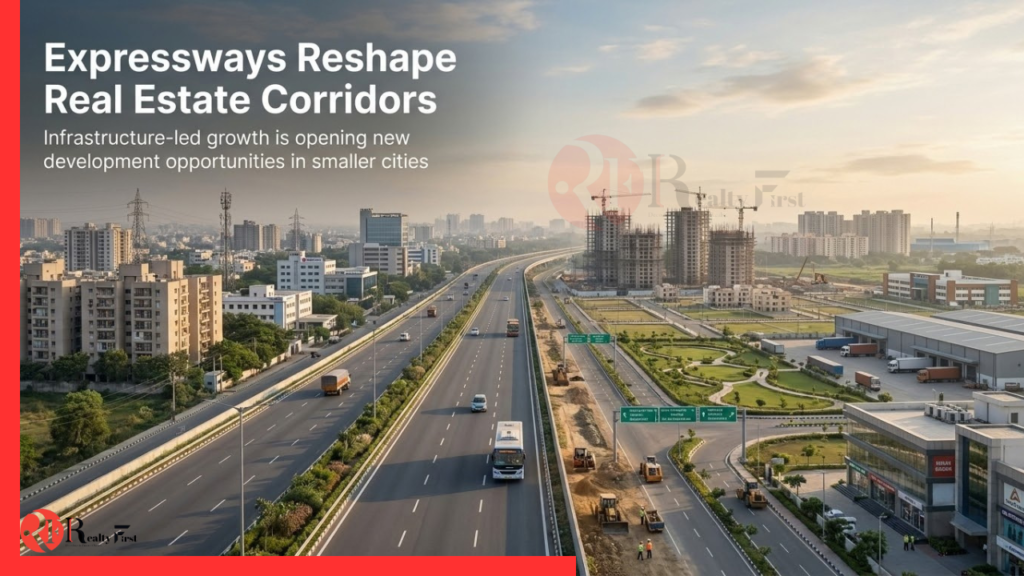
Mumbai: Real estate development in India’s smaller cities is increasingly moving beyond established urban boundaries, with improved road connectivity emerging as a key factor behind this expansion. New expressways and infrastructure projects are opening up peripheral areas for residential, plotted and mixed-use developments, gradually turning the outskirts of cities into emerging real estate corridors.
The impact of better connectivity is often visible first in commuting patterns and land-use activity. As travel becomes easier, residential developments tend to be followed by schools, hospitals, retail markets, hotels, warehouses and other commercial establishments. Over time, such activity can contribute to the emergence of new urban centres outside existing city limits.
Sunil Goel, Managing Director of Numax Group, said, “Expressways and improved road connectivity are important growth drivers for emerging real estate markets. When travel time to key parts of a city is reduced, people become more willing to consider buying homes outside the core city areas. This shift is transforming peripheral locations into new residential hubs.”
For developers, improved connectivity can also make larger land parcels in peripheral locations more viable for planned developments. Smaller cities often offer comparatively lower land costs and greater land availability, creating scope for larger residential communities and integrated projects.
Also Read: Casagrand launches Casagrand Vienna residential project in Chennai’s Adyar
Yash Miglani, Director of Migsun Group, said, “Infrastructure development in smaller cities has increased the potential for large-scale and planned residential development. With adequate land availability, developers can integrate parks, community facilities, retail spaces and entertainment options within the same development. This gives buyers not just a home, but also an opportunity to experience a more integrated lifestyle.”
The effect of expressway-led development can extend beyond housing. Better-connected locations can attract logistics and warehousing facilities, hotels, retail markets and other commercial activities. The resulting employment opportunities can further support residential demand in surrounding areas.
Kushagra Ansal, Director of Ansal Housing, said, “Real estate development should not be viewed only from the perspective of housing sales. When employment opportunities, markets and social infrastructure develop alongside improved connectivity, they provide long-term support to residential demand. In smaller cities, this process can help create new growth centres.”
However, the presence of an expressway by itself does not guarantee that a peripheral location will develop into a real estate hub. Factors such as land prices, approved development plans, water and electricity availability, public transport, employment centres, schools and healthcare facilities also influence the long-term potential of an area. For buyers and investors, this makes it important to assess the broader development ecosystem rather than base property decisions solely on a proposed road or infrastructure project.
Harvinder Singh Sikka, Chairman of Sikka Group, said that the long-term success of an infrastructure corridor depends on the pace at which planned urban development takes place around it. Alongside road connectivity, supporting infrastructure such as water supply, public transport, education, healthcare and commercial facilities is necessary for areas outside established city limits to develop into sustainable and liveable urban centres.
As smaller cities expand, infrastructure-led development corridors could become increasingly important to their real estate markets. Expressways are beginning to serve a role beyond transportation, providing a foundation for residential and commercial activity in peripheral locations.
Also Read: How Infrastructure Development Is Transforming Panipat’s Housing Market
The emerging trend raises a broader question for the real estate sector: rather than looking only at where the next expressway is being built, developers and investors may increasingly need to assess where new urban centres are likely to develop around these connectivity corridors.