Introduction
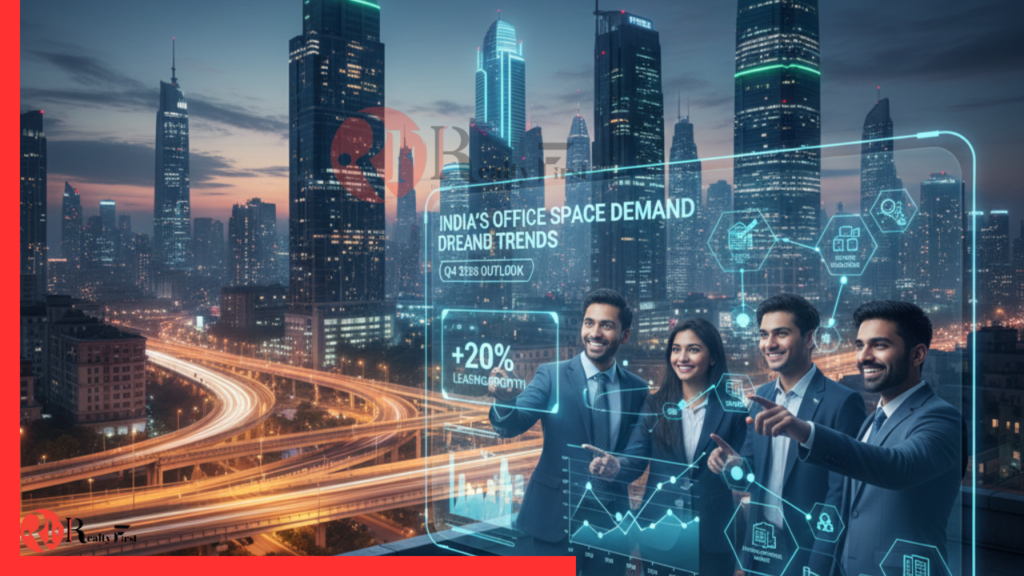
The conversation around office space demand trends in India has shifted dramatically over the past few years. What began as uncertainty during the remote work boom has now evolved into a more mature, data-driven understanding of how businesses actually use office space. Today, companies are not simply asking whether they need offices. They are asking what kind of office space truly supports productivity, talent retention, and long-term growth.
Across major cities such as Mumbai, Bengaluru, Hyderabad, Delhi NCR, and Pune, commercial real estate is witnessing a structural transformation. Enterprise occupiers, global capability centers, technology firms, BFSI institutions, and even startups are redefining how they lease and design office environments. In this detailed guide, we will explore office space demand trends in India, the drivers behind rising commercial leasing activity, emerging investment opportunities, rental movements, and what the future holds for commercial real estate investors and businesses alike.
If you are a real estate investor, developer, corporate decision-maker, or simply tracking India’s commercial property market, this comprehensive analysis will help you understand where the demand is headed and why.
The Evolution of Office Space Demand Trends in India
Office space demand trends in India have always mirrored the broader economic cycle. During high GDP growth phases, leasing activity surges. During economic slowdowns, companies consolidate. However, what makes the current phase unique is that demand is no longer driven purely by expansion. It is driven by strategy.
In 2024 and 2025, India recorded strong gross leasing volumes across Grade A office markets. According to leading property consultants, annual office absorption in India crossed 55 to 60 million square feet, driven primarily by technology services, global capability centers, financial services, and flexible workspace operators. This indicates not just recovery, but structural confidence in India’s long-term economic growth story.
Interestingly, multinational corporations are increasingly consolidating operations in India due to cost efficiency, skilled workforce availability, and supportive regulatory reforms. As a result, office space demand trends in India are being influenced by global outsourcing, digital transformation, and corporate realignment strategies rather than just domestic expansion.
Key Drivers Behind Rising Office Space Demand
Economic Growth and Corporate Expansion
India remains one of the fastest-growing major economies. As GDP growth remains stable, companies are expanding their physical footprint. This directly impacts commercial office space demand across metro cities and emerging tier-2 hubs.
For example, a US-based fintech company recently expanded its Bengaluru office by 150,000 square feet to accommodate data analytics and AI teams. This expansion was not about vanity presence. It was about accessing talent pools. Similar stories are playing out across Hyderabad and Pune.
Also Read: https://realtyfirstmag.com/commercial/risk-proof-commercial-real-estate-investment
Global Capability Centers Fueling Demand
Global Capability Centers, often referred to as GCCs, are among the strongest drivers of office space demand trends in India. More than 1,600 GCCs operate in the country, and the number continues to grow. These centers manage core functions such as R&D, finance, cybersecurity, and engineering for global corporations.
Unlike traditional back offices, modern GCCs require premium Grade A office space with advanced digital infrastructure, sustainable building certifications, and employee-centric amenities. This has led to strong pre-commitments in under-construction commercial projects.
Rise of Flexible and Managed Workspaces
Flexible workspace operators have emerged as a crucial segment within office space demand trends in India. Companies now prefer managed office solutions to maintain agility. Instead of signing long-term 9-year leases for large spaces, firms are opting for hybrid leasing strategies that combine core offices with flex seats.
In cities like Mumbai and Gurugram, flexible workspace providers have leased entire floors in premium buildings, subleasing them to startups and enterprises. This model reduces risk for occupiers while ensuring steady rental yield for landlords.
Grade A Commercial Real Estate Dominates Demand
One noticeable shift in office space demand trends in India is the overwhelming preference for Grade A commercial real estate. Companies are willing to pay higher rentals for better building quality, sustainability certifications, and location advantages.
Grade A office spaces typically offer:
High floor efficiency
Modern HVAC systems
Energy-efficient design
Green building certifications
Smart access and security systems
This preference is not just about brand image. Investors and tenants increasingly understand that efficient buildings reduce long-term operational costs. Energy savings, water recycling systems, and ESG compliance directly impact corporate reputation and financial performance.
As a result, vacancy rates in premium office corridors such as BKC in Mumbai, Outer Ring Road in Bengaluru, and HITEC City in Hyderabad remain significantly lower compared to older commercial districts.
Hybrid Work and Its Real Impact on Office Demand
When hybrid work became mainstream, many predicted the end of traditional offices. However, office space demand trends in India reveal a more nuanced reality. Companies have not eliminated offices. Instead, they have redesigned them.
Today’s office spaces focus on collaboration zones, breakout areas, meeting pods, and technology-enabled conference rooms. The objective is not to host employees five days a week but to create meaningful engagement when they do come in.
A leading IT company in Hyderabad recently redesigned its 300,000 square feet campus by reducing workstation density and increasing collaborative areas. This approach actually required more thoughtfully designed space rather than less space. Thus, hybrid work has redefined demand but has not reduced it structurally.
Rental Trends Across Major Indian Cities
Rental growth is a key indicator when analyzing office space demand trends in India. In 2025, prime office rents in Mumbai’s BKC crossed premium benchmarks, while Bengaluru’s Outer Ring Road continued to command strong absorption levels.
Hyderabad remains comparatively affordable, attracting both domestic and international tenants. Meanwhile, Delhi NCR has seen rental stability in Gurugram and Noida, driven by BFSI and consulting firms.
Tier-2 cities such as Ahmedabad, Coimbatore, and Indore are gradually entering the commercial office map. While they do not yet match metro absorption levels, companies exploring cost arbitrage are testing these markets.
Investors closely track rental escalation clauses, typically 12 to 15 percent every three years, which ensure stable income streams. This makes commercial office real estate a high CPC and high CPM advertising category, particularly relevant for financial services, REIT investments, and property advisory platforms.
ESG and Sustainable Office Spaces
Environmental, Social, and Governance compliance is now central to office space demand trends in India. Institutional investors and multinational tenants prioritize buildings that align with global sustainability standards.
Developers are integrating solar power systems, rainwater harvesting, wastewater recycling, and energy management systems to meet green certification benchmarks. Occupiers often include sustainability performance in lease negotiations.
This trend also attracts real estate investment trusts and foreign institutional investors who prefer assets with long-term sustainability credentials. In many cases, ESG-compliant buildings command rental premiums due to strong tenant demand.
Technology Integration and Smart Buildings
Technology has become a defining factor in office space demand trends in India. Modern occupiers expect integrated building management systems, real-time air quality monitoring, touchless access controls, and predictive maintenance tools.
Smart commercial buildings reduce downtime and improve occupant comfort. For landlords, technology enables data-driven asset management and cost optimization.
For instance, a commercial tower in Mumbai implemented IoT-based energy tracking and reported 20 percent operational savings within two years. These savings translate into better net operating income, which increases asset valuation.
Also Read: https://realtyfirstmag.com/commercial/flexi-workspaces-office-leasing
Investment Outlook for Commercial Real Estate
Institutional capital continues to flow into Indian commercial real estate. REITs have gained traction among retail investors who seek stable rental yield and long-term capital appreciation.
Office space demand trends in India indicate sustained interest from private equity funds and sovereign wealth funds. These investors prioritize completed Grade A assets with strong tenant covenants and long lease tenures.
As India strengthens its position as a global services hub, commercial real estate is expected to remain a preferred asset class. Analysts project stable absorption levels supported by GCC expansion and technology sector hiring.
The Future of Office Space Demand Trends in India
Looking ahead to 2026 and beyond, office space demand trends in India are expected to remain resilient. While global economic uncertainties may create short-term fluctuations, structural drivers such as digital transformation, urbanization, and foreign investment will continue to support leasing activity.
Companies are focusing on quality over quantity. They want offices that enhance collaboration, reflect brand identity, and align with ESG goals. Developers who understand this shift will capture future demand.
Ultimately, the Indian office market is not shrinking. It is evolving. And those who adapt to these evolving office space demand trends in India will benefit from sustained growth.
Conclusion
Office space demand trends in India reflect a market that has matured beyond traditional metrics. Demand is now influenced by sustainability, technology integration, workforce strategy, and global economic alignment. As businesses expand and global investors deepen their presence, India’s commercial office sector stands at a promising intersection of resilience and innovation.
For investors and occupiers alike, the message is clear. The future of work in India will continue to revolve around well-designed, technology-enabled, and sustainable office spaces that support long-term growth.