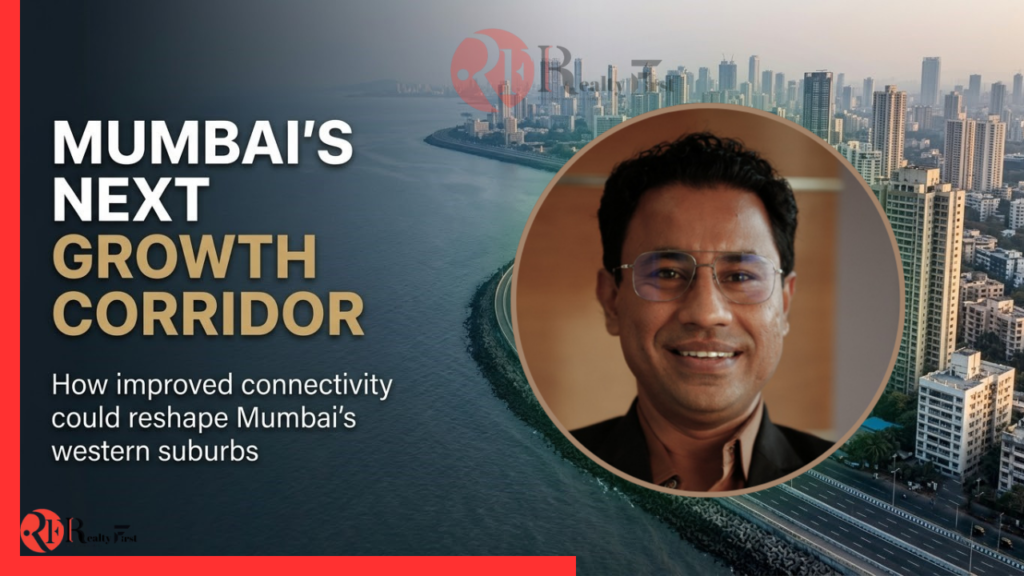
By Mr. Arshad Lashkaria, CEO & Managing Director, Lashkaria Group
In Mumbai, real estate value is increasingly linked to a factor that cannot be measured in square feet alone: time. As connectivity improves and the city continues to evolve, locations that offer easier access to employment centres, business districts and social infrastructure are likely to become increasingly attractive. In this context, the Coastal Road could have implications well beyond transportation, potentially reshaping the relationship between Mumbai’s western suburbs and its core.
The first phase of the Coastal Road has created a high-speed link between South Mumbai and the Bandra-Worli Sea Link. Its expansion towards the northern suburbs, including the Versova-Dahisar corridor, is expected to further improve connectivity along Mumbai’s western belt.
The most significant impact for commuters may not be the distance covered, but the time saved. A more direct western corridor could reduce reliance on the Western Express Highway and other congested arterial routes, making journeys between South Mumbai, Worli, Bandra and the western suburbs more seamless. Over time, this can influence residential preferences, business locations and investor interest.
Also Read: 315Work Avenue Leases Around 45,000 Sq. Ft. Workspace in Bhartiya City, Bengaluru
The potential impact is particularly relevant for Andheri, Jogeshwari, Goregaon and Borivali. These areas have evolved beyond their traditional identities as residential suburbs and now function as established employment, commercial and lifestyle destinations. Their residential catchments, suburban railway connectivity, metro links, proximity to the airport and expanding social infrastructure provide a strong base for further development.
Andheri is already one of Mumbai’s strategically connected micro-markets. Jogeshwari benefits from its position between Andheri, Goregaon and the eastern suburbs, while Goregaon has developed into a significant residential and commercial hub. Borivali, meanwhile, is increasingly benefiting from large-scale infrastructure improvements. Better integration with the Coastal Road could further strengthen these locations as parts of a more interconnected western urban corridor.
This connectivity could also reinforce the investment proposition of Mumbai’s western suburbs. Real estate appreciation tends to be more sustainable when infrastructure improvements coincide with established demand. Unlike emerging markets that rely substantially on future development to create their value proposition, the western suburbs already have established end-user demand, employment opportunities, retail, education, healthcare and social infrastructure. Improved connectivity can therefore strengthen an existing market rather than build one from the ground up.
For investors, that distinction matters. The opportunity is not simply about acquiring property in anticipation of infrastructure-led growth. It is about identifying established markets where better connectivity can initiate another phase of value creation. Improved accessibility can expand residential catchments, strengthen commercial viability, support rental demand and increase the long-term attractiveness of these locations.
The development also points to a broader change in the way Mumbai’s real estate market could be evaluated. Historically, proximity to South Mumbai has commanded a substantial premium. Going forward, however, connectivity could become a more important consideration than physical distance. If infrastructure succeeds in compressing travel times between the city’s core and western suburbs, value could increasingly gravitate towards locations that combine accessibility with liveability, amenities and relative value.
For developers, the implications are equally important. Infrastructure by itself does not create sustainable real estate value; rather, it can amplify the strengths of locations that already have sound fundamentals. The Coastal Road, alongside Mumbai’s expanding metro and road network, could therefore become a catalyst for the next stage of development across the western suburbs.
Also Read: How Mega Infrastructure Has Shaped Navi Mumbai’s Real Estate Story
Mumbai’s next phase of growth will not necessarily be determined by how far the city expands geographically, but by how effectively its different districts are connected. The Coastal Road is contributing to that shift. By reducing travel-time barriers between South Mumbai and the western suburbs, it could help reposition the western corridor from a residential hinterland into one of the key engines of the city’s next cycle of residential, commercial and investment growth.