By Manjunath V, Managing Partner at Aakruthi Properties
A home purchase today is less about a prestigious pin code and more about predictability. Predictability of commute. Predictability of water supply. Predictability of value five, ten, or even twenty years down the line. In a country where nearly 900 million people are expected to live in urban areas by 2050 and real estate is projected to approach the USD 1 trillion mark by 2030, the real differentiator is no longer the façade of a project but the infrastructure beneath it.
Future-ready infrastructure has become the silent filter shaping residential choices. Buyers are evaluating not just where a home stands today, but how the surrounding ecosystem is engineered to evolve.
Also Read: Building Communities Where Nature Comes First, Says SPA Group MD Prashant Kajaria
When Infrastructure Leads, Demand Follows
Recent data signals a significant expansion in housing demand. FY25 primary sales in Tier I cities reached ₹6,70,000 crore, alongside notable premiumisation, evidenced by 7,000 units priced between ₹4–6 crore sold in H1 2025—an appreciable year-on-year rise.
This growth is not accidental. It is concentrated in corridors where connectivity is functional, employment hubs are active, and civic upgrades are visible. Office absorption is projected to remain near 55 million sq. ft., while logistics leasing is expected to exceed 50 million sq. ft. for the fourth consecutive year in 2026. Residential demand naturally gravitates toward these economic anchors.
Even capital flows are mirroring this shift. Institutional investments crossed USD 7.5 billion in 2025, signalling confidence in infrastructure-backed real estate. At the same time, a total of 1,907 acres were transacted in Tier-2 and Tier-3 cities in H1 2025, almost double Tier-1 activity, reflecting a steady redistribution of development momentum.
Redefining Location: From Access to Ecosystem
Location, long considered the golden rule of real estate, is being redefined. Access alone is no longer sufficient. The conversation has expanded to include resilience, sustainability as well as technological readiness.
In emerging growth corridors of cities like Bengaluru, Whitefield, Sarjapur, Devanahalli, Hoskote, and Budigere Cross improved connectivity to tech parks and arterial roads has catalysed residential momentum. Nevertheless, what sustains that momentum is internal infrastructure planning.
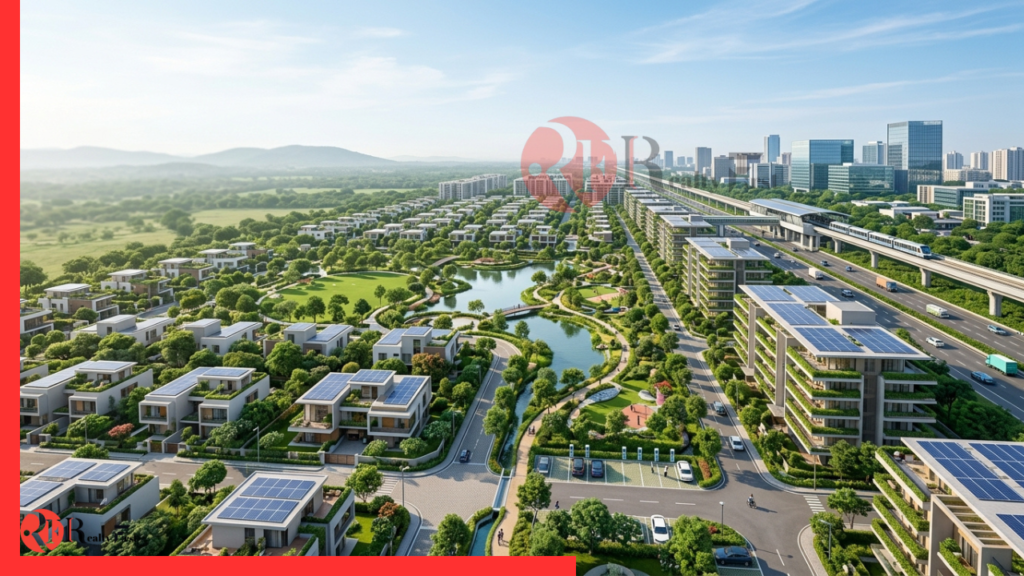
By incorporating permeable internal roads, communities enable effective groundwater recharge. Underground utilities streamline the built environment and improve safety, alongside robust rainwater harvesting frameworks, recharge pits plus planned stormwater drainage that address flooding and curb tanker dependence. In addition, separate potable and non-potable water lines promote long-term water efficiency.
Such infrastructure decisions extend beyond optics; they materially shape liveability in water-stressed urban centres. They reduce operational uncertainty and protect asset value.
Sustainability as Strategy, Not Slogan
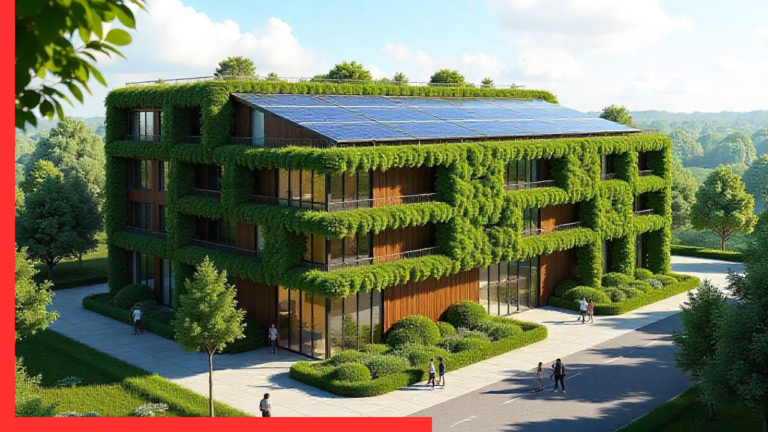
Increasingly, premium housing demand is anchored in sustainable infrastructure. Thoughtfully planned low-density layouts that maximise airflow and sunlight lower energy dependence, complemented by green buffers, drought-resilient native planting, and organic garden spaces that enhance environmental balance.
Large landscaped parks, reflexology pathways, yoga and meditation pavilions, outdoor gyms, pet parks, and eco-friendly recreational spaces transform residential projects into integrated wellness ecosystems. More than 50 per cent open space within communities signals a structural commitment to breathable urban living.
Future-readiness also extends to technology and mobility. Solar-ready plots, EV charging infrastructure, smart LED streetlights as well as digitally integrated security systems reflect preparedness for evolving energy and transport patterns. These features allow homes to adapt over the next 20–30 years without structural disruption.
Also Read: MIDC, Ramky Sign ₹3,000 Cr Deal to Develop Pharma Park in Raigad
Policy Support and Long-Term Confidence
An infrastructure-led growth framework continues to guide public policy. The Union Budget 2026–27 allocates ₹12.22 lakh crore to capital expenditure, emphasising asset creation. With ₹6,000 crore and ₹12,625.05 crore earmarked for PMAY Urban and PMAY Urban 2.0, project execution is predicted to accelerate while ensuring a stable housing supply. The proposed Infrastructure Risk Guarantee Fund complements these initiatives by mitigating construction-stage financing bottlenecks.
As India moves toward becoming a USD 35–40 trillion economy by 2047, urban expansion will be inevitable. The differentiator will not be how fast cities grow, but how intelligently they are built.
In sum, residential choices today reflect this shift in mindset. The purchase decision now extends beyond brand and size, with buyers scrutinising water resilience, infrastructure depth, environmental buffers, tech adaptability, and proximity to policy-supported growth zones. In doing so, the market is sending a clear message: future-ready infrastructure is no more an advantage; it is the baseline expectation shaping where India chooses to live next.