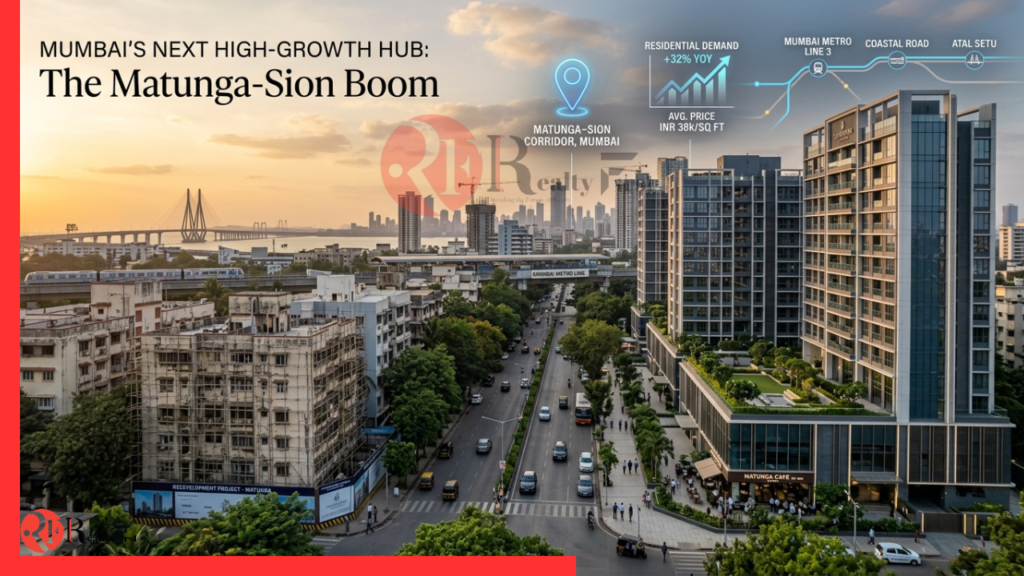
The Matunga–Sion corridor is quietly emerging as one of Mumbai’s most promising residential growth destinations, driven by large-scale redevelopment, infrastructure upgrades and sustained demand from homebuyers and investors. Long regarded as two of central Mumbai’s most established neighbourhoods, Matunga and Sion are witnessing a transformation that is reshaping their residential landscape while reinforcing their long-term investment appeal.
Known for their educational institutions, strong community networks and central location, the two neighbourhoods have traditionally been among Mumbai’s mature residential markets. Today, beyond the launch of new residential projects, the corridor is undergoing a broader phase of urban renewal. Redevelopment activity, combined with improved connectivity and modern housing, is positioning the area as a key real estate growth corridor in the city.
Also Read: The Executive Centre Expands Forescout’s Workspace at Pune’s Panchshil Business Park
A significant portion of this transformation is being driven by the redevelopment of ageing residential buildings. Older structures are steadily giving way to contemporary developments designed to meet evolving homebuyer preferences. At the same time, ongoing infrastructure projects across Mumbai are improving mobility and strengthening the corridor’s strategic advantage between South Mumbai, the western suburbs and major commercial districts.
Unlike several emerging suburban markets that are dependent on future infrastructure announcements, the Matunga–Sion corridor already benefits from established social infrastructure, seamless connectivity and well-developed residential communities. Industry experts believe this combination is creating a favourable environment for both end-users and long-term investors, while redevelopment projects continue to redefine the area’s housing stock.
According to Suhan Shetty, Founder of Rubics Group, the corridor offers a unique blend of connectivity and neighbourhood character that has become increasingly rare in Mumbai.
“Very few areas in Mumbai offer the rare combination of centrality, connectivity and neighbourhood character that the Matunga–Sion corridor does today. Along with seamless access to key business districts, educational institutions, healthcare facilities, lifestyle destinations and major transport networks, the area has constantly found a place among the city’s most coveted residential addresses,” he said.
Beyond its strategic location, Matunga continues to retain its distinctive cultural identity, tree-lined streets and close-knit community, characteristics that remain attractive to homebuyers seeking a balance between urban convenience and quality of life.
Shetty noted that this blend of heritage and modernisation is supporting demand for a new generation of premium residential developments.
“There is a unique balance here that has attracted demand and opened opportunities for luxury residential developments that place equal emphasis on design, sustainability and quality of life,” he added.
Redevelopment has become one of the defining themes behind the corridor’s evolution. With much of the existing housing stock in Matunga and Sion now more than five decades old, developers are increasingly replacing ageing buildings with modern residential projects featuring larger homes, organised parking, premium amenities and contemporary lifestyle offerings.
Chintan Sheth, Chairman and Managing Director of Sheth Realty, believes this redevelopment cycle is acting as a major catalyst for the area’s growth.
“Among Mumbai’s most compelling real estate locations today is the Matunga–Sion corridor. It is driven by a rare convergence of legacy, redevelopment potential and transformative infrastructure leading to its rapid growth,” he said.
According to Sheth, Matunga’s established residential character, together with Sion’s ongoing urban transformation, is strengthening confidence among both homebuyers and investors.
“Much of the housing stock in the corridor is over five decades old and offers a significant redevelopment opportunity that is already translating into strong market demand and renewed confidence in the corridor’s long-term growth prospects,” he said.
The investment case is also supported by the corridor’s strategic position within Mumbai’s transportation network. Located at the junction of the Central, Western and Harbour railway lines, the area offers direct connectivity to almost every part of the city. This accessibility has been further strengthened by several major infrastructure projects across the Mumbai Metropolitan Region.
Recent developments, including the Sion-BKC elevated connector, the Mumbai Trans Harbour Link (Atal Setu), the Coastal Road and the expanding Metro network, have significantly improved connectivity to key business districts such as Bandra-Kurla Complex, Lower Parel, Worli, South Mumbai and Navi Mumbai.
“The corridor’s appeal is further strengthened by its strategic location connected to the Central, Western and Harbour railway networks. This advantage is further amplified by transformative infrastructure projects such as the Sion-BKC elevated road, along with the Atal Setu, Coastal Road and the expanding Metro network,” Sheth said.
For many buyers, the Matunga–Sion corridor presents an opportunity to remain close to major employment centres without paying the premium associated with locations such as Bandra, Lower Parel and parts of South Mumbai. This positioning has broadened the area’s appeal among professionals, entrepreneurs and families seeking both connectivity and long-term value.
Rajendra M. Rajan, Founder of TransIndia Group, believes the corridor’s strength lies in its combination of connectivity, infrastructure development and constrained housing supply.
“The Sion–Matunga corridor sits at the intersection of connectivity, infrastructure upgrades, commercial access and limited housing supply, which come together to create enormous growth potential,” he said.
Rajan also highlighted the area’s strategic role within Mumbai’s evolving transport network.
“The Sion–Matunga corridor enjoys a unique advantage as a central gateway between Mumbai’s two transformational infrastructure projects, namely the Mumbai Coastal Road and Atal Setu. With seamless access to South Mumbai, BKC, Navi Mumbai, JNPT and the recently opened Navi Mumbai International Airport, the corridor is increasingly emerging as a high-connectivity residential and investment destination,” he said.
Market indicators suggest these advantages are already translating into stronger buyer interest. Industry estimates indicate that residential property values across parts of the corridor have appreciated significantly in recent years, supported by rising rental demand and a limited supply of quality housing.
According to Rajan, residential prices in the corridor increased by approximately 37 per cent between 2021 and 2025, while rental growth across Sion and neighbouring locations reflects strengthening occupier demand. He attributed this performance to the area’s mature neighbourhood ecosystem and constrained land availability, factors that continue to support long-term capital appreciation.
Apart from infrastructure and redevelopment, the corridor also benefits from a well-established social ecosystem that distinguishes it from many emerging residential markets. Residents have access to leading educational institutions, including Don Bosco High School, SIES College, Ruia College and KJ Somaiya College, along with established healthcare facilities, recreational destinations such as Five Gardens and Shivaji Park, and convenient connectivity to commercial hubs across Mumbai.
Also Read: Sion-Matunga Corridor’s Redevelopment Story Driving Its Residential Appeal
With redevelopment gathering momentum and infrastructure upgrades continuing to enhance accessibility, the Matunga–Sion corridor is steadily evolving from a well-established residential neighbourhood into one of Mumbai’s most strategically positioned and future-ready micro-markets. For both end-users seeking an elevated urban lifestyle and investors focused on long-term value creation, the corridor is increasingly emerging as a compelling residential destination.