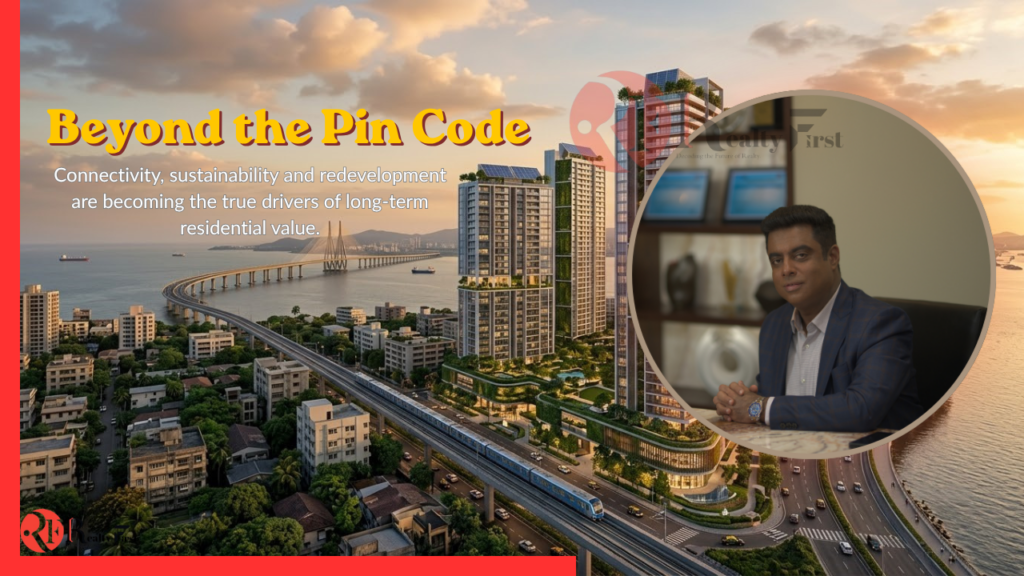
By Vishal Ratanghayra, Founder & CEO of Platinum Corp.
For decades, residential value in Mumbai has been closely associated with location, with a property’s address often serving as the primary indicator of both market worth and social standing. However, that long-standing equation is evolving as the city undergoes one of the most extensive infrastructure transformations in its history. Improved connectivity and large-scale urban development are reshaping buyer preferences, allowing emerging micro-markets to gain prominence while further strengthening the appeal of several established neighbourhoods.
The city’s redevelopment market is also witnessing sustained momentum. Premium housing continues to perform strongly, with the segment recording its highest-ever half-year sales value. According to industry analysis reports, redevelopment projects with an estimated gross development value (GDV) of nearly Rs 60,000 crore are in the pipeline, with around 75 to 80 projects expected to be launched over the next eight to nine quarters. This growth is being supported by expanding infrastructure and rising demand for premium residences.
In this changing environment, a prestigious pin code alone is no longer sufficient to define long-term residential value. Instead, buyers are placing greater importance on neighbourhoods that promise lasting connectivity, convenience and relevance, factors increasingly viewed as critical to sustaining demand and future appreciation.
Infrastructure Is Redefining Residential Preferences
Homebuyers today are looking beyond the traditional appeal of an address. Connectivity through roads and metro networks, along with access to workplaces, educational institutions, healthcare facilities, retail destinations and other essential services, has become central to purchase decisions. The focus has shifted from simply where a home is located to how efficiently it connects residents with the rest of the city.
Mumbai’s expanding infrastructure network is playing a decisive role in this shift. The Mumbai Trans Harbour Link has substantially strengthened connectivity between Mumbai and Navi Mumbai, while Metro Line 3 is improving accessibility across the city’s commercial corridor. Other major infrastructure projects, including the Goregaon-Mulund Link Road, Coastal Road, the expanding Metro network, and the upcoming Navi Mumbai International Airport, are reducing travel times and generating renewed interest in residential corridors expected to benefit from these developments.
Government investment in infrastructure is therefore changing the way residential value is assessed. Increasingly, buyers are evaluating properties based on convenience, mobility and quality of life rather than geographical distance alone.
Smarter Homebuying Decisions
Alongside neighbourhood strength and surrounding social infrastructure, homebuyers are adopting a more comprehensive approach to evaluating residential value. Attention is increasingly focused on how thoughtfully a project has been designed, its construction quality and its ability to remain relevant in the years ahead. Luxury is no longer defined solely by premium specifications or high-end finishes.
Today’s buyers place greater emphasis on functional layouts, spacious homes, abundant natural light and ventilation, flexible spaces that support hybrid working, dependable digital infrastructure and well-planned community amenities. Residential projects capable of adapting to changing lifestyles while delivering comfort, efficiency and long-term liveability are more likely to preserve both their market appeal and investment value.
Why Redevelopment Holds a Competitive Advantage
Redevelopment has become an integral part of Mumbai’s real estate landscape, offering a practical response to the city’s evolving housing requirements. Unlike greenfield developments, redevelopment projects combine contemporary architecture and modern amenities with the advantages of mature, well-established neighbourhoods.
Existing social infrastructure, developed communities and proven connectivity already form part of these locations, offering conveniences that cannot be replicated immediately in newly developed areas. For existing homeowners, redevelopment provides an opportunity to upgrade their living standards without leaving familiar surroundings. For new buyers, it offers an attractive combination of location, lifestyle and long-term value creation.
Also Read: Why Homebuyers Are Moving to Mumbai’s Suburbs for Luxury Living
Sustainability as a Long-Term Value Driver
Sustainability is also emerging as an increasingly influential consideration within Mumbai’s luxury housing market. Buyers are recognising that environmentally responsible development extends beyond ecological benefits and contributes directly to protecting long-term asset value.
Features such as energy-efficient systems, rainwater harvesting, water recycling, green building practices and environmentally conscious design help reduce operating costs while creating healthier living environments. As awareness around sustainable development continues to grow, these features are steadily becoming defining characteristics of premium residential projects rather than optional additions.
Ultimately, lasting residential value is created when multiple fundamentals come together. Sustainable development strengthens long-term resilience, infrastructure improves accessibility, intelligent design enhances everyday living, and redevelopment revitalises established neighbourhoods. According to Vishal Ratanghayra, these interconnected factors are increasingly shaping residential demand and enabling homes to retain their relevance and value well beyond the initial purchase.