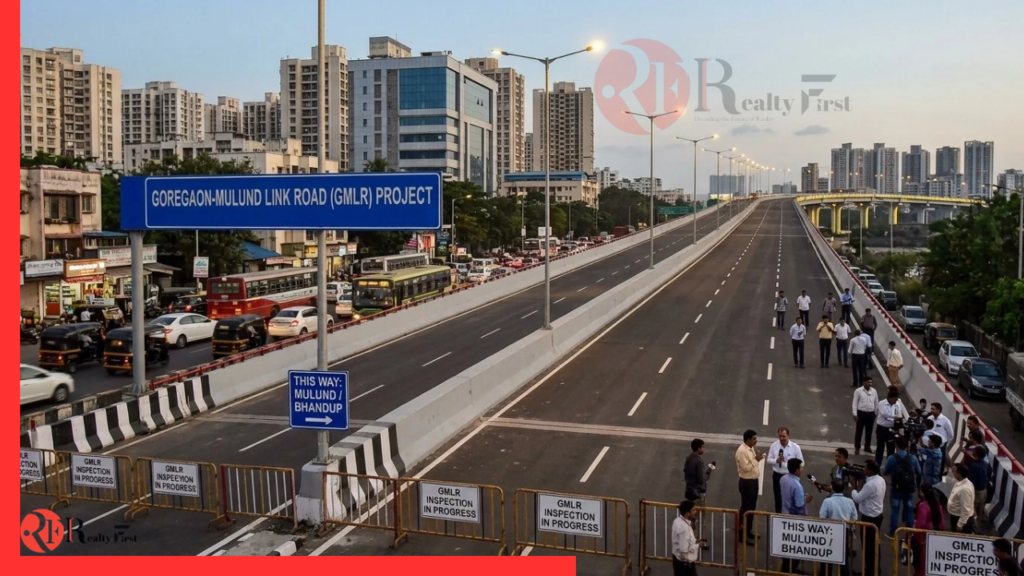
Mumbai’s long-standing east-west connectivity gap could be set for a significant change as the Goregaon-Mulund Link Road (GMLR) project advances towards its next milestone. According to media reports, the Brihanmumbai Municipal Corporation (BMC) is targeting October 15 for the opening to traffic of a 1.26 km flyover connecting Dindoshi Court and Dadasaheb Phalke Chitranagari, popularly known as Film City.
The flyover, designed with three lanes in each direction, forms part of the broader 12.2 km GMLR project. With final load testing and finishing work nearing completion, the development is drawing attention to its potential implications for real estate markets across Mumbai’s eastern and western suburbs.
Malad and Goregaon in the west, along with Mulund and Bhandup in the east, could benefit from improved accessibility. The anticipated effects include stronger residential demand, greater commercial interest and potential property price appreciation, although the extent of these changes will depend on how connectivity improves once the wider corridor becomes operational.
For commuters travelling between the Western Express Highway (WEH) and Eastern Express Highway (EEH), journeys have historically involved congested routes through the Jogeshwari-Vikhroli Link Road (JVLR), Ghodbunder Road or Aarey Colony. The GMLR is expected to reduce travel time between Goregaon and Mulund from more than an hour to under 20 minutes once fully operational.
That reduction could bring employment centres and residential neighbourhoods on either side of the city closer together, potentially changing homebuyers’ location preferences and the relative appeal of four key suburban real estate markets.
Also Read: Oriom Group Launches Oriom Realty to Expand into Odisha’s Residential and Commercial Property Market
Eastern Suburbs: Mulund and Bhandup
Mulund and Bhandup could gain from a more direct connection to western Mumbai’s commercial districts. Improved travel times may make the eastern suburbs more attractive to professionals working in western business hubs, particularly those seeking alternatives to the higher-priced residential options in established western locations.
Commenting on the potential impact on Mulund, Mr. Navin Makhija, Managing Director, The Wadhwa Group, says:
“Mulund has consistently established itself as one of the most structured and self-sustained residential hubs in Mumbai’s eastern suburbs. The fast-approaching opening of the GMLR flyover section marks a pivotal milestone for the entire micro-market. By slashing commute times to western commercial hubs like NESCO, Film City, and Mindspace, Mulund’s attractiveness to corporate buyers will skyrocket. We anticipate a steady upward trajectory in property valuations as the line between eastern and western living blurs, prompting end-users and investors to lock in premiums in Mulund’s top-tier developments.”
Bhandup, meanwhile, could benefit from its relative affordability and the potential for redevelopment. Better links to western employment centres may strengthen its appeal among buyers looking for improved connectivity without paying the price premium associated with some western suburban markets.
Mr. Karan Villaitramani, Director, Srishti Group, highlights the prospects for both eastern suburban markets: “Bhandup and Mulund represent two of the most dynamic growth vectors in Mumbai’s eastern belt today. Historically, Bhandup was viewed primarily as an emerging secondary market, but GMLR changes the equation entirely. The improved seamless connection to the western suburbs positions Bhandup as a prime redevelopment and affordable-luxury target for homebuyers seeking high connectivity without the western suburb price premium. Meanwhile, Mulund’s established residential landscape will see strengthened rental yields and capital appreciation as seamless East-West movement comes alive.”
The anticipated benefits are not uniform. Mulund enters this phase with an established residential base, while Bhandup’s relative affordability and redevelopment potential could help shape its response to improved east-west access.
Western Suburbs: Malad and Goregaon
On the western side, Malad and Goregaon already serve as important commercial, employment and retail destinations. The GMLR connection could widen their catchment areas by making these locations more accessible to residents of the eastern suburbs.
The flyover near Film City is expected to ease a key bottleneck on the western stretch of the corridor. If the broader project delivers the anticipated travel-time savings, the resulting connectivity could support demand for both commercial space and residential developments in the Malad-Goregaon belt.
Mr. Dhruman Shah, Promoter, Ariha Group, outlines the potential implications for the two western suburban markets: “The GMLR project is an absolute catalyst for the Malad-Goregaon belt. Goregaon and Malad have evolved into massive employment centers with expansive commercial parks and retail destinations. With the flyover near Film City opening for traffic, the bottleneck on the western side clears dramatically. This enhanced movement will attract high-value commercial occupiers and homebuyers from across the eastern suburbs, consolidating Malad and Goregaon as prime, resilient real estate destinations with strong price velocity.”
Malad’s residential market could also benefit from the combination of improved road connectivity and existing metro links. Easier cross-suburban travel may give homebuyers greater flexibility when choosing where to live, placing more emphasis on housing quality, amenities and integrated township developments.
Ms. Shraddha Kedia-Agarwal, Director, Transcon Developers, describes how these changes could influence residential demand in Malad: “Malad’s real estate landscape is undergoing a massive structural upgrade. Enhanced connectivity via GMLR, coupled with existing metro lines, positions Malad as a preferred lifestyle location for modern homebuyers. As East-West commuting barriers collapse, homebuyers are no longer constrained by geographical distance; they prioritize quality lifestyle developments, modern amenities, and integrated township concepts. We foresee a direct positive impact on absorption rates and a multi-year property appreciation trend in Malad.”
Property appreciation outlook will depend on project execution
Industry analysts anticipate that residential property values across Malad-Goregaon and Mulund-Bhandup could appreciate by 12% to 20% over the next 24 to 36 months as the flyover opens and construction of the twin subterranean tunnels beneath Sanjay Gandhi National Park progresses towards final completion.
The projected appreciation remains an outlook rather than a guaranteed outcome. Its realisation will depend in part on the delivery of the wider GMLR corridor and the extent to which improved travel times translate into sustained housing demand and commercial activity.
Also Read: Tier-2 Cities vs Metros: Where Is the Next Property Growth Coming From?
Developers are increasing their focus on mid-to-luxury housing, mixed-use developments and redevelopment projects across both sides of the corridor. As the GMLR advances, its significance for Mumbai’s property market will extend beyond a new road connection: the project could influence how homebuyers assess location, how businesses evaluate accessibility and how developers position projects across the eastern and western suburbs.
The scale of that shift will become clearer as additional sections are completed and the full corridor moves closer to operation.