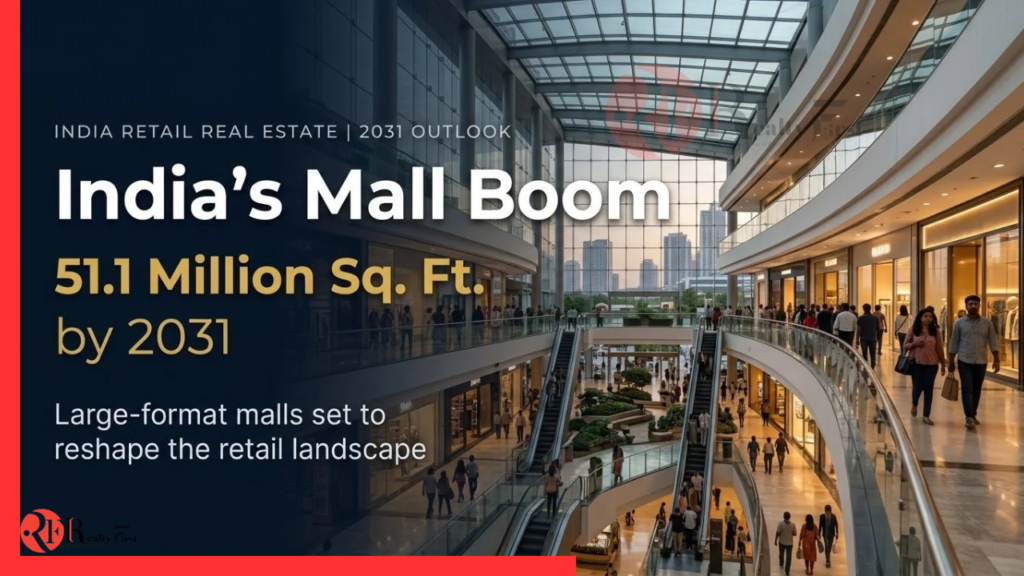
Mumbai: India’s organised retail real estate market is set for a significant expansion, with developers planning to add 51.1 million sq. ft. of shopping mall space by 2031, taking the total stock across the top seven cities to 143.2 million sq. ft., according to JLL’s report, Indian Retail 2031: Towards a future-ready ecosystem.
The planned expansion reflects rising consumer demand, the entry of international brands and the continued growth of domestic retailers. Large-format malls are expected to account for the biggest share of new supply, while developers are increasingly allocating space to entertainment, food and beverage (F&B), and services alongside conventional retail.
Of the 51.1 million sq. ft. of planned additions, large-format malls will contribute 28.7 million sq. ft., or 56% of the upcoming supply. Meanwhile, Delhi NCR and Hyderabad are expected to account for more than half of the new retail space planned across the country.
The report also points to greater concentration among organised retail property owners. The share of the top three listed developers in operational retail stock is projected to rise from 14% in H1 2026 to 21% by 2031, while the top 10 developers could account for 44% of the country’s total shopping mall stock.
Also Read: Tier-2 Cities vs Metros: Where Is the Next Property Growth Coming From?
India’s Shopping Mall Stock Reaches 92.1 Million Sq. Ft.
India’s retail property market entered the second half of 2026 with 92.1 million sq. ft. of shopping mall stock across the top seven cities. Gross leasing volumes reached 6.3 million sq. ft. in H1 2026, while the vacancy rate stood at 11.2%, according to the report.
The scale of planned development suggests that developers are responding not only to demand for additional retail space but also to changing consumer preferences and the growing importance of experience-led shopping destinations.
“India’s retail real estate sector is entering a new growth phase with significant scale, with 51.1 million sq. ft. of new mall space set to redefine the shopping experience by 2031. The shift toward large-format, experiential destinations, which will account for 56% of upcoming supply, signals a fundamental transformation in how consumers engage and how consumption patterns are evolving with changing generational preferences. With nearly one-third of these developments dedicated to entertainment, F&B, and services, we are moving beyond traditional commerce to create lifestyle destinations that blend technology, design, and experience,” said Saket Amrit, Head of Retail Services, India, JLL.
Large-Format Malls to Add 28.7 Million Sq. Ft.
Large-format shopping malls will form the largest component of India’s planned retail development pipeline, accounting for approximately 56% of the total upcoming supply between 2026 and 2031.
These developments will collectively add around 28.7 million sq. ft. of space, with greater emphasis on combining shopping with leisure, entertainment and other consumer services. Technology and design are expected to play important roles in shaping these destinations.
According to JLL, approximately 30-35% of the space in these large-format malls will be allocated to entertainment, F&B and services. Together, these categories are expected to occupy nearly 9-10 million sq. ft., reflecting the increasing focus on uses beyond conventional retail.
The proposed mix marks a shift towards shopping centres designed to serve multiple consumer needs within a single destination. Retailers and developers are responding to evolving shopping habits by incorporating leisure and service-oriented activities into mall planning.
Neighbourhood Malls to Expand Across Residential Areas
Alongside large-format developments, the 2026-2031 period is expected to see the emergence of next-generation neighbourhood malls. These projects will account for approximately 15% of the upcoming mall supply, representing a pipeline of around 7.9 million sq. ft.
Major listed developers are focusing on improving the shopping experience in key residential neighbourhoods. These developments are intended to address some of the challenges consumers face when shopping on high streets, while bringing organised retail and related services closer to residential catchments.
Although neighbourhood malls will represent a smaller share of planned additions than large-format destinations, their development signals a parallel focus on local convenience and access to organised retail.
Leading Developers Expected to Increase Their Market Share
The ownership of India’s organised retail real estate stock is projected to become more concentrated over the next five years.
As of H1 2026, the top three listed developers collectively owned approximately 14% of operational retail stock in Tier 1 markets. Based on estimates made public by these developers for April-June 2026, their share of India’s operational mall stock could increase to approximately 21% by the end of 2031.
The top 10 developers are projected to account for 44% of total shopping mall stock by 2031.
The expected increase points to a larger role for established developers in the country’s organised retail property market. Three major listed developers alone could account for approximately one-fifth of operational mall stock within five years, according to the estimates cited in the report.
This projected consolidation comes as developers prepare for another phase of expansion, supported by demand for organised retail space and the planned addition of new shopping destinations.
Delhi NCR and Hyderabad to Drive More Than Half of Upcoming Supply
Delhi NCR and Hyderabad are expected to account for more than half of the shopping mall space planned for development in India, underlining the importance of these markets in the next phase of retail real estate expansion.
Delhi NCR had the largest operational mall stock among the top seven cities in H1 2026, at 29 million sq. ft. Mumbai followed with 15.1 million sq. ft., while Bengaluru recorded 14.4 million sq. ft.
By 2031, Delhi NCR’s mall stock is projected to increase to 48.6 million sq. ft. Bengaluru’s stock is expected to reach 22 million sq. ft., while Mumbai’s is projected to grow to 21.6 million sq. ft.
These projections are based on current visibility into the delivery schedules of assets that are under construction or at the planning stage. Actual additions will therefore depend on the progress and delivery of the identified developments.
The scale of the planned pipeline in Delhi NCR and Hyderabad places these markets at the centre of India’s upcoming retail real estate expansion, while the projected growth in Bengaluru and Mumbai points to continued development in other established urban markets.
Also Read: How Vadhavan Port Could Shape Vasai’s Residential Real Estate Market
45.9 Million Sq. Ft. of New Retail Demand Pipeline Under Construction
The incremental demand for the new retail pipeline under construction stands at 45.9 million sq. ft., according to the report. This figure highlights the scale of the development pipeline and the demand expectations underpinning the expansion of organised retail real estate.
With total mall stock across the top seven cities projected to rise from 92.1 million sq. ft. as of June 2026 to 143.2 million sq. ft. by the end of 2031, the coming years are expected to bring a substantial increase in India’s shopping mall capacity.
Large-format destinations will account for most of the planned additions, while neighbourhood malls will provide a smaller, locally focused component. At the same time, Delhi NCR and Hyderabad are expected to drive a significant share of new supply, and leading listed developers are projected to increase their share of operational retail assets.
Together, these trends outline the direction of India’s organised retail real estate market through 2031, with the expansion of physical retail space accompanied by a greater emphasis on experience-led destinations and a more concentrated ownership structure.