Introduction
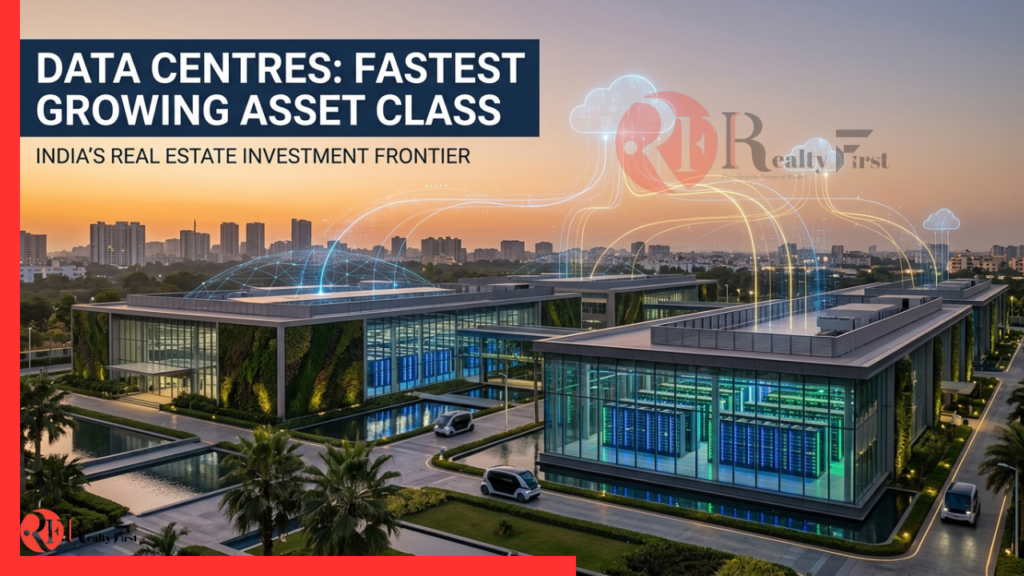
A decade ago, discussions around real estate investment were largely dominated by residential housing, office spaces, retail malls and industrial parks. Today, a new asset class is rapidly transforming the investment landscape. Data centres have emerged as one of the fastest growing segments within commercial real estate, attracting institutional investors, developers, infrastructure funds and global technology companies.
The shift is being driven by a simple reality. Every online search, video stream, digital payment, cloud application and artificial intelligence model relies on physical infrastructure to store, process and transmit data. While digital services appear invisible to consumers, the backbone supporting this digital economy consists of highly sophisticated data centres.
As artificial intelligence, cloud computing and digital transformation continue to accelerate, demand for data centre infrastructure is growing at an unprecedented pace. For real estate investors, developers and policymakers, data centres are no longer viewed as niche technology assets. They are increasingly being recognised as a strategic real estate asset class capable of generating long-term value and stable returns.
Also Read: Wellness-Oriented Living Shapes Homebuyer Preferences as Residential Communities Evolve
Why Data Centres Are Gaining Attention
The modern economy runs on data. Businesses across sectors including banking, healthcare, manufacturing, retail and telecommunications are generating massive volumes of information every day. At the same time, cloud adoption has become mainstream, requiring organisations to move data storage and computing functions away from traditional servers and into specialised facilities.
This transformation has created enormous demand for data centre capacity. India has emerged as one of the fastest-growing markets globally, supported by rising internet penetration, smartphone usage, digital payments and government-led digitisation initiatives. According to industry reports, India currently has approximately 1.6 GW of operational data centre capacity, while the development pipeline has expanded to around 3.1 GW, making it one of the most active markets in Asia Pacific.
For investors, this growth represents more than a technology story. It represents a real estate opportunity tied directly to long-term digital infrastructure demand.
How Data Centres Differ from Traditional Commercial Real Estate
Unlike office buildings or shopping centres, data centres are designed to house servers, networking equipment and cloud infrastructure. Their value is determined by factors such as power availability, fibre connectivity, cooling systems and operational reliability.
A traditional office building depends on tenant demand linked to business expansion. Data centres, however, benefit from structural demand generated by cloud providers, hyperscalers, artificial intelligence companies and enterprises that require continuous digital operations.
This creates a unique investment proposition. Data centre tenants typically sign long-term contracts, invest heavily in equipment and demonstrate lower relocation risk. As a result, occupancy levels often remain strong even during economic slowdowns.
For institutional investors seeking stable cash flows, this combination of infrastructure and real estate characteristics is particularly attractive.
The AI Revolution Is Accelerating Demand
Artificial intelligence has emerged as one of the most important drivers of data centre growth worldwide. Training and operating AI models require enormous computing power, significantly increasing demand for servers, GPUs and storage infrastructure.
Global technology companies are investing billions of dollars in AI-ready facilities. Recent developments involving hyperscale operators and major technology firms demonstrate how AI infrastructure is becoming a strategic priority across markets. India is increasingly benefiting from this trend as global operators expand their presence and capacity.
For real estate developers, the rise of AI has fundamentally changed site selection priorities. Access to reliable power, large land parcels and connectivity infrastructure has become as important as location itself.
Why India Is Emerging as a Data Centre Hub
India’s data centre growth story is supported by multiple structural advantages.
The country has one of the world’s largest internet user bases and continues to experience rapid growth in digital services. Data localisation requirements are encouraging companies to store information within India, creating additional demand for domestic infrastructure.
Major cities including Mumbai, Hyderabad, Chennai, Pune, Bengaluru and Delhi NCR have emerged as preferred destinations due to their connectivity, business ecosystems and infrastructure readiness. Mumbai is expected to cross 1 GW of operational capacity, while Hyderabad continues to attract significant investment from hyperscale operators.
Government policies, improved power generation capacity and growing investor confidence are also supporting expansion across both primary and emerging markets.
The Real Estate Opportunity Behind Data Centres
For developers and investors, data centres offer a compelling alternative to traditional asset classes.
First, they require large land parcels, creating opportunities for landowners and developers in strategic locations. Second, they generate demand for supporting infrastructure including substations, power networks and fibre connectivity. Third, they attract significant capital expenditure, resulting in long-term economic activity.
Industry estimates suggest that India’s data centre boom could generate millions of square feet of real estate demand while attracting billions of dollars in investment.
Unlike conventional commercial projects that may face cyclical demand fluctuations, data centres benefit from structural demand linked to digital consumption. As more businesses move operations online and AI adoption expands, infrastructure requirements are expected to continue growing.
Challenges Facing the Sector
Despite its strong outlook, the sector faces several challenges.
Power availability remains one of the most important considerations. Data centres consume substantial amounts of electricity and require uninterrupted power supply. Securing adequate energy infrastructure can significantly influence project feasibility.
Land acquisition, regulatory approvals and environmental considerations also play critical roles in project development. Investors increasingly evaluate locations based on infrastructure readiness rather than simply land availability.
Sustainability has become another important factor. Operators are investing in renewable energy, efficient cooling technologies and green building practices to reduce environmental impact while meeting growing capacity requirements.
What Lies Ahead
The future of data centres extends beyond storage and cloud computing. Emerging technologies including artificial intelligence, machine learning, edge computing, 5G networks and autonomous systems will require even greater computing capacity.
Industry forecasts indicate continued growth across India’s digital infrastructure ecosystem. Capacity additions, investment activity and hyperscale demand are expected to remain strong over the coming years as the country strengthens its position within the global digital economy.
For real estate investors, this evolution represents a rare opportunity to participate in a sector where technology, infrastructure and property converge.
Also Read: Chennai’s Growth Push Sparks Fresh Call for Second Airport, Say Industry Leaders
Conclusion
Data centres are no longer viewed as a niche technology segment. They have evolved into one of the most dynamic and fastest-growing asset classes within real estate. Driven by artificial intelligence, cloud adoption, digital transformation and rising data consumption, demand for digital infrastructure continues to expand across India and globally.
For developers, investors and policymakers, the opportunity extends beyond buildings. It involves participating in the infrastructure that powers the modern economy. As digitalisation accelerates and AI reshapes industries, data centres are expected to remain at the centre of the next phase of real estate growth.