For Mistry, the starting point was never land. It was the gap.
“For me, it is critical to understand where the market gap is and how we can position ourselves in a way that becomes a moat,” he says. “In India, there is not a single developer doing theme-based integrated luxury townships at the scale we are building. That differentiation becomes our moat.”
While the phrase “theme-based” may appear cosmetic at first glance, Mistry clarifies that Della’s model extends far beyond branding. Each township is structured around eleven integrated elements that combine hospitality, design, leisure, residential, and experiential infrastructure into one cohesive ecosystem. The objective is not simply to create inventory — but to engineer environments.
“Being a design futurist, it is my responsibility to anticipate what will happen in the future of design and how it will impact humanity,” he explains. “Live, work and play must coexist within the same ecosystem. The real question is — what kind of township do I live in that increases the years in my life, and life in my years? That is the premise.”
The Asset-Light Disruption
Central to Della’s expansion strategy is its asset-light structure. Unlike traditional developers, the company does not acquire land nor invest capital directly into projects. Instead, it partners with landowners who bring land and investment, while Della brings design intelligence, hospitality infrastructure, branding, operational expertise, and velocity of sales.
“We are India’s first asset-light real estate company,” Mistry states. “Land acquisition and approvals are highly local subjects. By not owning land or carrying debt, we can scale across India without blinking an eyelid.”
The structure allows landowners to invest significantly less capital than they would independently, while benefiting from enhanced value creation driven by Della’s brand positioning and integrated model.
“Most landowners would traditionally invest four times more capital if they developed alone. With us, they are not even putting in 25% of that. Our brand and conceptual strength allow us to command top-dollar realization.”
This model, he argues, creates a scalable, capital-efficient growth engine — one that enables Della to operate across diverse geographies simultaneously.
Infrastructure-Aligned Expansion
From 40-acre developments to 1,400-acre integrated cities, Della’s footprint spans multiple states. Yet expansion is not speculative.
“We are synergistically aligning with state infrastructure corridors,” Mistry explains. “We identify growth zones where government-backed infrastructure is already unfolding.”
A prime example is the 1,100-acre Della International City in Ahmedabad, positioned between Ahmedabad and Rajkot. Conceived as India’s first automobile-led international city, the project integrates an F1-grade racing circuit designed in collaboration with global specialists, alongside an 18-hole championship golf course and hospitality-driven infrastructure.
The racing circuit is not symbolic. It is designed to attract the automobile industry, including autonomous vehicle testing ecosystems equipped with radar and sonar technologies. Simultaneously, the lifestyle infrastructure is structured to draw global capability centres and senior management talent seeking integrated living environments.
“No GCC in India today offers the kind of lifestyle infrastructure we are building,” Mistry asserts. “We are creating international cities within cities.”
Sustainability With Measurable ROI
For Della, sustainability is not aesthetic positioning — it is quantifiable.
“Anything that cannot be measured is frivolous,” Mistry says candidly.
The company is working with IIT Madras on algae and microalgae experimentation and engaging leading global carbon footprint certifiers to benchmark performance. Every sustainability initiative must justify itself through measurable returns, long-term asset value enhancement, and operational efficiency.
With 2,850 employees on its payroll, Della operates with an infrastructure more commonly associated with integrated hospitality groups than conventional developers. “This reflects our long-term commitment,” he notes. “We are building for decades, not for exit cycles.”
Hospitality-Led Financial Structuring
The financial architecture behind Della’s projects further differentiates its model. Resort-led developments incorporate sale-and-leaseback structures, enabling early-stage revenue generation and smoother financial closure for land partners.
Hospitality assets are structured through separate special purpose vehicles, generating operational income multiples alongside real estate sales value. According to Mistry, this dual valuation framework creates premium positioning compared to standalone “vanilla” real estate.
“Family offices and institutions understand that hospitality-led development commands a different valuation. It carries a premium.”
Notably, Della remains debt-averse. Equity participation occurs at the landowner level, while Della arranges capital but keeps its own balance sheet asset-light.
Attracting a New Genre of Buyer
Perhaps the most compelling impact of Della’s ecosystem strategy lies in buyer transformation.
Without integrated infrastructure, a township in Ahmedabad might cater primarily to local demand. With motorsport circuits, championship golf, branded residences, and experiential hospitality, the buyer pool expands nationally and globally.
“We are attracting a new genre of buyer,” Mistry explains. “NRIs, automobile executives, golf enthusiasts, GCC leadership — this is not just local real estate anymore.”
Ahmedabad’s projected GDV of ₹16,000 crore reflects this broader positioning. Early market response, he suggests, indicates strong pent-up demand for differentiated urban formats.
Ecosystems Over Inventory
When asked whether the next decade will reward ecosystem builders over inventory developers, Mistry does not hesitate.
“There will be a clear differentiation between standalone low-cost developments and projects focused on quality of life.”
He draws a distinction between lifestyle marketing and structural quality of life design. For Della, community creation and long-term operational management form the backbone of value creation. Each township operates under a 20-year hospitality management agreement, ensuring continuity beyond initial sales.
“We are not here to sell real estate and move away.”
The Legacy Question
Looking ahead 15 to 20 years, Mistry’s ambition extends beyond financial metrics.
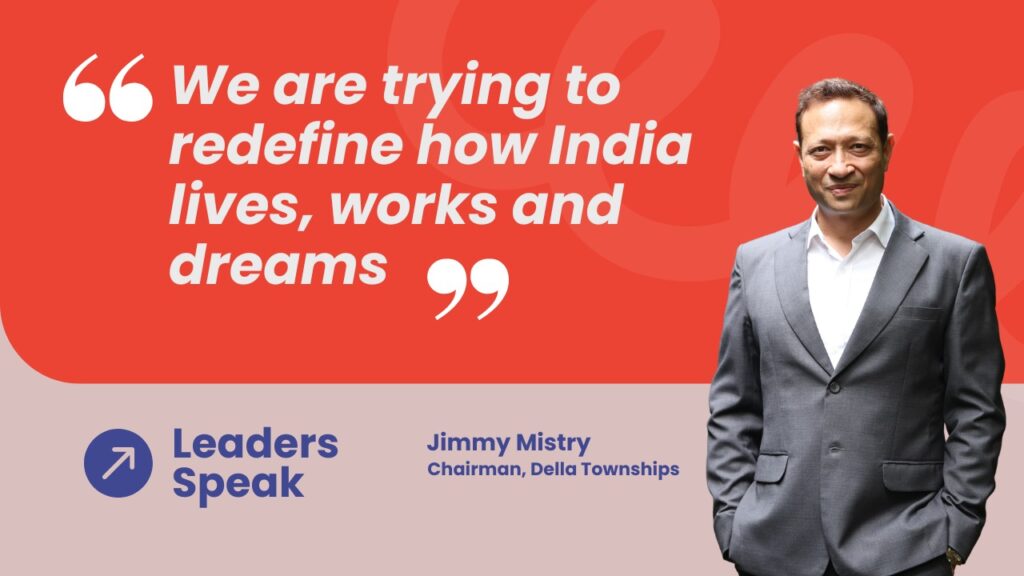
“We are trying to redefine how India lives, works and dreams,” he says. “Impacting lives and leading the industry toward integrated, hospitality-led townships — that will be the true measurement of success.”
With a rapidly expanding pipeline and a claimed GDV trajectory placing Della among India’s fastest-growing real estate brands, the company positions itself not merely as a developer — but as an architect of urban ecosystems.
If conventional real estate builds square feet, Della Townships seeks to build environments that shape behaviour, aspiration and longevity.
And in doing so, it may well signal a structural shift in how India’s next generation of cities is imagined.