
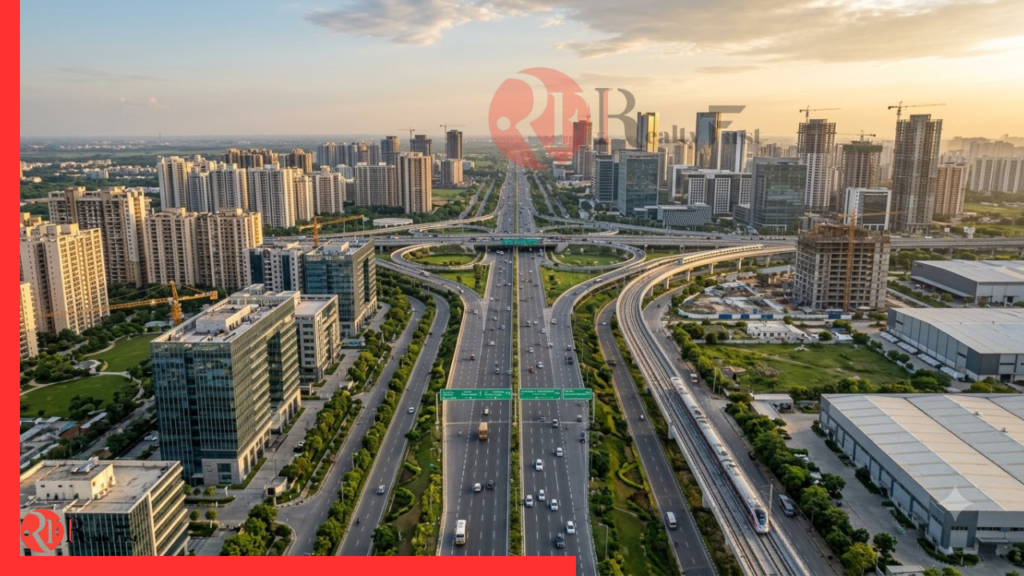
Mumbai: Major infrastructure projects have historically influenced the direction of Gurugram’s urban expansion. From NH-48 and the Southern Peripheral Road (SPR) to the Dwarka Expressway, each connectivity upgrade has reshaped residential and commercial development across the city. The proposed 46-km Gurugram-Rewari Highway is now emerging as another significant infrastructure project that could further accelerate the growth trajectory of New Gurugram.
Planned to begin near Sector 88B on the Dwarka Expressway and extend to the Kundli-Manesar-Palwal (KMP) Expressway, the highway is expected to strengthen connectivity between Gurugram, Manesar and Rewari. In addition to reducing travel time, the corridor will improve access to key transport networks, including NH-48, the Dwarka Expressway and the upcoming Delhi-Gurugram-SNB-Alwar RRTS corridor. For New Gurugram, industry observers believe the project’s importance extends beyond improved mobility, positioning the area as a more integrated residential and commercial destination.
Commenting on the project’s significance, Ashok Singh Jaunapuria, Managing Director & CEO, SS Group, said the new highway could mark another milestone in Gurugram’s long-term urban development.
“The transformation of New Gurugram has always been closely linked to infrastructure. Over the last few years, projects like the Dwarka Expressway have significantly improved the area’s appeal, and the Gurugram-Rewari Highway is expected to build on that momentum. Better regional connectivity will not only make commuting easier but also strengthen links between residential neighbourhoods, industrial hubs and commercial centres. As this ecosystem evolves, New Gurugram is likely to attract sustained end-user demand while supporting more balanced and future-ready urban development.”
The highway is expected to have a notable impact across New Gurugram’s residential corridor, particularly in Sectors 81, 82, 83, 84, 85, 86, 88A, 89, 90, 91, 92, 93, 95, 95A and 99A. These locations have steadily evolved into organised residential markets over the past several years, supported by expanding social infrastructure, educational institutions, healthcare facilities and proximity to major employment centres. Improved regional connectivity is anticipated to enhance accessibility for residents while reinforcing the long-term fundamentals of these micro-markets.
Unlike earlier infrastructure projects that primarily stimulated housing demand, the Gurugram-Rewari Highway is expected to contribute to a broader economic ecosystem. Stronger connectivity with IMT Manesar, Dharuhera and Rewari could encourage growth across industrial, warehousing, logistics and commercial segments alongside residential development. This combination of employment opportunities, infrastructure and housing is expected to support the emergence of a more balanced urban corridor rather than a market driven solely by residential expansion.
Also Read: Beyond Housing: Integrated MEP Planning Will Define the Success of Dharavi’s Redevelopment
As Gurugram’s development continues to extend beyond its established urban core, infrastructure remains a key factor influencing homebuyer preferences and long-term investment decisions. The Gurugram-Rewari Highway is expected to complement the city’s existing transport network while reinforcing New Gurugram’s position as one of the National Capital Region’s strategically connected growth corridors. Rather than creating an entirely new real estate destination, the project is expected to strengthen the ongoing evolution of New Gurugram into an integrated urban cluster where connectivity, employment and residential development progress together.