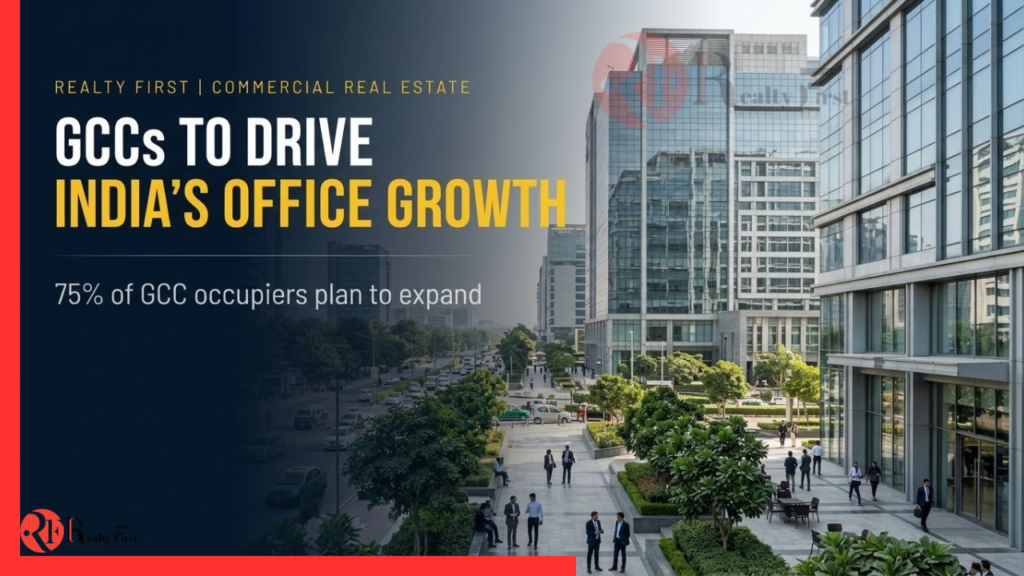
India’s office real estate market is heading into a phase of sustained occupier expansion, with Global Capability Centres (GCCs) expected to play a central role in shaping demand. CBRE’s India Office Occupier Survey 2026 indicates that 75% of GCC occupiers intend to expand their office portfolios in India over the next two years, underscoring the importance of the country’s role in global business operations.
The outlook extends beyond GCCs. Overall, 77% of occupiers surveyed plan to increase their India office portfolios over the same period. More significantly, 30% expect to expand their office footprint by more than 30%, nearly twice the 18% reported in the 2025 survey. The findings point to a market in which expansion plans are becoming more ambitious.
GCCs have already established a substantial presence in India’s office leasing market. Between 2022 and H1 2026, they leased more than 123 million sq ft, representing 36% of total office leasing during that period. The country now has more than 2,117 GCC firms employing 2.36 million professionals, while GCC revenues reached nearly US$100 billion in FY2026.
The broader office market is also registering record activity. Gross office absorption reached 45.5 million sq ft in H1 2026, the highest volume recorded in any half-year, according to CBRE. Of this, 24.6 million sq ft was absorbed in the second quarter alone. New office supply reached a record 32 million sq ft during H1, reflecting the scale of development activity alongside rising occupier demand.
Colliers data further highlights the contribution of GCCs. They accounted for 46% of Grade A office leasing in H1 2026, leasing 16.6 million sq ft. Together, these figures underline the growing influence of GCCs on the direction of India’s commercial real estate market.
Also Read: How Vadhavan Port Could Shape Vasai’s Residential Real Estate Market
GCCs are shifting demand towards specialised workplaces
The expansion of GCCs is accompanied by a change in the nature of work undertaken from India. Rather than being confined to traditional back-office functions, these centres are increasingly handling higher-value activities spanning research and development, engineering, product development, artificial intelligence, analytics, cybersecurity and enterprise transformation.
This shift is influencing the requirements of office occupiers. Alongside additional floor space, businesses are looking for well-connected, high-quality workplaces equipped to support technology-intensive operations and specialised teams.
Technology is also becoming a more direct consideration in leasing decisions. More than one-third of occupiers expect developments in AI and automation to influence their leasing choices over the next 12–24 months. Meanwhile, 93% of those surveyed are already deploying AI in some capacity, suggesting that the technology is becoming an established part of workplace planning.
The geographical spread of demand is changing as well. While established business districts remain important, emerging commercial corridors across Noida, Greater Noida and the Yamuna Expressway are gaining attention as technology infrastructure and new investments influence the wider NCR market.
For developers and investors, this creates a more complex demand environment in which location, infrastructure, workplace quality and the ability to accommodate evolving business functions increasingly intersect.
Connectivity becomes a key factor in NCR office decisions
Leasing activity in Delhi-NCR illustrates the continuing importance of established commercial centres alongside emerging office markets. The region recorded 2.8 million sq ft of gross leasing in Q1 2026. Gurugram accounted for 60% of the total, while Noida contributed 37%.
Noida Expressway emerged as the largest micro-market, while Udyog Vihar and NH-8 Prime also registered significant activity. GCC leasing across NCR stood at 0.9 million sq ft during the quarter.
Accessibility is becoming an important consideration as occupiers assess where to locate their operations. CBRE’s survey found that 70% of respondents consider access to commuting infrastructure crucial when selecting office space. At the same time, 95% regard traffic congestion and commuting challenges as a threat to business operations and employee experience. Another 18% said they would be willing to pay a premium for access to public transport.
These findings suggest that office-location decisions increasingly extend beyond the building itself. The surrounding transport network and the ease with which employees can reach the workplace are also becoming material considerations.
Retail property has recorded growth alongside the office market. CBRE reported retail leasing of 3.9 million sq ft in H1 2026, a 20% year-on-year increase. Delhi-NCR led the major markets, with fashion and apparel accounting for around 40% of leasing. Direct-to-consumer (D2C) retailers represented about 28%, providing an additional source of demand for high streets and organised retail destinations.
Office occupiers show a growing preference for quality assets
As GCCs take on more specialised responsibilities, the availability and quality of office space are becoming increasingly important to occupiers. CBRE found that 40% of respondents were concerned about the availability of high-quality, well-located office space through 2028.
Leasing activity reflects this emphasis on asset quality. Investment-grade properties accounted for 41% of leasing during 2025 and H1 2026, indicating the significant role such assets are playing in the current market.
Sandeep Chhillar, Founder and Chairman, Landmark Group, said, “Global Capability Centres are fast becoming the defining demand driver of India’s next commercial real estate cycle. With India’s GCC count projected to grow by 41% by 2030, and GCCs already accounting for nearly 35% of Grade-A office leasing across top cities, the numbers tell a clear story. Gurugram is firmly at the centre of this shift in NCR, the city’s combination of superior connectivity, mature infrastructure, established corporate ecosystem and deep talent access makes it one of the most compelling GCC destinations in the country. As mandates grow more sophisticated, location decisions are increasingly being made through the lens of the broader business ecosystem: talent availability, infrastructure quality and long-term liveability. The next phase of commercial real estate will be defined not by volume alone, but by the quality and adaptability of environments built for businesses and their people.”
The emphasis on infrastructure and workplace suitability is also relevant to emerging commercial corridors. As new locations develop, their ability to offer reliable connectivity, supporting infrastructure and well-planned commercial environments could influence how businesses distribute their operations across NCR.
Dr Amish Bhutani, Managing Director, Group 108, said, “Occupiers are becoming more selective about what makes a commercial location work over the long term. Demand will increasingly be driven by factors such as connectivity, accessibility, quality of infrastructure, surrounding development and the availability of well-planned commercial spaces. As emerging NCR corridors improve their connectivity and infrastructure, they will become more attractive for businesses seeking efficient and future-ready locations. The growing availability of quality office and retail spaces in these corridors will further strengthen demand for commercial real estate.”
Institutional investment adds another dimension to the cycle
Investor activity provides a further indication of the scale of capital moving into commercial real estate. Colliers reported that institutional real estate investment reached $4.5 billion in H1 2026, an increase of 50% year-on-year. Office assets accounted for more than 40% of these inflows.
Alongside occupier expansion, investment in digital infrastructure is influencing the development outlook across NCR. Data centres are emerging as another area of interest, with locations across Noida, Greater Noida and the Yamuna Expressway offering different development possibilities.
Karan Malik, Regional Director, Realistic Realtors, said, “The expansion of data centres is also opening up a longer development landscape for NCR. Noida and Greater Noida have the existing ecosystem, while the Yamuna Expressway region offers larger parcels and the potential to accommodate infrastructure at scale. The upcoming data centre parks across Noida, Greater Noida and Yamuna Expressway show that this is becoming a wider regional strategy rather than a single-location story. Real estate will increasingly follow the infrastructure that enables the digital economy.”
Also Read: Consumer Intelligence Can Help Developers Identify Genuine Property Buyers
The convergence of GCC expansion, technology adoption, talent requirements, connectivity and institutional investment is shaping the next phase of India’s commercial real estate market. With 75% of GCC occupiers planning to expand their Indian office portfolios over the next two years, demand is no longer only a question of adding floor space. The locations businesses choose, the quality of workplaces they occupy and the infrastructure supporting their operations are becoming increasingly important to the market’s next growth cycle.