Mumbai: India’s organised retail market recorded its strongest half-yearly leasing activity in four years during H1 2026, even as limited availability of quality shopping mall space constrained supply. Gross leasing across the country’s top seven retail markets rose 10.5% year-on-year to 6.27 million sq. ft. between January and June 2026, compared with 5.68 million sq. ft. in H1 2025, according to data from JLL.
The growth points to sustained retailer expansion despite external pressures and a limited addition of new shopping mall space. Mumbai, Delhi NCR and Bengaluru remained the primary demand centres, together accounting for more than 75% of total leasing activity during the first half of the year.
Also Read: Randeep Hooda Unveils Nehlia Developers’ 75-Acre Farmhouse Project, Nehlia Santo Hills
JLL said retail demand remained resilient between January and June 2026 despite multiple factors that could have affected the sector’s growth trajectory. Saket Amrit, Head-Retail Services, India, JLL, said, “India’s retail real estate sector is in the resilient growth phase, where demand is surging to record levels, reinforcing the sector’s position as a key driver in the economy. Despite global headwinds and sequential rise in retail inflation between January and June 2026, gross leasing volume across top 7 markets reached 6.27 million sq. ft. in H1 2026, the highest half-yearly leasing activity recorded in four years.”
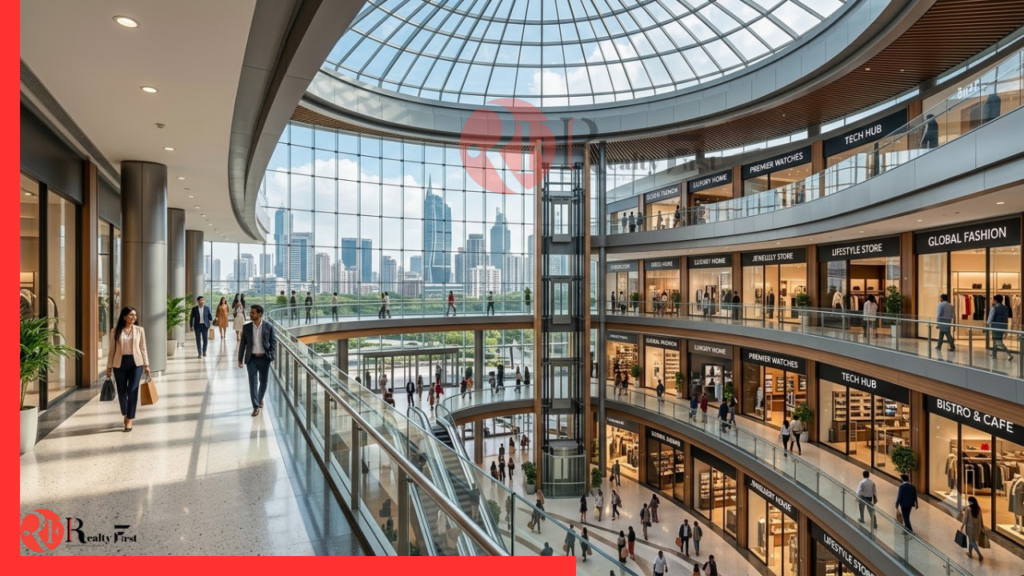
According to JLL, the country’s shopping mall stock stood at approximately 92 million sq. ft. as consumer preferences continued to evolve. Developers and retailers are increasingly prioritising asset quality, technology, convenience and experience-led formats, the property consultancy said.
Amrit added, “With the country’s total shopping mall stock now standing at approximately 92 million sq. ft. and consumer expectations rapidly evolving, developers and occupiers prioritizing quality over quantity and investing in next-generation assets that seamlessly integrate technology, convenience, and immersive, experience-led retail formats. The robust development pipeline of over 45 million sq. ft., expected by 2030, positions the sector for its next phase of sustainable, institutionally backed expansion, powered by strong domestic consumption, ambitious retailer expansion plans and an accelerating shift toward high-quality retail destinations that cater to India’s increasingly discerning and affluent consumers.”
Retail leasing strengthens through Q2 2026
The first quarter of 2026 followed the seasonal pattern typically associated with the opening quarter of a calendar year, with gross leasing reaching 3.09 million sq. ft. Retailer expansion continued despite tight supply conditions.
Momentum improved in the second quarter, with gross leasing increasing 2.7% sequentially to 3.18 million sq. ft. between April and June. The increase reflected continued expansion across retail formats, with domestic retailers accounting for 79.1% of overall gross leasing during H1 2026.
New shopping mall supply remained limited during Q2 2026. However, the availability of new retail space in peripheral areas of Delhi NCR and Hyderabad provided retailers with additional options as they sought to expand their physical store networks.
Across the top seven markets, new shopping mall supply during H1 2026 stood at 0.82 million sq. ft., a 64% year-on-year decline from the supply recorded in H1 2025. Following these additions, India’s total shopping mall stock reached approximately 92.08 million sq. ft.
Limited quality space pushes retailers towards alternate formats
The shortage of quality shopping mall space has become a constraint for major retail brands seeking to expand their store networks. According to JLL, retailers have been evaluating alternative formats over the past six to nine months as availability within established malls remained limited.
Despite the slower pace of supply additions, demand remained strong enough to push shopping mall vacancy rates lower. Vacancy across the top seven cities declined by 45 basis points year-on-year, from 11.60% in H1 2025 to 11.15% at the end of H1 2026.
At the broader pan-India level, organised retail demand also strengthened as consumers increasingly favoured experience-driven formats. Shopping malls accounted for 43.1% of total gross leasing in H1 2026, up from 38.9% in H1 2025. Leasing within shopping malls increased 22.4% year-on-year, highlighting retailers’ preference for premium and organised retail environments.
Mumbai, Delhi NCR and Bengaluru lead retail demand
Mumbai remained the largest contributor to retail leasing during H1 2026, accounting for 29% of total activity, followed by Delhi NCR at 24%. Bengaluru contributed another 23%, taking the combined share of the three markets to more than 75%.
The concentration of leasing in these markets reflects retailers’ continued preference for established locations with strong consumption bases.
Kolkata recorded one of the sharpest increases in leasing activity, with volumes rising 87.3% year-on-year following the completion of a new mall in Q1 2026. Delhi NCR and Mumbai also posted significant growth, with leasing increasing 75.9% and 69.6%, respectively, supported by continued occupier expansion.
Bengaluru, Hyderabad and Chennai, meanwhile, recorded a moderation in leasing activity during the period.
Source: Real Estate Intelligence Service (REIS), JLL Research
Note: Numbers rounded off to two decimal places. Gross leasing includes real estate space leased in shopping malls, high streets and prime retail developments.
Fashion and apparel remains the largest leasing category
Fashion and apparel accounted for the largest share of retail leasing in H1 2026 at 33%, followed by food and beverage at 18%. Entertainment represented another 16% of total leasing activity.
The entertainment segment gained ground during the period, increasing its share from 12% in H1 2025 to 16% in H1 2026. Space take-up in the category rose 41.5% year-on-year, driven largely by family entertainment centres, including bowling alleys, gaming zones and children’s play areas.
The trend points to the growing role of experience-oriented formats within organised retail spaces.
The daily needs and grocery segment moved in the opposite direction, with leasing volume declining 39%. JLL attributed the decline primarily to the rapid expansion of quick-commerce and dark-store networks.
Domestic retailers continue to drive leasing
Domestic retailers remained the principal source of leasing demand during the first half of 2026, accounting for 79.1% of total gross leasing.
While the pace of new international brand entries into India moderated during H1 2026, established global brands already operating in the country continued to expand. Gross leasing by international retailers increased 62.1% year-on-year.
New international brands entering India during the period were concentrated across food and beverage, fashion and apparel, footwear, and bags and accessories.
JLL said the continued expansion of both domestic and international retailers reflected the resilience of India’s retail demand fundamentals despite the prevailing global economic environment.
Also Read: Upper Dwarka Expressway Could Be NCR’s Next Infrastructure-Led Growth Corridor
More than 45 million sq. ft. of mall space in development pipeline
While retail developers face short-term supply constraints, the medium-term pipeline could provide additional capacity for organised retail growth.
Approximately 45.5 million sq. ft. of shopping mall space is currently under various stages of construction across the top seven cities and is expected to become operational by 2030.
JLL said developers remain focused on building quality shopping mall infrastructure, which could support the expansion of India’s organised retail landscape and attract greater institutional interest over the longer term.