
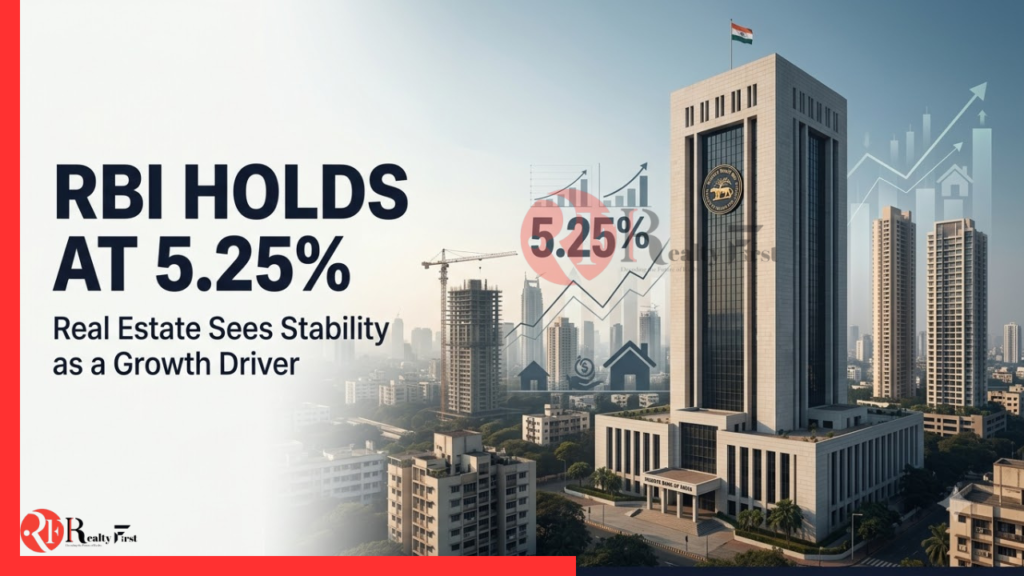
The Reserve Bank of India (RBI) has kept the policy repo rate unchanged at 5.25% and retained its neutral stance, with the decision drawing a broadly positive, though measured, response from the real estate industry.
The decision comes against a backdrop of global uncertainty, including energy market volatility, fluctuating crude prices, inflationary pressures, geopolitical developments and supply chain disruptions linked to the ongoing West Asia conflict. While the industry had hoped for a rate cut that could further improve home loan affordability and stimulate housing demand, developers and real estate consultants said policy continuity would provide greater visibility for both buyers and project planners.
The RBI’s decision was taken at the third bi-monthly Monetary Policy Committee (MPC) meeting of FY27. Industry participants said stable borrowing costs could help preserve buyer confidence, particularly as the festive season approaches, while giving developers greater certainty around investments, project execution and financial planning.
Also Read: Beyond Rehabilitation: How Redevelopment Design Is Reshaping Mumbai’s Urban Future
Ashish Bhutani, CEO, Bhutani Infra, said, “Maintaining the repo rate is a prudential decision by the RBI that has come about after weighing various factors regarding the need to balance between fostering economic growth and preserving macroeconomic stability. A steady interest rate regime gives much-needed predictability to the market participants, which enables them to take important decisions in a more structured manner. The real estate segment is also benefited by policy consistency, and this helps in improving buyer sentiment, proper planning of projects, and ensuring financial discipline within the industry. The fast-paced growth in the infrastructure segment and the strength in demand levels mean that a steady monetary policy would help in keeping the investment momentum going.”
Stable Rates Seen Supporting Luxury and Premium Housing
For the luxury housing segment, industry executives said that while high-value buyers are generally less sensitive to changes in borrowing costs, policy stability can still influence investment confidence.
Ravikant, Co- Founder Elegance Infra and Enterprises said, “Maintaining the repo rate by RBI is a favourable sign for the luxury real estate market. Interest rate stability increases confidence levels amongst the high-net-worth individuals and non-resident Indians, which helps in making informed decisions for investing in expensive and valuable properties. Although this segment of real estate market is less susceptible to interest rates, yet stability in policy makes them more favorable for investment in luxury property segments.”
Raghunath Reddy Bhattagiri, MD and Founder, Triguna Projects, said, “The RBI’s policy on retaining the repo rate is a sign of a prudent stance considering the changing global situation. This stability in the interest rate is good news for the real estate sector since it helps to keep the mood of the buyers alive and EMI rates for home loans constant for the users. In a scenario where the risks of inflation are still there and global headwinds are still strong, the stable rate system gives both the developers and buyers a chance to make plans.”
The broader industry response has similarly centred on predictability. Developers and real estate consultants expect unchanged borrowing costs to support housing demand and provide a relatively stable environment for long-term investments, even as inflation, construction costs and global risks remain areas of concern.
Festive Season Could Provide a Key Demand Window
Amit Goyal, Managing Director, India Sotheby’s International Realty, said the RBI’s decision marks the fourth consecutive policy in which the repo rate has remained at 5.25%, and viewed the move as supportive of market stability.
“This is the fourth consecutive RBI policy with the repo rate unchanged at 5.25%, and we welcome the decision. Despite higher crude prices and June retail inflation rising to an 18-month high, the RBI has prioritised stability. It reflects confidence in the resilience of the Indian economy, while remaining watchful of global risks.
For real estate, the timing is significant. This is the last policy review before the festive season, giving homebuyers and developers greater certainty to plan purchases and launches. Stable EMIs are particularly important as some overheated markets begin to see demand moderate. We expect this unchanged interest rates, together with easing crude prices, to support buyer sentiment and help sustain housing demand through the festive season.”
The festive period is also expected to remain important for residential sales, with stable EMIs potentially helping buyers plan purchases with greater certainty. At the same time, market participants pointed to affordability pressures created by higher construction and labour costs as a factor that could influence sales momentum.
Vimal Nadar, National Director & Head of Research, Colliers India, said, “RBI has kept the repo rate unchanged at 5.25% along with continuation of neutral stance, reflecting a vigilant approach amid the resurgence of West Asia crisis, volatile crude prices, fluctuating rupee and persistent inflationary risks. Although trade uncertainty, tariff rate recalibrations & renewed supply chain disruptions could weigh on growth prospects and affect multiple economic sectors, Indian real estate holds potential to navigate the downside risks successfully.
Additionally, stability in interest rates continue to provide comfort to homebuyers, especially in the affordable and middle-income segments. With the upcoming festive season, stability in EMIs could boost housing demand in the next few quarters. However, affordability pressures stemming from rising construction and labour costs may moderate sales as compared to the previous year. Developers, meanwhile, are likely to remain focused on cost management and timely project deliveries. Moreover, the recent RERA advisory to grant a four-month extension to eligible projects impacted by the West Asia conflict, provides a much-needed regulatory relief to affected developers.”
Developers Continue to Focus on Cost and Execution
For developers, unchanged interest rates provide continuity at a time when construction costs remain elevated and foreign investment sentiment has been affected by geopolitical uncertainty.
Shrinivas Rao, FRICS, CEO, Vestian, said, “The RBI’s decision to keep the repo rate unchanged at 5.25% depicts its balanced approach amid prevailing geopolitical uncertainty, an uneven monsoon, and rising domestic inflation. The stable monetary policy is expected to support capital inflows into the real estate sector at a time when developers continue to grapple with elevated construction costs and softer foreign investment sentiment due to the West Asia conflict. The current mortgage rates may offer a limited window for prospective homebuyers before any potential policy tightening. If crude oil prices and inflationary pressures intensify in the coming months, the RBI may consider a 25-basis point rate hike in its next MPC meeting.”
Akhil Saraf, Founder & CEO, Reloy (A proptech Firm), said, “The RBI’s decision to keep the repo rate unchanged at 5.25% brings much-needed stability to the real estate sector. In today’s market, predictability is just as valuable as lower interest rates. For homebuyers, it means greater confidence in planning their finances and making purchase decisions, while for developers, it provides the certainty needed to plan investments and execute projects efficiently. Although a rate cut would have provided an additional boost to housing demand, maintaining the current rate strikes the right balance between supporting economic growth and keeping inflation in check. Overall, this policy continuity is expected to sustain positive sentiment across the residential real estate market.”
The financing environment is also being viewed as supportive for creditworthy buyers, with some lenders offering home loans at rates of about 7.25%. Industry executives said the combination of stable borrowing costs, developer incentives, flexible payment plans and competitive pricing could influence purchase decisions during the upcoming holiday season.
Anupam Rastogi, Co-Founder & CBO, Square Yards, said, “The residential real estate industry benefits from the RBI’s decision to keep the repo rate at 5.25% since it promotes a steady and predictable borrowing environment. For creditworthy homeowners, financing conditions remain appealing because some lenders offer home loans at rates as low as about 7.25%. Stable borrowing prices, developer incentives, flexible payment plans, and competitive pricing could boost buyer sentiment and promote purchasing decisions as the holiday season draws near. Because ready-to-move-in and near-completion properties offer more assurance regarding delivery and the possibility of long-term value appreciation, the atmosphere is especially favorable for individuals contemplating such properties”
Amit Prakash Singh, Co-Founder and CBO, Urban Money, said, “The RBI’s decision to maintain the repo rate at 5.25% reinforces a stable and predictable borrowing environment, which is positive for the residential real estate sector. With select lenders offering home loans at rates starting at approximately 7.25%, financing conditions remain attractive for creditworthy homebuyers. As the festive season approaches, stable borrowing costs, combined with developer incentives, flexible payment plans and competitive pricing, could strengthen buyer sentiment and encourage purchase decisions. The environment is particularly favourable for those considering ready-to-move-in and near-completion properties, which offer greater certainty around delivery and the potential for long-term value appreciation.”
Industry Sees Scope for Future Rate Cuts
While the immediate response to the RBI’s decision has been positive, several industry voices said a future rate cut could provide an additional boost to housing affordability and investment activity if inflationary pressures moderate.
Kamlesh Thakur, President, NAREDCO Maharashtra, said, “The RBI’s decision to maintain the repo rate at 5.25% while retaining a neutral stance reflects a prudent approach amid global uncertainties and evolving inflation dynamics. While the industry was hopeful of a rate cut, policy stability itself provides confidence to both developers and homebuyers. With borrowing costs remaining unchanged, housing demand is expected to continue its momentum, particularly in the mid-income and premium segments. The upward revision of India’s GDP growth projection to 6.7% underscores the resilience of the domestic economy. Going forward, as inflation moderates in line with the RBI’s expectations, there could be room for a more accommodative monetary policy. A future rate cut would further improve housing affordability, strengthen buyer sentiment, and accelerate investments across the residential and commercial real estate sectors.”
Kaushal Agarwal, Chairman, The Guardians Real Estate Advisory, said, “The RBI’s decision to keep the repo rate unchanged brings continuity and predictability to the market at a time when global geopolitical developments and inflationary pressures continue to create uncertainty. Stable interest rates ensure that home loan EMIs remain broadly unchanged, allowing prospective buyers to make informed purchasing decisions without concerns over rising borrowing costs. The Indian housing market has demonstrated remarkable resilience over the past few years, supported by strong end-user demand, rising incomes, and growing confidence in the economy. With GDP growth projected at 6.7%, we expect housing demand to remain healthy across key micro-markets.”
The policy decision has also been viewed as supportive of both residential and commercial real estate, particularly in well-connected urban locations where demand for quality developments remains firm.
Shilpin Tater, Managing Director, Superb Realty, said, “The RBI’s decision to maintain the repo rate is a balanced move considering the current global economic environment and domestic inflation outlook. Policy stability is particularly important for the real estate sector as it enables developers to plan projects with greater financial certainty while allowing buyers to benefit from stable lending rates. Demand for quality residential & commercial developments, especially in well-connected urban locations, is expected to remain robust. We remain optimistic that supportive monetary measures in the future could further strengthen investment activity.”
Shraddha Kedia-Agarwal, Director, Transcon Developers, said, “The RBI has adopted a measured and responsible approach by maintaining the repo rate while closely monitoring inflationary trends and global developments. Although a rate cut would have enhanced affordability for homebuyers, the decision to maintain stability provides confidence to both consumers and developers in an uncertain macroeconomic environment. The premium and luxury housing segments continue to witness healthy demand driven by aspirational buyers and strong wealth creation, while the broader residential market remains supported by genuine end-user demand. Stable financing costs, coupled with India’s improving growth outlook, should sustain market momentum.”
Dhruman Shah, Promoter, Ariha Group, said, “The RBI’s decision to keep the repo rate unchanged reflects its focus on balancing growth with inflation management amidst ongoing global uncertainties. For the real estate sector, policy continuity is a positive outcome as it preserves financial stability and ensures that financing conditions remain predictable for both developers and homebuyers. Stable interest rates, combined with sustained infrastructure investments and urbanization, will continue to support residential sales.”
Overall, the RBI’s decision to retain the 5.25% repo rate has provided the real estate industry with policy continuity at a time when developers and homebuyers are navigating a mix of domestic and global uncertainties. The absence of a rate cut means there is no immediate additional relief on borrowing costs, but industry participants believe stable EMIs, greater financial predictability and sustained housing demand can help preserve market momentum.
Also Read: Why Power Addresses Have Become Maharashtra’s Most Valuable Real Estate Assets
For developers, the focus is likely to remain on cost management, timely project delivery and disciplined investment decisions. For homebuyers, particularly in the affordable, middle-income, premium and luxury segments, stable financing conditions could provide greater visibility as the festive season approaches. The broader trajectory of the real estate market will continue to depend on inflation, energy prices, economic growth, construction costs and the RBI’s future monetary policy decisions.