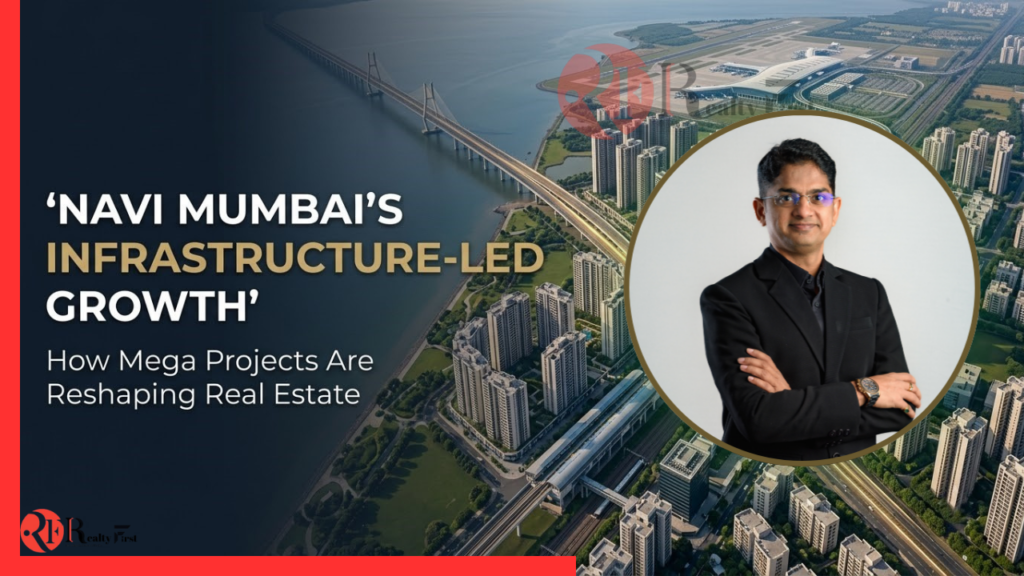
By Bhavesh Shah, JMD, Today Group
Navi Mumbai was conceived as a satellite city to ease the pressure on Mumbai. Over time, however, the planned urban centre has developed into a self-sustaining metropolis, supported by established business districts, modern infrastructure and a regulated real estate market. Its connectivity, both within the city and with surrounding regions, has also strengthened its position as an important growth centre.
The transformation has been closely linked to infrastructure. Large-scale transport and connectivity projects have opened up new development corridors, altered travel patterns and influenced the way homebuyers and investors assess locations across Navi Mumbai.
Also Read: Why Nerul Sets the Benchmark for Residential Demand
How Navi Mumbai transformed
Unlike cities where urban expansion often takes place in an unstructured manner, Navi Mumbai was developed around planned land use, wider roads, defined residential and commercial zones and substantial green spaces. This planning framework has provided a foundation for sustainable urban growth while supporting the development of large infrastructure projects.
The resulting infrastructure network has also contributed to Navi Mumbai’s emergence as an investment-friendly and liveable city. As connectivity has improved, previously peripheral locations have gained greater relevance within the city’s real estate landscape.
Multimodal connectivity paves the way for real estate growth
The relationship between infrastructure and real estate is particularly visible in Navi Mumbai. Improved connectivity has played an important role in the city’s growth, with land prices and real estate values appreciating each time a major infrastructure project has been commissioned.
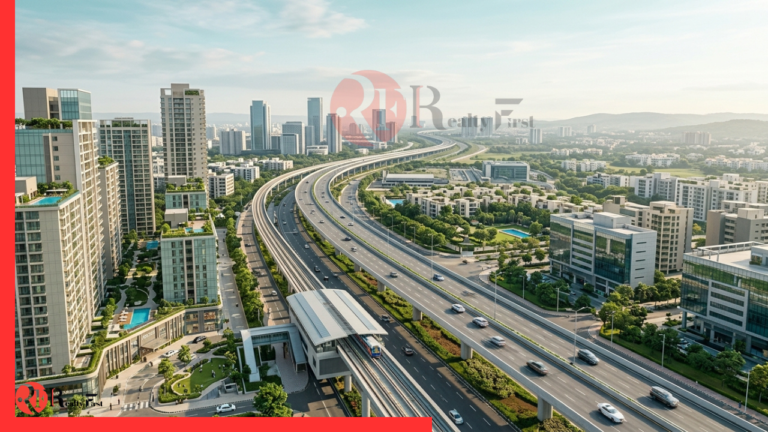
Projects including the Navi Mumbai International Airport (NMIA), Atal Setu, Navi Mumbai Metro Line 1, the suburban railway network and the Sion-Panvel Highway have expanded accessibility and helped open up new development corridors. Upcoming initiatives such as the Navi Mumbai Coastal Road, additional metro lines and water taxi services are expected to further strengthen this network.
The impact is not limited to the city itself. Regional infrastructure projects are expected to broaden Navi Mumbai’s economic influence. The 126-km Virar–Alibaug Multimodal Corridor, for instance, is expected to support the emergence of areas such as Pen, Uran and Khopta as major commercial, logistics and industrial hubs.
Another important project is the under-construction Panvel–Karjat Suburban Rail Corridor, which will improve connectivity between Navi Mumbai and Raigad. By easing pressure on existing road and rail networks, the corridor is expected to support urban expansion across Navi Mumbai and Mumbai 3.0.
Better infrastructure has already changed more than just commute times. It has contributed to greater commercial activity, employment generation and residential demand. This, in turn, has strengthened investor confidence and enabled homebuyers and developers to identify locations with longer-term growth potential.
As a result, commercial, residential and mixed-use development is extending into newer parts of Navi Mumbai rather than remaining concentrated in established locations.
How Atal Setu is influencing connectivity and buyer perception
Among the infrastructure projects that have had a significant impact on the Mumbai Metropolitan Region (MMR) is the 21.8-km Atal Setu, India’s longest sea bridge. The bridge connects Chirle in Navi Mumbai with Sewri in Mumbai and provides an alternative route towards South Mumbai, substantially improving connectivity.
Its influence extends beyond travel. The improved accessibility has changed the way homebuyers and investors view several locations that previously received relatively limited attention.
Ulwe, Dronagiri, Pushpak Nagar and Chirle are among the areas that have seen renewed interest as the long-term connectivity benefits of Atal Setu have become increasingly apparent.
The bridge has also strengthened Navi Mumbai’s position within the wider regional economic ecosystem, supporting the potential for greater logistics, warehousing and commercial activity across the region.
Navi Mumbai International Airport could drive a new growth wave
Globally, airports have often influenced the development of cities and their peripheral areas. Navi Mumbai International Airport is expected to play a similar role in shaping the city’s next phase of economic and real estate growth.
The NMIA is envisaged as more than a transport facility. Its development is expected to attract investment across premium residential projects, hospitality, including five-star and seven-star hotel properties, educational institutions, healthcare, retail and commercial infrastructure. Together, these sectors could contribute to the creation of a broader live-work-play ecosystem.
With phase 1 of Navi Mumbai International Airport operational and flights now operating to international destinations from here, the airport is emerging as a key component of a new economic corridor. Its presence is paving the way for activity across aviation, logistics, warehousing, hospitality, retail, manufacturing and corporate services.
The airport’s influence will be supported by other existing and planned infrastructure. These include the Mumbai Metro Gold Line, which will connect both airports, Targhar Railway Station and the proposed water taxi services that will soon be launched.
According to CIDCO, the NMIA will handle over 90 million passengers annually, positioning it among India’s largest airports. Over the next 10 years, the airport is expected to be one of the major catalysts behind Navi Mumbai’s evolution from a planned satellite city into a globally connected economic hub.
This infrastructure-led transformation is also influencing the real estate market. Businesses emerging around the airport are contributing to market appetite for residential, commercial and mixed-use developments. Panvel, Kharghar, Upper Kharghar, Ulwe and Pushpak Nagar are expected to be among the biggest beneficiaries of this infrastructure expansion.
Navi Mumbai’s high-growth micro-markets
Navi Mumbai’s planned development has resulted in a diverse set of micro-markets, each catering to different categories of buyers.
Vashi, Nerul and Seawoods have established themselves as premium residential destinations. Kharghar benefits from its strong educational ecosystem, while Ulwe has gained prominence because of its connectivity and proximity to South Mumbai.
Upper Kharghar has emerged as an affordable housing market, with metro connectivity adding to its accessibility. Panvel remains one of Navi Mumbai’s largest real estate nodes, supported by its strategic location connecting Mumbai, Pune and the Konkan Region.
Among the newer locations, Dronagiri and Pushpak Nagar have an early-mover advantage linked to the Navi Mumbai International Airport. Their proximity to the airport is gradually drawing greater interest from investors.
Also Read: Signature Global Awards INR 920 Crore Construction Contracts for Sarvam at DXP Estate`
Evolving homebuyer aspirations and Navi Mumbai’s future
The infrastructure-led development of Navi Mumbai has also supported the growth of its employment ecosystem. Business districts such as Belapur CBD, Vashi, Turbhe MIDC, Mahape and Airoli host IT parks, financial institutions, business parks, industrial clusters and manufacturing units. These employment centres generate direct and indirect job opportunities and, in turn, support demand for residential development in nearby locations.
The city’s economic evolution has also changed the profile and expectations of its homebuyers. Navi Mumbai was initially viewed primarily as a more affordable alternative to Mumbai. That positioning, however, has changed over time.
Affordability is no longer the sole factor influencing residential decisions. Access to healthcare and educational institutions, open green spaces, improved interconnectivity and a wider choice of housing configurations with modern lifestyle amenities have become increasingly important.
This has broadened Navi Mumbai’s homebuyer base to include young professionals, entrepreneurs, NRIs, investors and retirees, among others.
The city’s real estate story is therefore increasingly tied to the scale and quality of its infrastructure. As transport networks, employment centres and regional connectivity continue to expand, infrastructure is not merely supporting Navi Mumbai’s growth—it is helping redefine where the next phase of its residential, commercial and mixed-use development will take place.