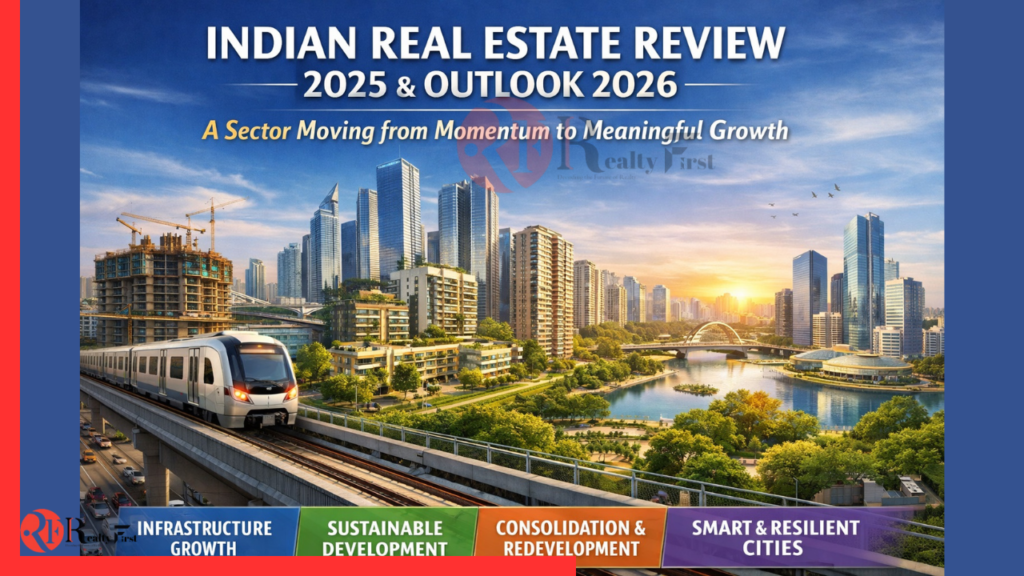
The Indian real estate sector concluded 2025 on a strong and confident note, backed by sustained end-user demand, regulatory maturity, and infrastructure-led transformation. The year marked a decisive shift toward consolidation, experience-driven development, and long-term value creation, setting a robust foundation for 2026.
Reflecting on the year gone by, Mr. Prashant Sharma, President, NAREDCO Maharashtra said, “The year 2025 has been a landmark period for India’s real estate sector, marked by significant policy reforms, robust demand across asset classes, and a renewed focus on sustainable urbanization. The sector has not only demonstrated resilience but has accelerated its transformation into a more transparent, tech-enabled, and consumer-centric industry.”
Infrastructure and Connectivity Redefine Urban Growth
Infrastructure emerged as the most powerful growth catalyst in 2025, fundamentally altering how value is created across cities—particularly in the Mumbai Metropolitan Region.
Mr. Vijay Choraria, Managing Director, Crest Ventures Limited, observed, “Connectivity is no longer an enabler; it is the primary driver of real estate value. Over the next five years, Mumbai will evolve into a multi-nodal metropolitan region, enabled by a once-in-a-generation infrastructure build-out that collapses distance and reshapes the hierarchy of urban value.” He further highlighted that emerging, well-connected nodes will increasingly outperform legacy pin codes as commuting friction reduces.
Echoing this shift, Mr. Kamlesh Thakur, Co-Founder & Managing Director, Srishti Group, noted, “The year 2025 marked a clear shift from connectivity to accessibility. Homebuyers are no longer evaluating locations solely on distance, but on ease of daily movement, time savings, and seamless access to workplaces, social infrastructure, and lifestyle hubs.”
Housing Demand Remains Resilient and End-User Driven
Residential real estate in 2025 continued to be led by end users, with steady traction across mid-income, premium, and luxury segments. Buyers showed a strong preference for branded developers, well-planned projects, and future-ready neighbourhoods.
Mr. Kaushal Agarwal, Chairman, The Guardians Real Estate Advisory, stated, “2025 reaffirmed that India’s real estate sector is no longer cyclical but structurally strong. Luxury and ultra-luxury housing witnessed record absorption, fuelled by HNIs and NRIs seeking stability and long-term value in Indian assets.”
Redevelopment emerged as one of the most defining themes of the year, particularly in land-constrained markets. Mr. Dhruman Shah, Promoter, Ariha Group said, “Redevelopment has undoubtedly been the standout story of 2025. With land scarcity intensifying, societies and tenants are increasingly choosing redevelopment as the most viable route to modern infrastructure and enhanced living standards.”
Design, Well-being and Intelligence Shape the New Narrative
Beyond volumes and infrastructure, 2025 marked a deeper structural shift in how real estate is designed, evaluated, and consumed.
Mr. Shilpin Tater, Managing Director, Superb Realty, explained, “Real estate is no longer just about constructing spaces. It is about shaping intelligent, human-centric ecosystems. Buyers and occupiers today are choosing fewer but better-designed spaces that deliver measurable everyday value.” He added that design, technology, and well-being are no longer optional differentiators but core performance drivers shaping long-term relevance.
New Segments Gain Momentum
Commercial real estate remained stable through 2025, supported by Grade-A offices, flexible workspaces, and GCC demand. Warehousing, plotted developments, and gated communities also saw rising traction.
Mr. Gaurav Varma, Director, ORA Group, said, “Plotted developments saw 25–30% year-on-year demand growth in 2025, as buyers increasingly preferred land ownership, flexibility, and long-term appreciation. This aspirational shift is expected to strengthen further in 2026.”
From an advisory and capital perspective, Mr. Nihar Jayesh Thakkar, Founder, The Mandate House Pvt. Ltd noted, “2025 marked a phase of stability and consolidation, with developers focusing on faster execution, reduced leverage, and stronger governance. The sector today is more transparent, financially disciplined, and aligned with long-term fundamentals.”
Outlook 2026: Structured Expansion, Smarter Cities, Sustainable Value
As the sector steps into 2026, industry leaders expect growth to be more measured, infrastructure-aligned, and quality-driven, with sustainability, redevelopment, and integrated planning taking centre stage.
Mr. Prashant Sharma, President, NAREDCO Maharashtra said, “As we enter 2026, expectations remain high for continued growth, innovation, and collaboration between industry, government, and stakeholders. Policy support, infrastructure momentum, and sustainability will be key enablers of the next phase of real estate growth.”
Reinforcing the central role of connectivity, Mr. Vijay Choraria, Managing Director, Crest Ventures Limited stated, “Over the next five years, Mumbai will no longer be viewed as a compact island city but as a multi-nodal metropolitan region spanning Panvel, Virar, and Alibaug. Connectivity will dictate demand more decisively than legacy pin codes.”
From a development lens, Mr. Kamlesh Thakur, Co-Founder & Managing Director, Srishti Group added, “With multiple infrastructure projects nearing completion, several underserved corridors are expected to transform into prominent residential and mixed-use destinations. Developers will increasingly focus on creating landmark projects aligned with evolving mobility patterns and urban aspirations.”
Highlighting the growing importance of design intelligence and long-term relevance, Mr. Shilpin Tater, Managing Director, Superb Realty said, “As we step into 2026, integrated, mixed-use developments aligned with walkability and proximity will gain prominence. Buildings designed around people, intelligence, and balance will remain relevant for decades.”
On emerging investment themes, Mr. Kaushal Agarwal, Chairman, The Guardians Real Estate Advisory noted, “Plotted land investments are expected to gain renewed relevance as improved road, rail, and metro connectivity opens up new growth corridors. Long-term land ownership will increasingly be seen as a strategic asset.”
Sharing a broader market outlook, Mr. Gaurav Varma, Director, ORA Group said, “As we enter 2026, the outlook remains distinctly optimistic. With policy stability, rising consumer confidence, and expansion into new micro-markets, Indian real estate is positioned for sustainable, scalable, and smart growth.”
Summing up the sector’s forward momentum, Ms. Shraddha Kedia-Agarwal, Director, Transcon Developers said, “Infrastructure will continue to be the backbone of real estate growth in 2026, while sustainability, integrated living, and responsible development will shape the next phase of urban evolution.”
As India steps into 2026, the real estate sector stands poised to move from momentum to maturity—building cities that are connected, resilient, and fundamentally people-centric.