Picture this. You order a product online at 11 pm on a Tuesday, and it lands at your door by Thursday morning. That seamless experience, which most of us now take for granted, is made possible by a massive, largely invisible network of warehouses, distribution hubs, and logistics parks spread across the country. Behind every fast delivery, every efficiently stocked pharmacy shelf, and every just-in-time component arriving at a factory floor, there is a sophisticated piece of real estate working hard to make it happen. The warehousing and logistics realty boom that India is currently experiencing is not just a trend in the property market. It is a fundamental shift in the way the economy stores, moves, and manages goods at scale.
In 2026, industrial real estate and logistics parks have firmly established themselves as one of the hottest asset classes in the entire real estate sector. Institutional investors, both domestic and global, are pouring capital into warehousing infrastructure at a pace that would have been unimaginable a decade ago. E-commerce giants, third-party logistics companies, FMCG majors, pharmaceutical firms, and auto component manufacturers are all scrambling for quality warehouse space in strategic locations. The demand is real, the numbers are compelling, and the long-term fundamentals look stronger than ever. In this article, we are going to explore exactly what is driving the warehousing and logistics realty boom in India, which cities and regions are leading the charge, what investors need to know, and where this market is headed over the next few years.
Why the Warehousing and Logistics Realty Boom Is Happening Right Now
To understand the warehousing and logistics realty boom that is reshaping India’s industrial real estate landscape, you need to look at three converging forces that have fundamentally altered supply chain thinking across every major industry. The first is the explosive growth of e-commerce and quick commerce. The second is India’s post-GST supply chain reorganisation. And the third is the massive push in manufacturing driven by the Production Linked Incentive schemes and global supply chain diversification away from China. Each of these forces, individually, would be enough to stimulate significant demand for logistics real estate. Together, they have created a tidal wave of demand that the market is still catching up with.
The transformation that GST brought to India’s logistics sector is perhaps the most underappreciated driver of the warehousing boom. Before the Goods and Services Tax was implemented in 2017, companies maintained warehouses in virtually every state to avoid paying interstate taxes, resulting in a fragmented, inefficient network of small, poorly designed storage facilities. GST changed that overnight by creating a single national market. Companies suddenly had the freedom to consolidate their warehousing operations into fewer, larger, strategically located facilities. This triggered a wave of grade-A warehouse construction that is still rolling forward in 2026, as companies continue to optimise their supply chains around efficiency and reach rather than tax avoidance.
E-Commerce and Quick Commerce: The Demand Engine
The growth of e-commerce in India has been nothing short of extraordinary, and it shows no signs of slowing down in 2026. Online retail now accounts for a significant and growing share of total consumer spending, and the expectations of online shoppers have shifted dramatically. Same-day and next-day delivery is no longer a luxury offered only by premium services. It is rapidly becoming the baseline expectation across categories from groceries and personal care to electronics and fashion. Meeting these delivery timelines requires a fundamentally different kind of warehousing infrastructure than what the market offered even five years ago. Companies need facilities that are closer to population centres, equipped with advanced sorting and automation technology, and large enough to hold diverse inventory without sacrificing operational efficiency.
Quick commerce, which involves delivering groceries and essentials in 10 to 30 minutes, has taken this pressure to an entirely new level. Companies operating in this space require dense networks of dark stores and micro-fulfilment centres positioned within urban areas, often within a few kilometres of residential neighbourhoods. This has created a completely new segment of logistics real estate demand in tier 1 and tier 2 cities, as quick commerce players compete aggressively for the best-located urban warehousing space. The intersection of rapid consumer expectation growth and urbanisation is creating a structural, long-term demand for logistics real estate that is independent of short-term economic cycles.
Manufacturing Boom and the PLI Scheme Effect
India’s Production Linked Incentive schemes, which cover sectors ranging from electronics and semiconductors to pharmaceuticals, food processing, and auto components, have triggered a meaningful wave of new manufacturing investment. As factories come online and production scales up, the need for proximate warehousing and logistics infrastructure grows proportionally. A smartphone assembly plant in Tamil Nadu, for instance, needs secure, climate-controlled storage for components arriving from across the world, and efficient outbound logistics for finished products going to distributors across India and for export. Every new factory that opens under the PLI umbrella effectively generates a demand footprint for industrial real estate that extends well beyond the factory walls themselves.
Global supply chain diversification is adding another layer to this manufacturing-driven demand. As multinational companies reduce their dependence on China for manufacturing and seek alternative production bases in Asia, India has emerged as a top destination. Companies from electronics, apparel, chemicals, and engineering sectors are setting up facilities in India, and each new entrant brings its own requirement for warehousing, cold storage, bonded logistics zones, and customs-integrated facilities. This is particularly evident in the Chennai-Bengaluru industrial corridor, the Pune-Mumbai belt, and the emerging industrial clusters of Rajasthan and Gujarat, where the combination of PLI-driven domestic investment and FDI is creating a sustained, multi-year wave of logistics real estate demand.
The Rise of Grade-A Warehousing and What It Means for the Market
One of the defining characteristics of the current warehousing and logistics realty boom is the dramatic shift toward grade-A facilities. A decade ago, the majority of India’s warehousing stock consisted of what industry professionals politely call grade-B or grade-C facilities, which is a euphemism for old, poorly constructed buildings with inadequate floor loading capacity, insufficient clear height, poor truck docking infrastructure, and limited safety and fire suppression systems. These facilities were cheap to lease but costly to operate, resulting in inefficiency, product damage, and safety risks that most modern supply chain operators cannot afford to accept. The warehousing boom has changed this equation dramatically.
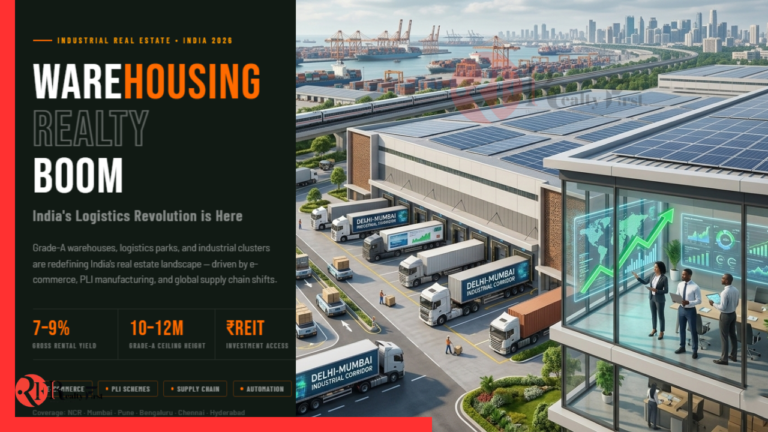
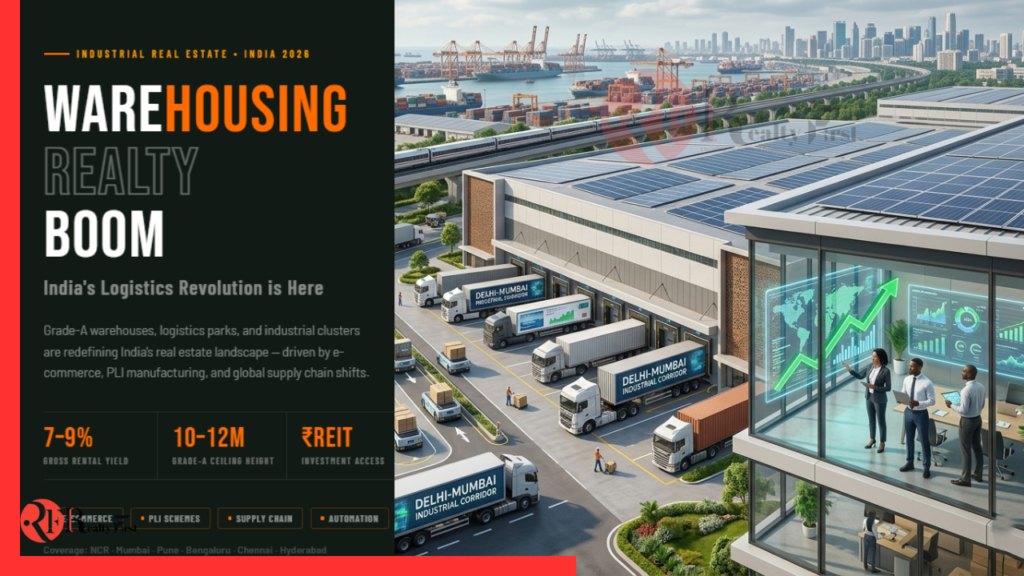
Grade-A warehouses in India today are built to international specifications. They typically feature clear heights of 10 to 12 metres or more, advanced fire suppression systems, solar-powered rooftops, LED lighting, automated material handling systems, and docking bays designed for modern trailer trucks. They are often located within well-planned logistics parks that offer security, power backup, and other shared infrastructure. The tenants of these facilities, which include the likes of Amazon, Flipkart, DHL, Mahindra Logistics, and major FMCG and pharmaceutical companies, are willing to pay a meaningful premium over grade-B alternatives because the operational efficiency gains easily justify the additional rent. This tenant quality has, in turn, attracted institutional investors and real estate investment trusts who see grade-A logistics assets as stable, long-duration income-generating investments.
Key Developers and Institutional Investors Shaping the Market
The warehousing and logistics realty boom has attracted a new class of specialised developers and investors who have transformed the market’s professionalism and scale. Companies like Welspun One, Indospace, ESR India, Embassy Industrial Parks, and Logos India are building large-scale, integrated logistics parks across India’s major industrial and consumption corridors. These developers bring institutional-quality construction standards, long-term tenant relationships, and sophisticated asset management capabilities that were largely absent from India’s industrial real estate market a decade ago. Their entry has raised the bar for the entire sector, pushing even smaller and regional developers to upgrade their product quality or risk being left behind.
On the investor side, major global pension funds, sovereign wealth funds, and private equity firms have identified Indian logistics real estate as a compelling long-term opportunity. Firms like Blackstone, GIC of Singapore, CPPIB, and others have made substantial commitments to the sector either through direct investments in developer platforms or through portfolio acquisitions of completed assets. The listing of Nexus Select Trust and discussions around logistics-focused real estate investment trusts in India have also opened up this asset class to retail investors who previously had no way to participate in the institutional-grade logistics real estate market. This democratisation of access, combined with the strong underlying fundamentals, has made warehousing and logistics realty one of the most talked-about investment themes in India’s property sector.
City-by-City Snapshot of India’s Logistics Real Estate Hotspots
India’s warehousing and logistics realty boom is not evenly distributed across the country. It is concentrated in a handful of strategic clusters where the combination of industrial activity, consumption demand, transportation infrastructure, and land availability makes logistics real estate development most viable. Understanding these clusters is essential for investors, developers, and corporate occupiers who want to position themselves effectively in this market.
National Capital Region and the Delhi-Mumbai Industrial Corridor
The National Capital Region remains one of the largest and most active warehousing markets in India. Locations like Kundli-Manesar-Palwal, Bhiwandi on the outskirts of the NCR influence zone, and the emerging clusters along the Delhi-Mumbai Industrial Corridor are seeing consistent absorption of grade-A warehouse space. The sheer size of the Delhi NCR consumption market, which covers over 30 million urban consumers, combined with the region’s role as a distribution hub for northern and western India, makes it an essential anchor for any national supply chain network. Infrastructure upgrades including the completion of key expressway sections, new rail freight corridors, and expansion of logistics hubs at Dadri and Greater Noida are further enhancing the region’s attractiveness.
Mumbai, Pune, and the Western Maharashtra Belt
The Mumbai Metropolitan Region and its extended logistics catchment area, which stretches from Bhiwandi and Panvel to Pune and Nashik, represents one of the most mature and active logistics real estate markets in Asia. Bhiwandi, often called India’s warehousing capital, hosts an enormous concentration of logistics facilities serving the greater Mumbai consumption market and the port-linked import-export trade. The development of the Jawaharlal Nehru Port Trust and the upcoming Navi Mumbai International Airport are expected to further boost demand for logistics infrastructure in this belt. Pune, with its strong automotive and electronics manufacturing base, continues to generate significant demand for specialised industrial and warehouse space in corridors like Ranjangaon, Chakan, and Talegaon.
Bengaluru, Chennai, and the South India Logistics Surge
South India has emerged as one of the most dynamic regions for logistics real estate development in 2026. Bengaluru’s position as India’s technology capital translates into enormous demand for e-commerce and quick commerce fulfilment infrastructure, with the city’s outer ring road and northern industrial corridors seeing particularly high levels of warehousing absorption. Chennai’s dual role as a manufacturing hub, particularly for automotive and electronics sectors, and as one of India’s most important port cities, makes it a critical logistics node. The city’s Oragadam-Sriperumbudur corridor has become one of the country’s fastest-growing industrial and warehousing clusters, attracting major investments from global and domestic companies alike.
The Investment Case for Warehousing and Logistics Realty in 2026
For investors evaluating the warehousing and logistics realty boom as an asset class, the fundamental investment case rests on three pillars. The first is a structurally growing demand base that is not dependent on any single sector or economic cycle. The second is a significant and persistent supply shortage of institutional-quality warehousing space relative to India’s size and stage of economic development. The third is a strong and improving yield profile, with grade-A logistics assets in India typically delivering gross rental yields of 7 to 9 percent, which compares very favourably with residential yields of 3 to 5 percent and office yields of 5 to 7 percent in most cities.
The risk profile of logistics real estate investments is also relatively attractive for long-term investors. Modern grade-A warehousing facilities tend to attract creditworthy, large corporate tenants who sign long leases, typically three to five years or more, with built-in rent escalation clauses. Tenant stickiness is high in this asset class because moving a fully operational warehouse involves significant disruption cost for the tenant, which means they tend to renew rather than relocate unless given a compelling reason to do so. The combination of long lease duration, creditworthy tenants, and predictable rent escalation creates a cash flow profile that closely resembles a high-yield bond with the added benefit of real asset backing and appreciation potential.
However, investors should also be aware of the risks. The warehousing market is not immune to oversupply risks, particularly in micro-markets where development has been rapid. Location quality is paramount, and logistics assets in peripheral locations with poor road connectivity or limited power infrastructure can face vacancy challenges. Due diligence on the quality of construction, the strength of the tenant covenant, and the specific supply-demand dynamics of the micro-market is just as important in logistics real estate as in any other property sector. Working with specialised advisors who understand the operational realities of logistics businesses is essential for making sound investment decisions in this space.
Where Is India’s Warehousing and Logistics Realty Boom Headed?
Looking ahead, the medium-term outlook for India’s warehousing and logistics realty sector remains exceptionally positive. Several powerful tailwinds will sustain demand growth well beyond 2026. The continued expansion of e-commerce penetration into tier-2 and tier-3 cities will require a parallel expansion of logistics infrastructure into smaller urban centres, creating a new wave of demand in markets that have so far seen limited institutional-grade development. This decentralisation of logistics infrastructure is already beginning to happen, with developers and occupiers increasingly targeting cities like Lucknow, Jaipur, Coimbatore, Bhubaneswar, and Kochi for their next round of warehousing investments.
Technology will play an increasingly important role in defining the next generation of logistics real estate. Automated warehouses equipped with robotic picking systems, autonomous guided vehicles, and AI-driven inventory management are moving from pilot projects to mainstream adoption as the technology matures and becomes more cost-effective. This technology shift has important implications for real estate because automated warehouses typically require higher ceiling heights, stronger floor loading capacities, and more sophisticated electrical and data infrastructure than conventional facilities. Developers who design and build with these requirements in mind today will be better positioned to attract premium tenants and command superior rents as the automation wave accelerates.
Finally, sustainability is becoming a non-negotiable dimension of logistics real estate development. Large corporate occupiers in sectors like e-commerce, FMCG, and pharmaceuticals are increasingly committed to carbon neutrality targets that extend throughout their supply chains. They are actively seeking warehousing partners whose facilities meet green building standards, use renewable energy, and can provide carbon accounting data for ESG reporting purposes. Developers who invest in solar installations, energy-efficient design, water recycling systems, and green certification for their facilities are already seeing this reflected in faster leasing cycles and stronger tenant retention. The warehousing and logistics realty boom of 2026 is not just about building more space. It is about building better, smarter, and greener space for the next generation of supply chains.
Also Read: Infrastructure Push and Realty Growth Reshaping India’s Property Landscape
Conclusion: The Warehousing and Logistics Realty Boom Is Just Getting Started
The warehousing and logistics realty boom that India is experiencing in 2026 is not a temporary spike. It is the beginning of a multi-decade transformation of how the country stores and moves goods. The structural drivers, which include e-commerce growth, manufacturing expansion, infrastructure investment, and supply chain modernisation, are durable and self-reinforcing. As India’s economy grows, its logistics infrastructure will need to grow with it, and the real estate that underpins that infrastructure will remain a compelling opportunity for developers, investors, and occupiers for years to come.
For investors, the message is clear. Industrial and logistics real estate is no longer a niche or secondary asset class in India. It has matured into a mainstream investment category with strong fundamentals, institutional-quality assets, and an expanding universe of investment vehicles from direct development to REITs. For businesses operating supply chains in India, the message is equally clear. The era of tolerating substandard warehousing infrastructure is over. Grade-A facilities that deliver operational efficiency, safety, sustainability, and technology readiness are now a competitive necessity, not a luxury.
If you are looking to understand, invest in, or benefit from India’s warehousing and logistics realty boom, now is the time to act. The best locations are filling up, the best assets are being claimed by well-capitalised players, and the window for early-mover advantage in emerging logistics clusters is narrowing with every passing quarter. Do your research, engage with the right advisors, and position yourself on the right side of one of the most significant real estate stories in India’s economic history.