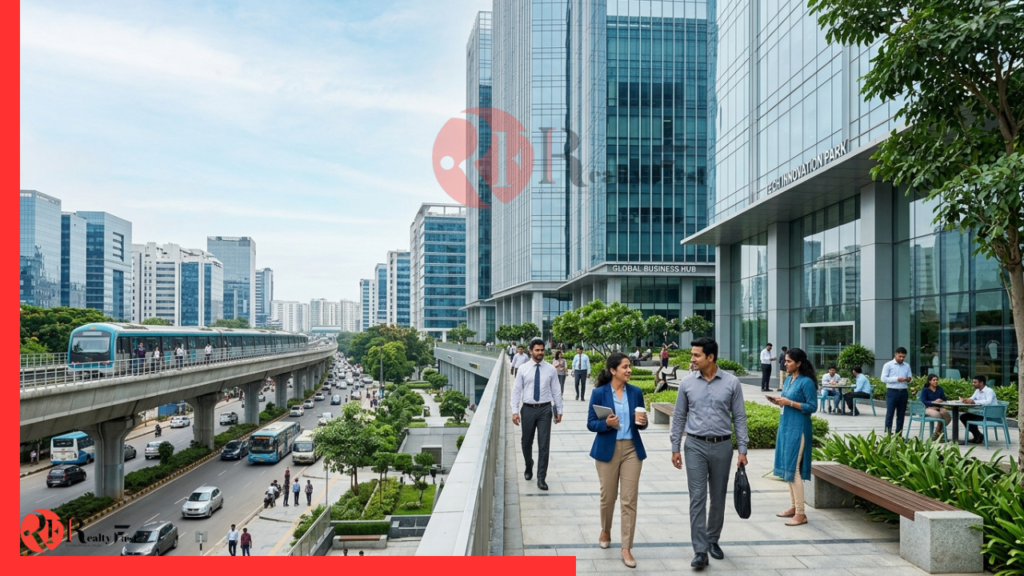
India’s office market is increasingly being influenced by the rapid expansion of Global Capability Centres (GCCs), with multinational companies driving a growing share of commercial leasing activity across key urban markets including NCR, Bengaluru, Hyderabad and Pune.
Industry experts noted that GCC occupiers are reshaping workplace demand, influencing office design preferences and, in several emerging business corridors, contributing to residential absorption as well.
Also Read: How Infrastructure Upgrades Are Driving Commercial Real Estate in Andheri
According to data compiled by Bengaluru-based consultancy Wizmatic, multinational IT, ITeS and ER&D operations in India added nearly 1.7 million jobs since FY20, taking total employment to approximately 4.2 million. The consultancy estimated exports from these centres reached nearly $153 billion in FY25 and could rise further to around $164 billion in FY26.
A recent CBRE India market assessment observed that GCC occupiers continued to account for a significant share of Grade-A office leasing activity across India’s leading cities during 2025, with increasing demand visible in NCR and several emerging peripheral business districts.
Industry stakeholders believe this trend is also expanding interest towards newer urban centres supported by improving infrastructure and connectivity.
Uddhav Poddar, CMD, Bhumika Group, said, “The GCC-led expansion across NCR is gradually bringing newer cities like Faridabad into sharper focus. With infrastructure upgrades such as the Delhi-Mumbai Expressway, FNG corridor and metro connectivity improving accessibility, Faridabad is emerging as a strong prospective destination for MNCs, IT/ITeS firms and organised businesses looking beyond saturated office markets for better value and long-term scalability. While the city currently houses smaller divisions and backend operations of several established companies alongside traditional businesses, the evolving infrastructure and improving urban ecosystem are steadily strengthening its appeal as a future-ready corporate and commercial hub. This shift is already visible in the growing demand for organised commercial developments and premium residential projects.”
According to industry experts, occupiers within GCC ecosystems are increasingly preferring integrated business environments that combine office, retail and residential infrastructure within organised urban regions.
Sanchit Bhutani, Managing Director, Group 108, said, “At the commercial level, the impact is becoming increasingly visible in long-term office space demand. Companies operating within GCC ecosystems are showing stronger preference for organised regions where office, retail and residential infrastructure function together. This shift reflects a stronger focus on long-term operational planning, employee convenience, and ecosystem-driven growth. As a result, established business corridors with organised urban infrastructure are witnessing heightened demand and stronger occupier confidence.”
Industry experts further noted that the current GCC expansion cycle differs from earlier outsourcing-driven growth phases due to the increasing complexity of operations being handled within India.
Kapil Chugh, VP Sales, Rise Infraventures Limited, said, “There is clearly a structural shift underway in how multinational firms are using India. Earlier expansion cycles were largely execution-oriented and heavily cost-driven. Today many GCCs are handling product ownership, analytics, compliance and strategic technology functions. Once operations move up the value chain, the occupier’s commitment to physical infrastructure also becomes deeper. Developers are therefore planning more flexible and amenity-rich office environments because tenant expectations are evolving rapidly.”
Knight Frank India, in a recent office market update, observed that occupier demand from multinational firms is increasingly spreading towards newer business districts supported by improved infrastructure and connectivity over the last five years.
Mohit Batra, Regional Director, Realistic Realtors, said, “What developers are witnessing now is not merely another leasing cycle. GCC expansion is gradually influencing how urban business districts are being designed and monetised. Occupiers are seeking continuity, ecosystem depth and future scalability rather than isolated office assets. That has implications not only for commercial development but also for residential planning, retail integration and city-level infrastructure priorities.”
Also Read: Road Connectivity & Property Appreciation: How Infrastructure Drives Real Estate Growth
Industry observers believe the current office demand cycle appears more durable because it is increasingly linked to long-duration operational commitments rather than short-term outsourcing contracts.
While technological advancements such as artificial intelligence may eventually influence workforce structures, industry stakeholders noted that the physical footprint of India’s GCC ecosystem continues to expand across multiple urban markets.