By Gagan Mehta, Director, AGM Vijaylaxmi Group
Mumbai’s real estate market is witnessing a structural shift as infrastructure and mobility networks increasingly influence commercial and residential demand. Accessibility and liveability have historically shaped urban growth across the city, but expanding metro connectivity is now redefining traditional business and investment patterns.
Goregaon East has emerged as one of the key beneficiaries of this transformation. Improved connectivity through multiple transit systems is repositioning the micro-market into an important commercial and residential destination within Mumbai’s suburban landscape.
Also Read: GREMI Receives AICTE Approval, Becomes India’s First Standalone Real Estate Business School
Metro Connectivity Strengthening Goregaon East
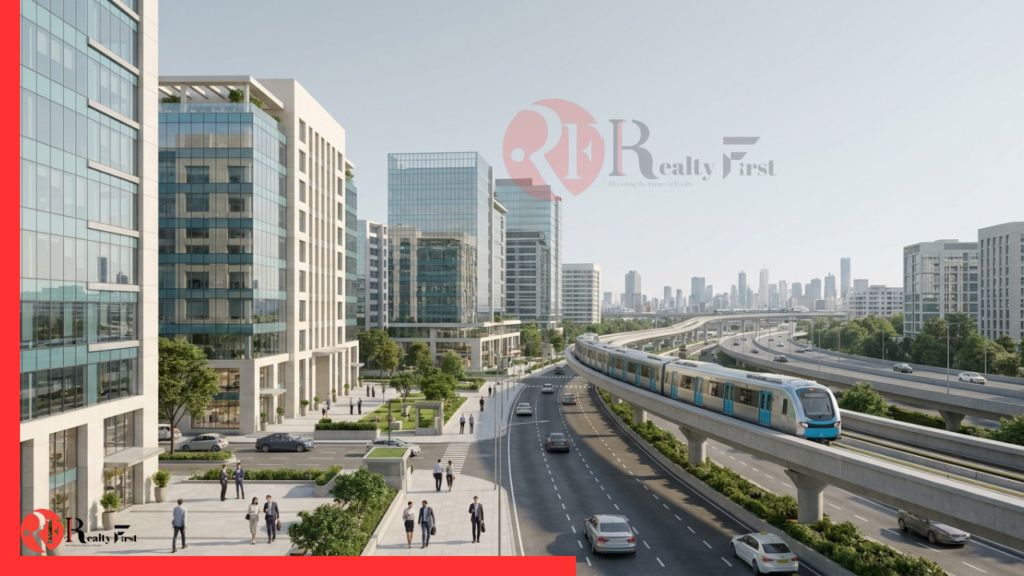
The operational Metro Line 7 has integrated Goregaon East into Mumbai’s expanding rapid transit network. Its proximity to Metro Line 2A and the upcoming Metro Line 6 is expected to further improve accessibility and reduce travel times across major business districts.
This convergence of transport infrastructure has strengthened Goregaon East’s position as a transit-oriented micro-market supported by connectivity, relatively lower-density surroundings, and proximity to green-adjacent zones.
The impact of connectivity extends beyond commuting convenience. Infrastructure upgrades are influencing land values, reshaping housing demand, and accelerating real estate activity in the area. Reduced travel durations and improved access to employment hubs are also contributing to higher housing absorption and faster inventory movement.
Travel Time Emerging As A Key Factor
Businesses and homebuyers are increasingly evaluating locations based on travel efficiency rather than physical distance. Goregaon East benefits from connectivity through the Western Express Highway, suburban rail access, and metro corridors.
Under favourable traffic conditions, commuters can reach Bandra-Kurla Complex in under 20 minutes, while South Mumbai remains accessible in nearly 40 minutes through the Sea Link and Coastal Road network. Improved transport infrastructure has made daily commuting more practical for working professionals and businesses operating across Mumbai.
Office Leasing Activity Reflects Market Confidence
Recent media reports citing Propstack data indicate that Goregaon East has witnessed significant suburban office leasing activity. One large occupier leased more than 73,000 square feet of Grade A office space with a total commitment exceeding Rs 144 crore over a five-year tenure.
The agreement reportedly includes a full-term lock-in period, a security deposit exceeding Rs 20 crore, and a starting monthly rental in the range of Rs 2.25 crore to Rs 2.30 crore during the initial years, with escalation clauses applicable thereafter.
The transaction reflects growing confidence in the long-term commercial viability of Goregaon East as an emerging suburban business hub.
Infrastructure Projects Supporting Commercial Growth
The locality’s access to both western and central suburban talent pools is improving workforce mobility and broadening employment catchment areas. Enhanced connectivity is also supporting the growth of Grade A office developments, managed workspaces, and mixed-use commercial projects.
Upcoming infrastructure initiatives, including the Coastal Road project and the Goregaon-Mulund Link Road with twin tunnels, are expected to strengthen long-term demand and improve commercial asset valuations within the micro-market.
Investors Focus On Long-Term Value
Investment decisions in commercial real estate are increasingly being driven by future growth potential and infrastructure readiness. Goregaon East is attracting investors focused on long-term capital preservation and steady asset appreciation.
Office and retail assets are being evaluated not only for immediate rental yields but also for sustained leasing demand and future market value. Improved metro connectivity and large-scale infrastructure development are expected to support long-term commercial growth in the area.
Transit-Oriented Development Changing Urban Planning
Unlike earlier phases of suburban expansion associated with unplanned vertical growth, Goregaon East is increasingly being viewed as a transit-oriented development node.
Demand for proximity and connectivity is encouraging planned density, mixed-use projects, and community-focused urban planning. Developers are incorporating open spaces and self-sustained neighbourhood designs aimed at reducing dependence on long-distance commuting.
Connectivity And Liveability Driving Demand
Real estate trends indicate that buyers and occupiers are increasingly prioritising locations offering a balance between connectivity and quality of life. Goregaon East benefits from proximity to green belts while maintaining access to major commercial districts without the density pressures commonly associated with central Mumbai.
The micro-market is gradually evolving into a decentralised commercial hub that aligns with Mumbai’s broader shift toward distributed business districts and reduced dependence on traditional central business zones.
Also Read: Urban Mobility and Quality of Life: The Gurugram Metro Story
Outlook For Goregaon East
Goregaon East is no longer being viewed as a peripheral extension of Mumbai’s real estate market. The area is steadily developing into a transport-led and infrastructure-backed commercial destination with improving urban amenities.
As metro connectivity and large-scale infrastructure projects continue to expand, Goregaon East is expected to play an increasingly important role in Mumbai’s commercial real estate growth and business location strategy.