
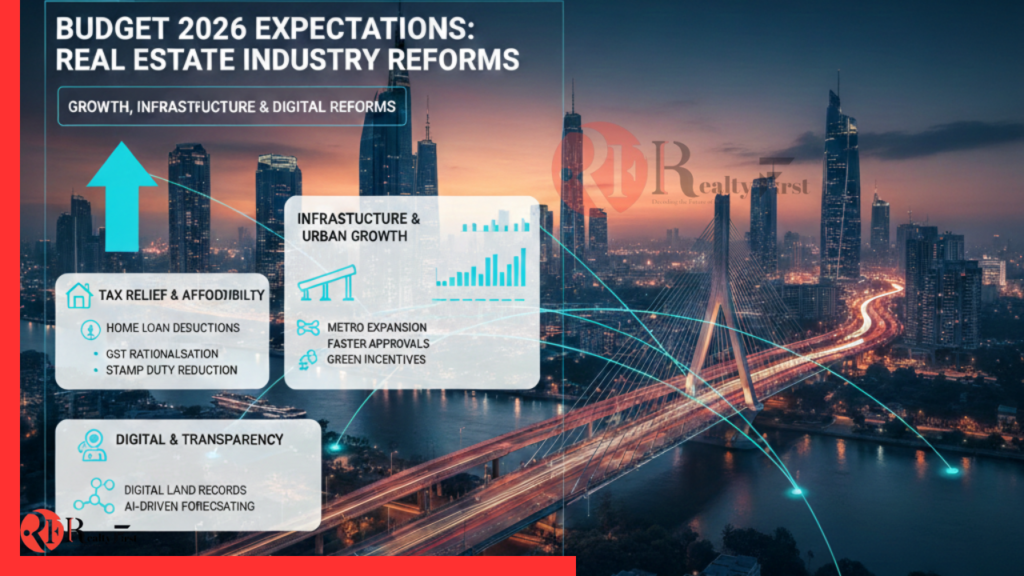
As expectations build ahead of the Union Budget 2026, India’s real estate sector is urging the government to introduce targeted policy interventions to sustain housing demand, enhance affordability, and accelerate infrastructure-led urban growth. Industry leaders believe that with fiscal support, regulatory clarity, and sustained investments in connectivity and digital systems, the sector can further strengthen its contribution to economic growth, employment generation, and large-scale urban transformation.
A key expectation across developers and industry bodies is the need to reinforce end-user confidence through enhanced tax incentives. These include higher deductions on home loan interest and principal repayments, rationalisation of GST on construction materials, and restoration of input tax credit to ease rising cost pressures.
Prashant Sharma, President, NAREDCO Maharashtra, said the sector remains a critical driver of economic momentum and employment. He noted that granting infrastructure or industry status to housing—especially affordable and mid-income segments—would improve access to institutional finance and reduce borrowing costs, thereby supporting faster execution and affordability.
Industry stakeholders have also highlighted the importance of policy continuity and long-term funding support to sustain buyer sentiment across housing segments. Kaushal Agarwal, Chairman, The Guardians Real Estate Advisory, said calibrated tax relief for homebuyers, along with a relook at stamp duty and registration charges, could meaningfully lower the cost of ownership and encourage first-time buyers.
Echoing similar views, Shraddha Kedia-Agarwal, Director, Transcon Developers, emphasised that easier access to long-term, low-cost funding and faster approvals are essential to sustaining demand across residential, luxury, and mixed-use developments. She added that clarity in taxation and incentives for sustainable development would further strengthen developer and buyer confidence.
Urban infrastructure and redevelopment have emerged as another central pillar of pre-Budget expectations. Industry leaders believe faster execution of metro corridors, arterial road networks, and redevelopment-led housing projects is critical to unlocking new micro-markets and improving city livability.
Kamlesh Thakur, Co-Founder & Managing Director, Srishti Group, said accelerating key infrastructure projects and streamlining regulatory approvals would significantly enhance accessibility and support long-term urban growth. He added that rationalisation of GST on construction materials and incentives for green development would improve project viability and supply efficiency.
From a premium and redevelopment-led housing perspective, Dhruman Shah, Promoter, Ariha Group, noted that luxury housing and urban redevelopment projects continue to witness strong end-user interest. He said faster clearances, single-window approvals, and infrastructure-led connectivity improvements are crucial to delivering globally benchmarked residential assets in dense urban markets.
Sharing a broader premium-market outlook, Rohit Santosh, CEO, Bombay Realty, highlighted the need to address structural constraints such as the ₹10 crore cap on capital gains reinvestment. He also called for enhanced home loan interest deductions and industry status for real estate, alongside sustained investments in transformative infrastructure projects like the Coastal Road and Atal Setu to support India’s evolving premium housing landscape.
Adding a future-focused dimension to the pre-Budget discourse, Sriram Chitlur, CEO, TalkingLands, pointed to data fragmentation as one of the sector’s biggest bottlenecks. He advocated treating land as Digital Public Infrastructure (DPI), supported by open data initiatives, digital land records, and tokenisation. According to him, such reforms would enable AI-driven forecasting, faster transactions, reduced litigation, and greater transparency across the real estate value chain.
Overall, industry stakeholders expect Union Budget 2026 to deliver a balanced framework combining tax relief, infrastructure-led development, sustainability, and digital transformation. Developers believe that a stable and reform-oriented policy environment will not only support housing demand across segments but also reinforce real estate’s position as a long-term pillar of India’s economic and urban development.