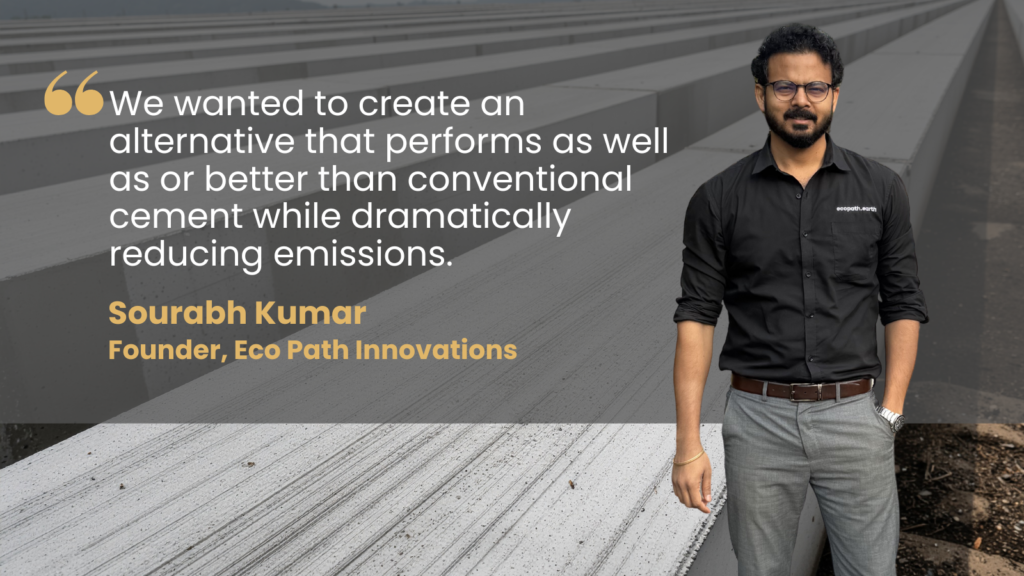
In this conversation with Realty First Magazine, Sourabh Kumar shares his entrepreneurial journey, explains the science behind Eco Path’s innovations, and discusses how manufacturing-led infrastructure can help India build faster, smarter, and more sustainably.
As India accelerates urban development, the pressure on the construction and infrastructure sector to reduce carbon emissions and conserve water has never been greater. Traditional concrete and cement-based construction remain among the world’s largest contributors to greenhouse gas emissions, while also consuming significant quantities of fresh water during the curing process.
Sourabh Kumar, Founder of Eco Path Innovations, is working to address these challenges through cement-free construction materials and low-carbon precast infrastructure solutions. By repurposing industrial by-products into high-performance binders, the company is developing roads, footpaths, drainage systems, and external infrastructure with significantly lower environmental impact.
Also Read: IndiFrame secures Midtown residential project in Nalasopara West
Turning Industrial Waste into Sustainable Infrastructure
Sourabh Kumar’s journey into sustainable construction began during his earlier entrepreneurial ventures, where he worked extensively with recycled materials and waste streams. Through interactions with developers and infrastructure stakeholders, he identified a recurring challenge.
“Everyone wanted to adopt sustainable materials, but they needed solutions that were both cost-effective and available at scale,” he explains.
This insight led to the creation of Eco Path Innovations, with a specific focus on external infrastructure such as roads, footpaths, drainage systems, boundary walls, and precast products, areas where concrete consumption is substantial and where lower-carbon alternatives can create immediate impact.
At the core of Eco Path’s innovation is a proprietary binder technology that replaces traditional cement with industrial by-products such as fly ash and ground granulated blast furnace slag (GGBS).
“Cement has been the world’s most widely used binder, but its production is highly energy-intensive and carbon-heavy,” says Kumar. “We wanted to create an alternative that performs as well as or better than conventional cement while dramatically reducing emissions.”
The result is a geopolymer-based concrete that delivers several performance advantages:
- Up to 80% lower carbon footprint
- Higher density and lower permeability
- Better resistance to acidic environments
- Enhanced durability in sewer and drainage applications
- Superior fire resistance, with structural integrity retained up to approximately 900°C
By comparison, conventional concrete can begin to degrade at much lower temperatures.
Eliminating Water Curing
One of the most significant advantages of Eco Path’s technology is that its precast products require no curing water.
Traditional concrete needs to be watered daily for up to 28 days to achieve optimal strength. Eco Path’s materials, however, cure through internal chemical reactions without any additional water after manufacturing.
“All our products, including pavers, kerbs, slabs, and drainage components, require zero curing water,” Kumar says. “For water-stressed regions, this can be transformative.”
The innovation offers meaningful benefits not only in arid regions but also across urban projects where fresh water conservation is becoming increasingly important.
Industry Adoption and Market Validation
Eco Path Innovations has already partnered with major developers, including Lodha Group, and has executed more than 20 projects in Pune using its sustainable materials.
According to Kumar, the response from the market has been overwhelmingly positive.
“The demand is growing rapidly. Developers are looking for sustainable solutions that don’t compromise on cost or scalability, and that’s exactly where we fit.”
The company is currently expanding into Mumbai and other high-growth markets, with strong interest emerging from across India.
Why Precast Construction is the Future
Kumar believes that India’s construction industry is moving toward a manufacturing-led model, driven by labour shortages, rising costs, and the need for higher precision.
“There is a severe shortage of skilled manpower, and this challenge will only intensify,” he says. “Precast manufacturing allows infrastructure to be produced in controlled environments, ensuring consistency, quality, and faster execution.”
Key advantages of precast infrastructure include:
- Reduced dependency on on-site labour
- Better dimensional accuracy
- Improved quality control
- Faster project completion
- Lower material wastage
In Kumar’s view, conventional cast-in-situ construction will gradually give way to factory-produced infrastructure systems.
Policy Support and Government Incentives
While private developers are increasingly embracing sustainable construction, Kumar believes broader adoption will require stronger policy support.
He suggests several mechanisms that could accelerate market transformation:
- Lower borrowing costs for projects using green building materials
- Preferential home loan rates for sustainable buildings
- Mandatory minimum use of sustainable materials in projects
- Stronger construction and demolition waste management regulations
“If policy creates a clear market signal, many more companies will invest in developing sustainable alternatives,” he says.
Demonstration Projects and Public Infrastructure
Eco Path is also collaborating on public demonstration projects, including the development of cement-free footpaths and roads.
The company has worked with IRB Infrastructure Developers Limited to create what Kumar describes as India’s first cement-free road.
“These showcase projects are critical because they demonstrate that sustainable infrastructure is not just theoretically possible—it is practical, scalable, and durable.”
Real Estate Leading the Shift
Among all sectors, Kumar sees the strongest adoption within residential and commercial real estate, particularly among the next generation of developer leadership.
“The younger generation of real estate leaders is genuinely committed to sustainability,” he notes. “Many are adopting green materials even when it is not required by certification standards.”
This shift is helping accelerate demand for environmentally responsible construction products.
Long-Term Vision for Eco Path Innovations
Kumar’s ambition is to establish Eco Path Innovations as a global leader in sustainable building materials and waste-to-value technologies.
“We want to be the company that converts industrial waste into meaningful construction products that can be used across India and around the world.”
A Message to Developers and Policymakers
Kumar urges the industry to take a longer-term view and create opportunities for emerging technologies.
“This sector has traditionally focused on immediate cost and short-term gains,” he says. “But the decisions we make today will shape the cities of tomorrow. Stakeholders must be willing to experiment, support innovation, and think five to ten years ahead.”
Also Read: Coworking as an Asset Class: Redefining Risk, Returns, and Office Strategy
Building the Cities of Tomorrow
As India pursues rapid urban expansion and climate goals simultaneously, sustainable infrastructure solutions will become increasingly essential.
Through cement-free binders, waterless curing, and manufacturing-led construction, Eco Path Innovations is demonstrating that infrastructure can be built faster and more responsibly—without compromising durability or performance.
If adopted at scale, such innovations could significantly reduce the carbon and water footprint of the nation’s built environment, paving the way for a cleaner and more resilient infrastructure future.