India’s office real estate market continues to demonstrate resilience, with Bengaluru maintaining its position at the forefront of leasing activity. Driven by global capability centres (GCCs), technology firms, and a deep talent ecosystem, the city has steadily evolved into the country’s most dynamic commercial hub. Within this broader transformation, North Bengaluru is emerging as a key growth corridor, supported by infrastructure expansion, affordability, and a shift toward integrated developments.
BCIT itself was conceived not as a standalone office park, but as part of a larger integrated urban development. Unlike traditional commercial projects that are built in isolation, the development was designed as a complete live-work-play environment from the outset. This approach reflects a broader shift in how modern workplaces are being conceptualised, where convenience, lifestyle, and productivity are deeply interconnected.
According to Dayal, the strength of Bengaluru as a commercial destination lies primarily in its talent pool. Businesses tend to follow skilled human capital, and the city continues to offer one of the deepest reserves of trained professionals in India. This availability enables companies to not only establish operations but also scale them efficiently. Alongside this, factors such as relatively affordable living costs, favourable climate, cultural diversity, and strong social infrastructure contribute significantly to its continued attractiveness.
The concept of livability, however, extends beyond just cost considerations. It encompasses access to quality healthcare, education, residential options, and lifestyle amenities. Bengaluru’s ecosystem offers a balance between professional opportunities and personal well-being, making it a preferred destination for both companies and employees. This balance is increasingly influencing corporate location strategies.
Infrastructure remains a critical driver of real estate expansion, particularly in emerging corridors like North Bengaluru. Proximity to the international airport, ongoing metro connectivity, and improving road networks have made the region attractive for large-scale office developments. While Dayal acknowledges that infrastructure development still needs to keep pace with business growth, he emphasises that demand has remained strong regardless. Enhanced infrastructure, when delivered efficiently, will further accelerate this momentum.
North Bengaluru is already witnessing a shift in corporate preferences. Several global companies have begun establishing large campuses in the region, indicating a gradual movement away from traditional central business districts toward decentralised commercial clusters. This transition is expected to continue as companies seek larger land parcels, integrated environments, and better connectivity to global transport hubs.
Policy initiatives, including recent budgetary focus on infrastructure and data centres, are also playing a supporting role. While data centres themselves may not generate significant direct employment, they act as critical enablers of digital infrastructure, which in turn fuels growth in office leasing and related sectors. As digital adoption deepens, these investments are expected to strengthen the overall commercial ecosystem.
Within BCIT, the response to evolving workplace expectations has already been integrated into the design philosophy. Post-pandemic shifts toward collaborative work environments, wellness-focused design, and sustainability have become standard considerations. Developments now incorporate green building certifications, enhanced indoor air quality systems, open spaces, and community-driven amenities as baseline features rather than differentiators.
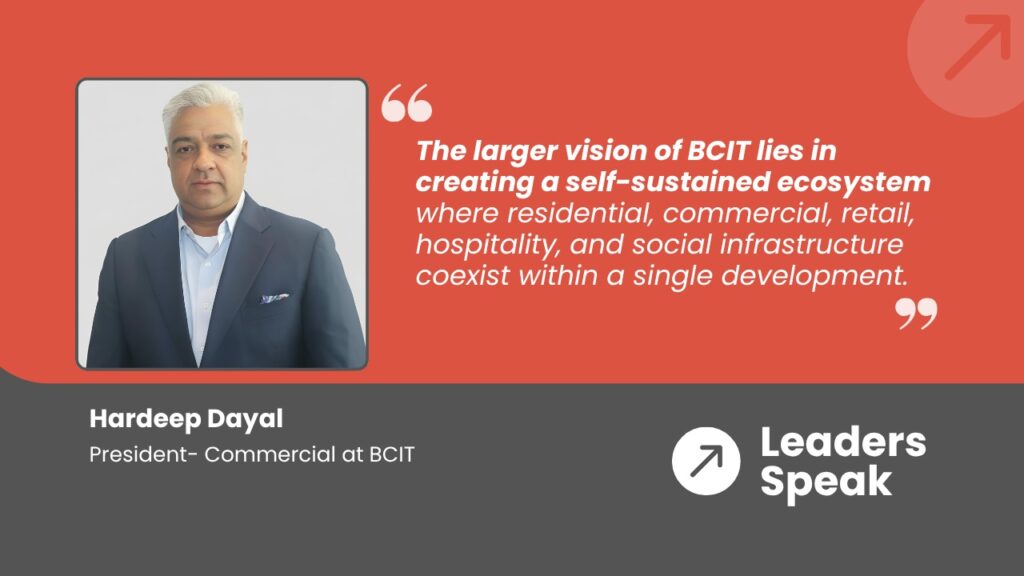
The larger vision of BCIT lies in creating a self-sustained ecosystem where residential, commercial, retail, hospitality, and social infrastructure coexist within a single development. This integrated approach significantly reduces commute times and enhances quality of life, aligning with the changing expectations of today’s workforce. The ability to live close to work, access essential services within walking distance, and participate in a vibrant community environment is becoming a decisive factor for occupiers.
From an investment perspective, interest in commercial real estate remains strong. Global institutional investors continue to show appetite for Grade A office assets, whether within integrated developments or standalone formats. However, investment strategies vary depending on fund mandates, with some focusing solely on office assets while others prefer broader exposure across mixed-use developments.
Looking ahead, Dayal believes that India’s top metropolitan markets will continue to dominate office demand over the next four to five years, supported by talent availability, infrastructure, and economic opportunities. While emerging and tier-2 cities may capture incremental growth, the core business activity is expected to remain concentrated in established urban centres.
A key takeaway from the evolution of projects like BCIT is the importance of planning large-scale developments with a long-term perspective. In integrated ecosystems, foundational infrastructure and services play a critical role in determining long-term success. Poor planning at this stage can create challenges that are difficult to rectify later.
As India’s urban landscape continues to transform, integrated commercial ecosystems are steadily moving from being a niche concept to a mainstream expectation. North Bengaluru’s rise, supported by developments like BCIT, signals a broader shift in how cities are expanding — not just through buildings, but through carefully designed environments that prioritise both economic activity and quality of life.