
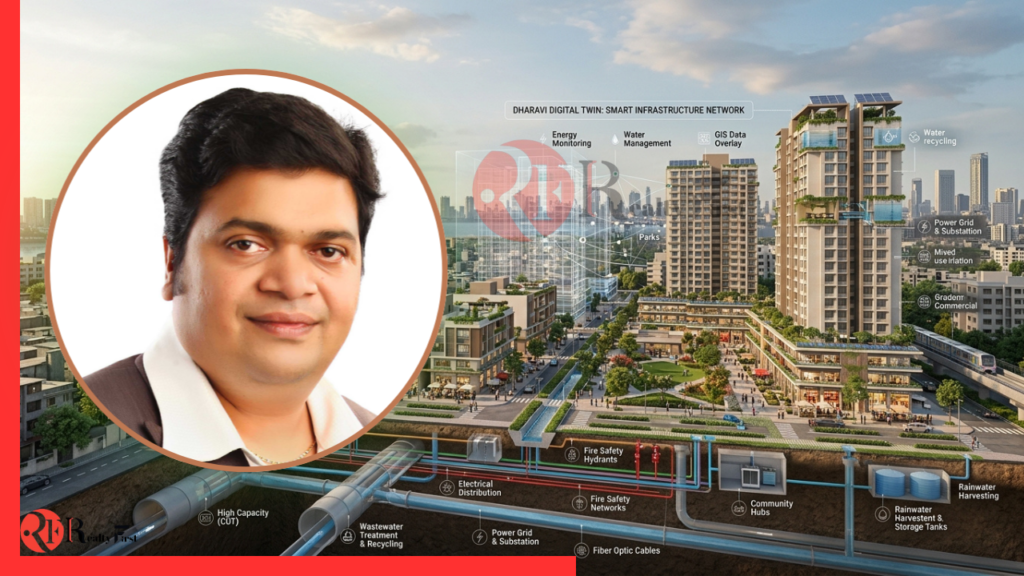
Firoj Kumar Jena, CEO, Clancy Global
Dharavi’s redevelopment is being viewed largely through the lens of housing, rehabilitation and the scale of urban transformation it could deliver. But the long-term success of such a complex project will depend on infrastructure that is far less visible. The engineering systems beneath and behind the buildings—covering Mechanical, Electrical, Plumbing and Fire Protection (MEPF)—will play a critical role in determining whether the redeveloped area can function as a resilient, efficient and sustainable urban ecosystem.
The ambition, therefore, should extend beyond replacing informal housing with new structures. Dharavi presents an opportunity to establish a benchmark for integrated urban engineering in India, combining climate resilience, digital technologies and coordinated infrastructure planning at a scale rarely attempted before.
Also Read: Enlite Secures Second Indian Patent for Cloud-Based Building Management Controller Configuration
Unlike a conventional residential neighbourhood, Dharavi operates as a closely connected economic and social ecosystem. Homes exist alongside workshops, small industries, retail outlets, educational institutions and community facilities. This mixed-use character makes a building-by-building approach to infrastructure inadequate. MEPF systems need to be conceived at the neighbourhood and precinct level, allowing utilities to function as a coordinated network serving residential, commercial and social requirements.
Such an integrated model can improve operational efficiency while also strengthening the area’s ability to respond to future urban pressures.
The complexity of the redevelopment also makes multidisciplinary coordination essential from the earliest stages. Architectural and structural planning must be aligned with MEPF systems, information and communication technology infrastructure, security systems and municipal utility networks. Experience from large-scale urban developments shows that when engineering disciplines collaborate through integrated design processes rather than working sequentially, design conflicts can be identified earlier, construction delays can be reduced and overall project efficiency can improve.
Mechanical systems will be particularly important in determining the quality of life within a dense urban environment. With residential and commercial activities operating alongside each other, adequate ventilation and healthy indoor air quality will be critical. Passive design measures, intelligent building orientation, energy-efficient ventilation and heat mitigation strategies will need to work together to reduce cooling requirements while maintaining healthier indoor conditions.
The benefits extend beyond comfort. Better mechanical planning can improve liveability, reduce long-term energy consumption and help address the effects of rising urban temperatures.
Fire and life safety must be treated with the same level of strategic importance. In a redevelopment of Dharavi’s scale, emergency preparedness cannot be limited to meeting statutory requirements. Fire detection and suppression systems, smoke extraction, emergency access, evacuation planning and resilient utility infrastructure need to be embedded into the planning framework from the beginning.
Treating these systems as fundamental elements of urban design rather than compliance requirements can create safer communities and strengthen overall resilience.
Electrical infrastructure will also determine how effectively the redeveloped area functions over the long term. A community of Dharavi’s scale will require dependable power systems capable of handling peak demand while supporting increasingly digital lifestyles and businesses.
Redundant power distribution networks, smart metering and digital monitoring can provide the foundation for real-time energy management, predictive maintenance and more efficient operations. These systems can also enable residents and administrators to monitor consumption, optimise energy use and reduce wastage.
The shift towards cleaner energy provides another opportunity to build resilience into the redevelopment. Where feasible, rooftop solar installations, battery storage and other renewable energy technologies should be integrated into the infrastructure plan rather than treated as standalone sustainability measures. Such systems can reduce dependence on conventional grids, improve energy resilience and support India’s wider decarbonisation objectives.
Water infrastructure requires similar long-term thinking. With Mumbai facing population growth and increasing climate variability, water security is no longer simply an operational issue; it has become a critical urban planning priority. Every litre of water entering the redeveloped area should be treated as a valuable resource.
Rainwater harvesting, water recycling and efficient distribution networks should therefore be incorporated into the core infrastructure strategy. Dual plumbing systems that distinguish between potable and recycled water, along with precinct-level sewage treatment facilities, can help reduce freshwater demand and support a more circular approach to water management.
Such systems can ease pressure on municipal resources while improving the sustainability of high-density urban development over the long term.
At the precinct level, Dharavi could also adopt infrastructure approaches commonly associated with global smart-city development. Centralised sewage treatment plants, recycled water networks, common utility corridors and integrated service tunnels could improve maintainability while limiting disruption in the future.
In selected areas, district cooling and central utility systems may also provide opportunities for greater operational efficiency and lower environmental impact.
Climate resilience must be embedded into this infrastructure planning. Mumbai’s increasingly intense monsoon events make it essential for the redevelopment to anticipate extreme rainfall rather than simply respond to it. Flood resilience measures, sustainable drainage systems, improved stormwater management and climate-resilient utility corridors should be considered from the design stage.
The objective should be to ensure that essential infrastructure continues to function during extreme weather events and that urban life remains as uninterrupted as possible.
This makes it important to view Mechanical, Electrical and Plumbing infrastructure not as separate technical disciplines, but as components of a single, interconnected ecosystem. A systems-based approach could become one of the defining features of Dharavi’s redevelopment and potentially provide a model for future urban regeneration projects across India.
The financial planning of MEP infrastructure will be equally important. In large urban renewal programmes, MEPF systems typically account for 20–30 percent of the total construction cost and have a direct bearing on long-term operational performance.
Infrastructure budgets should therefore extend beyond conventional electrical and plumbing provisions to account for fire protection systems, water treatment and recycling facilities, ICT infrastructure, security systems, Building Management Systems (BMS), renewable energy installations, sewage treatment plants, stormwater management networks and utility monitoring platforms.
Early engineering cost modelling can help stakeholders make more informed investment decisions, manage lifecycle expenditure and avoid expensive retrofits once buildings are occupied. For a redevelopment on the scale of Dharavi, the outcome will depend not only on the buildings constructed above ground but also on the engineering infrastructure that supports the millions of daily interactions taking place within the community.
Digital technologies can further strengthen this planning process. Building Information Modelling (BIM), Geographic Information Systems (GIS) and Digital Twin technologies are increasingly enabling planners to simulate utility networks, maintenance requirements, emergency scenarios and future infrastructure needs before construction begins.
An integrated digital approach can help identify clashes and coordination issues at an early stage, improve collaboration between disciplines and reduce the risk of construction delays and cost overruns.
The use of real-time monitoring, predictive analytics and digital asset management can extend these benefits throughout the operational lifecycle. Data-driven infrastructure allows operators to move from reactive maintenance towards anticipating potential failures before they occur.
Over several decades, this approach can help reduce maintenance costs, extend the life of critical infrastructure and improve service reliability for residents.
Ultimately, the value of integrated MEP planning should be assessed through a lifecycle engineering perspective. Infrastructure cannot be designed only for the day residents occupy their new homes. It must be planned to operate efficiently for the next fifty years, with systems that can be maintained, upgraded and digitally monitored as requirements evolve.
This requires capital expenditure (CAPEX) and operational expenditure (OPEX) to be evaluated together during the planning stage. Long-term performance, therefore, needs to become a core design consideration rather than an outcome addressed after construction.
Our experience across large residential townships, commercial developments, healthcare facilities, hospitality projects and institutional campuses has shown that the most successful developments are those where engineering considerations are incorporated from the conceptual stage. Early involvement of engineering disciplines can improve design efficiency, minimise construction clashes, strengthen sustainability outcomes and deliver measurable savings across both capital and operational costs.
For a project as complex and large-scale as Dharavi, integrated engineering should consequently be regarded as a strategic investment, not merely a technical requirement.
Also Read: The Evolution of Real Estate Marketing: Adapting to the New Buyer Journey
The redevelopment of Dharavi offers India an opportunity to rethink the way large-scale urban renewal is planned and delivered. If integrated MEP planning, digital engineering, lifecycle cost optimisation and climate resilience are incorporated from the outset, the project can set a benchmark for technologically enabled urban infrastructure.
The real measure of redevelopment may ultimately lie beyond the buildings themselves—in the invisible systems that enable communities to live, work and grow safely, efficiently and sustainably for generations.