
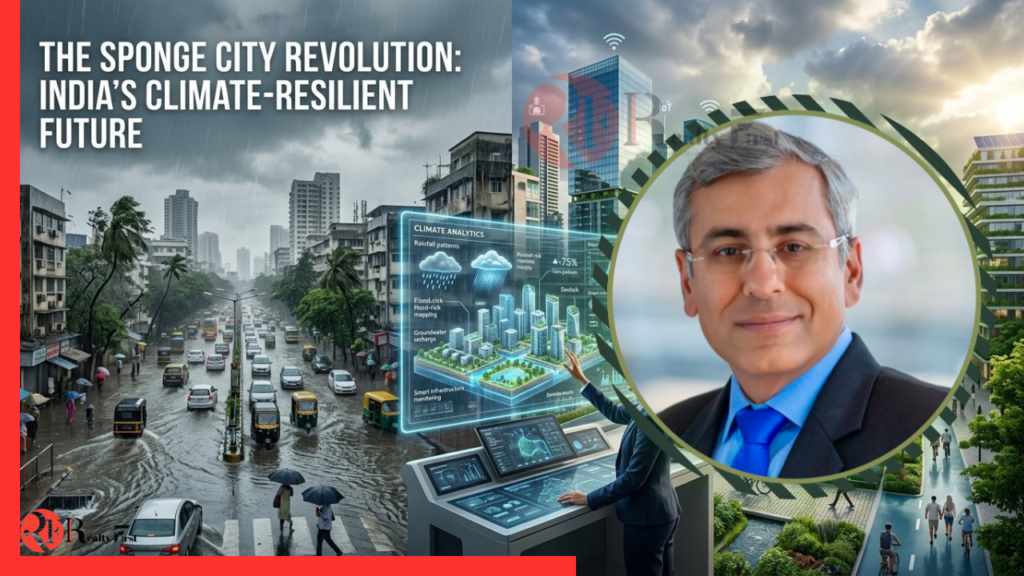
By Kamlesh Thakur
The recent spell of unprecedented rainfall across Mumbai and Maharashtra has reinforced a reality that cities can no longer afford to ignore: climate patterns have changed fundamentally. Extreme weather events that were once considered rare are occurring with increasing frequency, shifting the focus from disaster response to long-term urban resilience.
According to Kamlesh Thakur, the conversation must now move beyond managing the aftermath of climate-related events and towards reimagining how cities are planned, designed and built. He argues that developers, urban planners, policymakers, environmental experts and civic authorities must collectively rethink urban infrastructure to withstand a rapidly changing climate.
The challenges extend well beyond seasonal flooding. Thakur notes that many Indian cities face the paradox of severe waterlogging during the monsoon, only to experience acute water shortages for much of the year. With urbanisation accelerating and populations expanding, he believes rainwater harvesting, groundwater recharge and water conservation should become integral components of city planning rather than optional sustainability measures.
He also highlights the impact of rapid concretisation on urban ecosystems. As permeable land surfaces continue to shrink, rainwater is increasingly diverted into already overburdened drainage networks instead of naturally filtering into the ground. This not only intensifies flood risks but also limits groundwater replenishment, further straining long-term water security.
Another issue demanding attention is the growing incidence of trees collapsing during heavy rainfall and high winds. According to Thakur, excessive paving and concretisation around tree bases have restricted root development, weakened natural anchorage and reduced the soil’s capacity to absorb water. Protecting urban green cover, he argues, requires creating conditions that allow trees to develop healthy root systems rather than focusing solely on plantation drives.
Against this backdrop, Thakur advocates exploring the “Sponge Cities” model as part of India’s future urban planning strategy. The concept enables cities to absorb, store, filter and reuse rainwater instead of treating it solely as stormwater to be discharged. By incorporating permeable pavements, green roofs, urban forests, wetlands, rain gardens, recharge pits, lakes and smart stormwater management systems, Sponge Cities can help mitigate flooding, replenish groundwater reserves, strengthen water security and improve overall urban liveability. With climate risks intensifying, he believes the approach deserves serious consideration within India’s planning framework.
Thakur also raises several policy questions that he believes require urgent attention. Among them is whether stormwater drainage systems should be redesigned to accommodate significantly higher rainfall intensity instead of relying on historical averages. He also questions whether all new developments should be required to incorporate flood-resilient design, rainwater harvesting, groundwater recharge and water recycling as standard practice.
Further, he asks whether greater use of permeable pavements, green corridors, urban forests and open spaces should be mandated to restore the natural urban water cycle. He also calls for deeper integration of technology, artificial intelligence, digital mapping and real-time weather forecasting into urban planning and disaster management systems. In addition, he argues that building regulations should evolve to strike a better balance between urban development, environmental resilience and long-term sustainability.
Thakur further suggests that Maharashtra should consider developing a roadmap towards creating Sponge Cities, where urban development is designed to work with natural ecosystems rather than against them.
While construction activity is often blamed whenever cities experience flooding, Thakur believes the issue is considerably more complex. Responsible construction practices remain essential, he says, but lasting solutions will depend on building resilient urban ecosystems where infrastructure, governance, planning and development function in a coordinated manner.
He maintains that the future of Indian cities will depend not on slowing development but on improving how development is executed. In his view, sustainable urban growth is not a choice between economic expansion and environmental protection; rather, both objectives must reinforce one another.
According to Thakur, climate resilience can no longer remain an afterthought in infrastructure planning. Instead, it must become a foundational principle of urban development. He points to Mumbai’s long-standing resilience in the face of adversity and argues that the city’s infrastructure should now evolve to reflect that same strength.
He concludes that the discussion must shift away from assigning responsibility after climate events and instead focus on collaborative action. Governments, urban planners, developers, engineers, environmentalists and citizens all have a shared role in creating cities that are safer, greener, more water-secure and better equipped to address future climate challenges.
For Thakur, the path forward is clear. The cities of tomorrow cannot be planned using yesterday’s assumptions. Climate resilience, water security and sustainable urbanisation, he argues, must form the three pillars of India’s next phase of urban development.