New Delhi: India’s Global Capability Centres (GCCs) are moving beyond their traditional role as execution hubs, increasingly taking ownership of products, platforms and higher-value capabilities. This transformation is also changing how companies approach talent, workplace strategy and commercial real estate, according to a report released by Awfis Space Solutions Ltd in partnership with Zinnov.
Titled “The Great Workplace Reset: How India GCCs are Redefining Work, Workforce, and Workspace,” the report examines the evolution of India’s GCC ecosystem across five areas: the country’s GCC landscape, the changing economics of work, workforce dynamics, workspace as an operating decision, and case studies on the role of flexible and managed workspaces in GCC expansion.
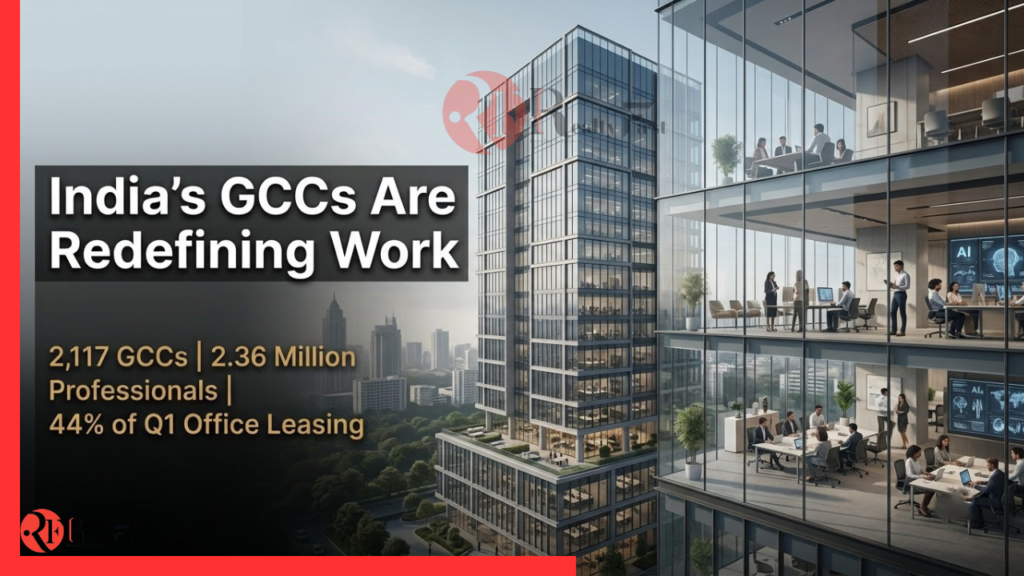
India currently has 2,117 GCCs operating 3,728 units across the country. These centres generate USD 98.4 billion in revenue (FY26E) and employ more than 2.36 million professionals. The number of GCCs has increased by nearly 32% since FY21, while 506 companies from the Global 2000 now operate centres in India.
The report also points to a widening GCC base beyond large global corporations. PE-backed companies, mid-market enterprises and digital native businesses are increasingly establishing centres in India, indicating that the GCC model is being used not only for scale but also as a platform for growth and innovation.
Also Read: India’s 3PL Sector Absorbs Over 110 Million Sq. Ft. of Warehousing Space Since 2021: JLL
GCC Work Moves Up the Value Chain
The nature of work undertaken by India’s GCCs has changed significantly between 2015 and 2026. Commodity and procedural activities have declined, while higher-value functions have expanded.
Complex problem-solving work now accounts for 38.1% of the GCC work portfolio, while cutting-edge R&D work has doubled. According to the report, almost half of India’s GCCs now have an equal or greater share of frontier work compared with their headquarters.
The shift is particularly pronounced among companies developing AI products. Such companies undertake 2X more Cutting-edge R&D work in India than those primarily adopting third-party AI, suggesting that India’s role is expanding from AI deployment to core innovation.
This change in the nature of work is also influencing GCC workforce requirements.
India’s AI/ML talent pool within GCCs has nearly doubled from 122,000 professionals in 2023 to a projected 250,000 in 2026, making India the second-largest AI talent market globally after the United States.
Workspace Becomes an Operating Decision
As GCC mandates become more strategic, the report argues that workspace is increasingly being viewed as an operating decision rather than simply a real estate decision.
It identifies five factors influencing that decision: talent, control, speed, flexibility and brand.
The shift is reflected in India’s office leasing market. In the first quarter of 2026, the country recorded its highest-ever quarterly office leasing volume of 20.7 million sq ft. GCCs accounted for 44% of that demand, equivalent to 9.1 million sq ft, representing the largest amount of space GCCs have absorbed in a single quarter.
GCCs’ share of office leasing has increased for three consecutive quarters. Of the Q1 2026 GCC demand, 64% came from ecommerce, BFSI and technology, while 73% was generated by US-headquartered companies. Bengaluru and Hyderabad together accounted for 67% of the demand.
Flexible workspace is also gaining traction among GCC occupiers. The report estimates that GCCs now account for 40 to 45% of enterprise flex seat uptake, while 67% of GCCs plan to increase flex space to more than a tenth of their real estate portfolio.
The report further documents case studies of GCCs that expanded from incubation to more than 3,000 seats within months through managed and flexible office formats delivered by Awfis. The examples span global commerce, healthcare technology, media monitoring and consumer manufacturing.
GCC Strategy and Workplace Design Converge
The findings suggest that the evolution of GCCs is creating a closer connection between business strategy, workforce planning and workplace decisions. As the centres take on more complex mandates, the need for speed and flexibility in establishing or expanding operations becomes more significant.
As part of its continuing partnership with Zinnov, Awfis is also the workspace partner for the 19th edition of Zinnov Confluence 2026. This marks the second consecutive year of its association with the industry event, which brings together GCC leaders, enterprise decision makers and industry experts to discuss the future of global capability centres in India.
Mr. Amit Ramani, Chairman and Managing Director, Awfis Space Solutions Ltd., said, “This report validates the trajectory we have built our business around. India’s GCCs are no longer just execution centers, they now own products, platforms, and AI led mandates, and that kind of strategic mandate cannot be supported by conventional real estate timelines. It demands workspace that moves as fast as the business does, which is exactly why flexible and managed office formats have become the category’s fastest growing choice among GCCs.
Awfis has spent this shift building the scale and specialisation to meet this evolving demand, with an integrated model spanning flexible workspaces, managed offices, and Transform by Awfis (Design & Build) that lets us take a center from early incubation to a fully custom, brand led workspace on time. That is precisely the speed and control India’s next generation of GCCs are asking for.”
Also Read: Luxury, Liveability and the New Buyer Checklist for High-Growth Markets
Nitika Goel, CMO & Managing Partner, Zinnov, said, “The centre of gravity of AI work has shifted from invention to industrialisation, and that shift has rewritten the GCC Workforce. The specialist we tracked in job descriptions three years ago is now a full-stack engineer, combining domain depth, AI frameworks, and business context to own outcomes. Once the work and the Workforce have changed this much, the workspace decision moves up with them. It becomes a leadership call across talent, control, speed, flexibility, and brand, and India’s newest GCCs are already making that call at entry.”