
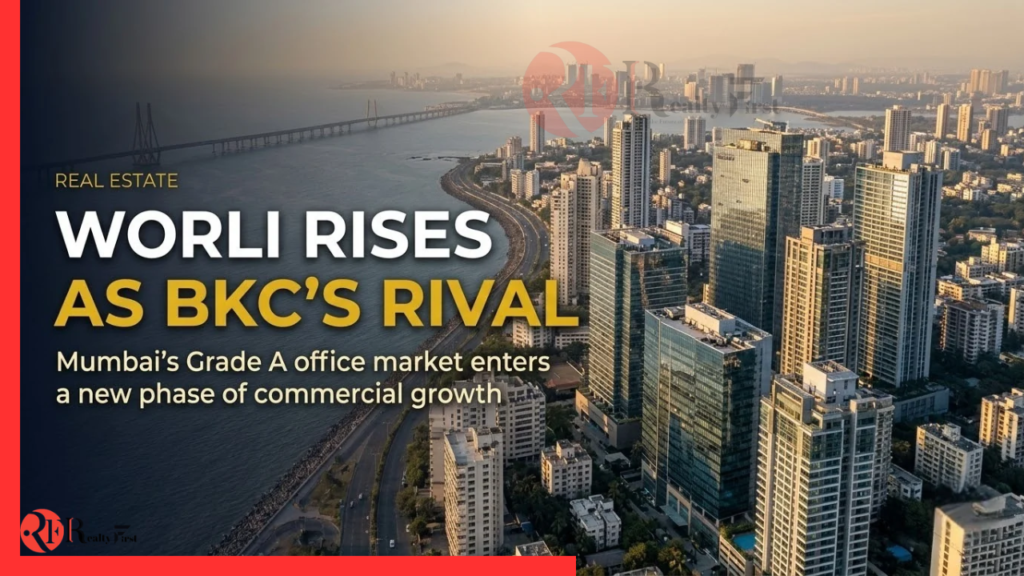
For nearly two decades, the Bandra-Kurla Complex (BKC) has set the benchmark for premium office rentals in Mumbai. That position is now facing a challenge from the Worli–Prabhadevi corridor, where rising rentals, tighter vacancy and improving connectivity are reshaping corporate location preferences. The shift is also bringing attention to a less visible gap in the market: the limited availability of Grade A office space that businesses and investors can purchase rather than lease.
The changing dynamics are reflected in recent leasing activity. In April 2026, Japanese financial services group Nomura secured office space on the 26th and 27th floors of Altimus in Worli under a 10-year lease. The agreement was signed at approximately ₹435 per sq ft per month on chargeable area, equivalent to around ₹725 per sq ft on carpet area, with an annual rental escalation of 5%.
Grade A office rentals in Worli currently range from ₹456 to ₹661 per sq ft per month on carpet area, compared with ₹380 to ₹608 per sq ft in BKC. The overlap in rental ranges indicates how far Worli has moved towards the pricing levels of Mumbai’s established financial district.
Also Read: Prateek Group’s Noida Project Expected to Generate Over 2,000 Jobs
The broader office market is providing further support to this transition. Mumbai recorded 5.88 million sq ft of office leasing in the first half of 2026, an increase of 17.8% year-on-year and a record for the period. The citywide vacancy rate stood at 10.8%, its lowest level in 16 years and below the national benchmark of approximately 15%. In the Worli–Prabhadevi micro-market, vacancy was lower at 8%. These figures point to a market where demand for quality office space is continuing to absorb available supply.
Connectivity is another factor influencing the corridor’s commercial prospects. Metro Line 3 links Worli with Cuffe Parade, BKC and the airport, while the Coastal Road has improved access to South Mumbai. The Sewri–Worli Elevated Connector, scheduled for completion in early 2027, is expected to connect Worli directly with the Atal Setu and Navi Mumbai International Airport.
Together, these infrastructure projects are changing the accessibility profile of an area that has historically occupied a distinct position between South Mumbai’s established business districts and the newer commercial centres further north. For companies evaluating office locations, the combination of access to established business communities and improving links across the metropolitan region is adding to Worli’s appeal.
However, the growth in leasing demand has not been matched by a comparable range of ownership options. Much of the upcoming office supply across the Worli catchment comprises large-floor-plate towers designed primarily for institutional occupiers seeking entire floors or multiple floors on lease. This leaves relatively limited inventory for businesses and investors looking to acquire smaller Grade A office units.
Demand for offices in the 3,000 sq ft range is particularly relevant to family offices, owner-occupiers, advisory firms and growing businesses that prefer ownership over long-term rental commitments. The shortage of such units has created a distinction between the supply being developed for large corporate tenants and the requirements of smaller institutional and private buyers.
The gap is also drawing attention to the relationship between rental and capital values in the micro-market. While office rentals have moved closer to BKC levels, capital values have not followed the same trajectory, according to industry participants. This difference is being viewed as an opportunity by developers looking to introduce commercial properties designed around ownership-led demand.
Worli Naka is emerging as a focal point in this discussion because of its proximity to several major infrastructure projects. Mr. Vedanshu Kedia, Director, Prescon Group, said the location’s connectivity and the shortage of ownership-oriented office inventory were influencing the commercial opportunity in the area.
“Worli Naka sits at the exact geographical hinge where Mumbai’s three most significant connectivity projects—Metro Line 3, the Coastal Road and the Sewri–Worli connector converge within a two-kilometer radius. While rentals here have already caught up with BKC, capital values have lagged, creating an exceptional entry point for investors. What the market currently lacks is tailored product. Institutional developers continue to build multi-floor lease stock, leaving very little supply planned from the ground up for growing firms or family offices who want to own high-specification, iconic building that promises ahigh quality experience at a trophy address. That is the exact product gap we are catering to with our new commercial offering here.”
Prescon is planning a commercial tower at Worli Naka, with office spaces ranging from approximately 1,550 to 10,000 sq ft of carpet area. The development is expected to include destination-controlled lifts and a high parking ratio. Its proposed unit sizes place it within the segment of the market where smaller businesses and private investors may be looking for ownership options.
The wider commercial repositioning of Worli is also being linked to the changing geography of corporate demand in Mumbai. While BKC remains a leading business district, the availability of alternative locations with improving connectivity is giving occupiers more options beyond traditional office clusters.
Mr. Khetsi Barot, Managing Director, The Guardians Real Estate Advisory, said the infrastructure pipeline could influence both corporate location decisions and the commercial profile of the area.
“The commercial re-rating of Worli reflects how infrastructure can unlock real estate value and reshape corporate location preferences. While BKC remains a leading business district, Worli offers a compelling alternative, combining proximity to South Mumbai’s established business community with improving connectivity to the airport and the Western Suburbs. As corporate occupiers increasingly consider well-connected business locations beyond traditional hubs, the availability of Grade A commercial space with ownership options could become an important differentiator. Businesses and investors evaluating Worli ahead of key infrastructure developments, including the Sewri-Worli connector, could be well positioned to benefit from the area’s evolving commercial profile, potential rental income and long-term capital appreciation.”
Worli’s evolution from an industrial mill precinct into a premium commercial address has been gradual, supported by the development of modern office buildings and its proximity to established residential and business districts. The next phase of its growth is likely to depend on whether the market can provide the kind of office inventory that matches the requirements of a wider range of occupiers and buyers.
Grade A developments offering contemporary building specifications, efficient floor plates and governance standards are expected to remain important in determining rental performance and occupancy levels. In a market where vacancy is already low, the quality and suitability of available stock could become as important as the location itself.
Also Read: Gunjur-Varthur Corridor Emerges as Bengaluru’s Next Major Real Estate Cluster
With the Sewri–Worli connector expected to be completed in early 2027, the corridor is approaching another stage in its infrastructure-led transformation. Industry observers expect the remaining boutique office inventory to attract interest from high-net-worth buyers and corporate occupiers evaluating purchases ahead of the key connectivity upgrades. Whether this demand translates into sustained price appreciation will depend on the pace of infrastructure delivery, the availability of suitable ownership-led supply and the continuation of Mumbai’s office leasing momentum.