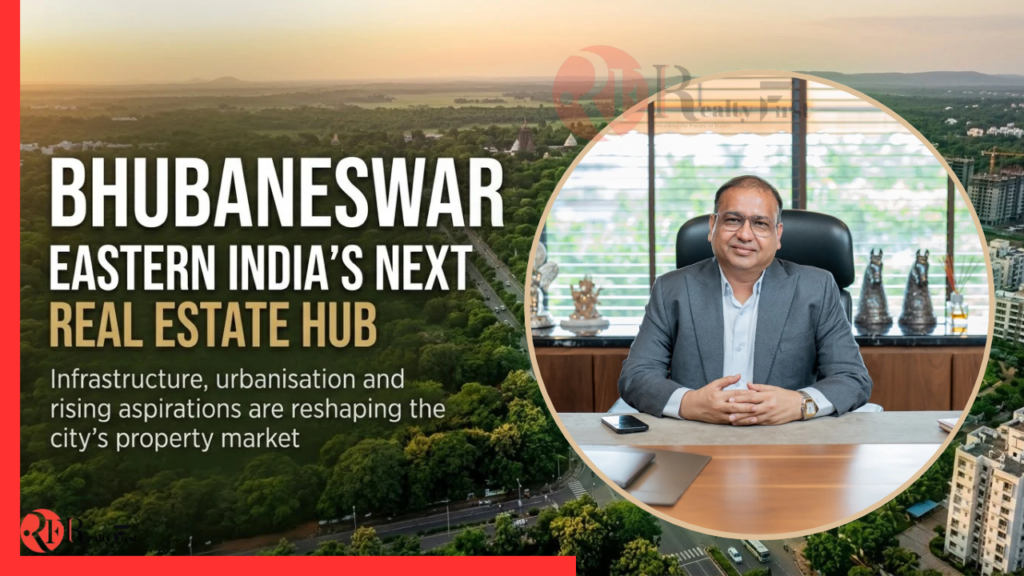
By Mr Rajesh Agarwal, Director, Oriom Group
Odisha’s economic growth has long been driven by its mineral wealth, steel, aluminium, power and heavy industrial base. That foundation is now giving way to a broader growth story, shaped by urbanisation, infrastructure expansion and the changing aspirations of a modern Odisha. Real estate is increasingly becoming a visible expression of this transition, with Bhubaneswar at the centre of the state’s evolving urban and economic landscape.
The capital city is attracting a new generation of residents looking beyond housing to opportunities for employment, education, investment and an improved quality of life. The expansion of corporate businesses, IT, healthcare, education, financial services, start-ups and other knowledge-led sectors is creating jobs, supporting income growth and driving demand for better residential and commercial infrastructure. These developments are collectively strengthening Bhubaneswar’s position as an emerging real estate market in eastern India.
The next phase of the city’s growth, however, will depend as much on infrastructure and connectivity as on economic expansion. Improved transport links are widening the city’s development footprint, creating new corridors for residential and commercial projects beyond its established urban centre. Bhubaneswar airport connects the city to domestic and international destinations, while expanding road and rail networks strengthen its links with Cuttack, Puri, Khordha and industrial centres such as Jharsuguda and Rourkela. The growth of the Bhubaneswar Capital Region is also opening up additional land and development opportunities.
Also Read: Banke International Properties backs India Champions as Leading Arm Sponsor for WCL Season 3
Civic infrastructure is another factor shaping the city’s real estate outlook. Its early inclusion in India’s Smart Cities initiative has supported planned urban development, digital governance, public amenities, technology-enabled civic services and its clean-city positioning. As the urban footprint expands, peripheral locations are gaining attention as potential residential and commercial corridors, extending the market beyond the traditional city limits.
Market data points to the scale of this transformation. According to the latest CII-Knight Frank India report, Bhubaneswar is among 11 emerging markets expected to play a significant role in India’s next real estate growth cycle. Residential property prices in the city rose 63% between 2021 and 2026, compared with 42% across India’s top eight metropolitan markets. Over the 2016–2026 period, residential prices in Bhubaneswar recorded a compound annual growth rate (CAGR) of 8%, twice the 4% registered by major metros.
The city’s expanding employment base and rising incomes are contributing to this momentum. The services sector accounts for about 50% of Bhubaneswar’s GDP, while the city commands a significant share of Tier-2 retail and shopping-centre stock. It is also among six hubs that collectively recorded 5.3 million sq ft of warehousing transactions in 2025, as cited in the report. The study identifies infrastructure development, connectivity, job creation, services and MSME growth, skilled talent availability, rising consumption and Bhubaneswar’s emergence as a Global Capability Centre (GCC) destination among the factors supporting its real estate expansion.
The shift is evident in housing demand, which is gaining traction across premium and affordable segments. Entrepreneurs, high-net-worth individuals and Odias living in other States and overseas are contributing to demand for luxury homes with premium amenities in locations such as Khandagiri, Patia and Chandrasekharpur. At the other end of the market, budget housing is attracting interest in suburban locations including Raghunathpur, Pahal, Patrapara and Sundarpada. The opportunity extends beyond residential development, with demand also growing for office spaces, co-working facilities, retail, hospitality and commercial properties available for sale and lease.
Changing consumer preferences are further influencing the city’s development profile. Buyers are increasingly seeking homes that offer more than basic accommodation, with lifestyle, design, convenience and community becoming important considerations. This is supporting interest in premium and luxury housing, integrated communities, contemporary architecture, larger living spaces and serviced residences. Demand is also evolving across modern commercial developments, organised retail, hospitality and mixed-use projects that bring residential, work and social spaces together.
Also Read: From Affordability to Premiumisation: Noida’s Housing Market Moves Up the Value Chain
As Bhubaneswar strengthens its position as an emerging real estate destination in eastern India, the opportunity for developers is shifting from meeting housing demand alone to shaping the city’s future urban character. The next phase of development will require projects that respond to changing aspirations, combine multiple urban functions and reflect the needs of a new generation. Building the Bhubaneswar of tomorrow, therefore, will be about creating an aspirational, integrated and future-oriented city that forms a defining part of Odisha’s next chapter of growth.