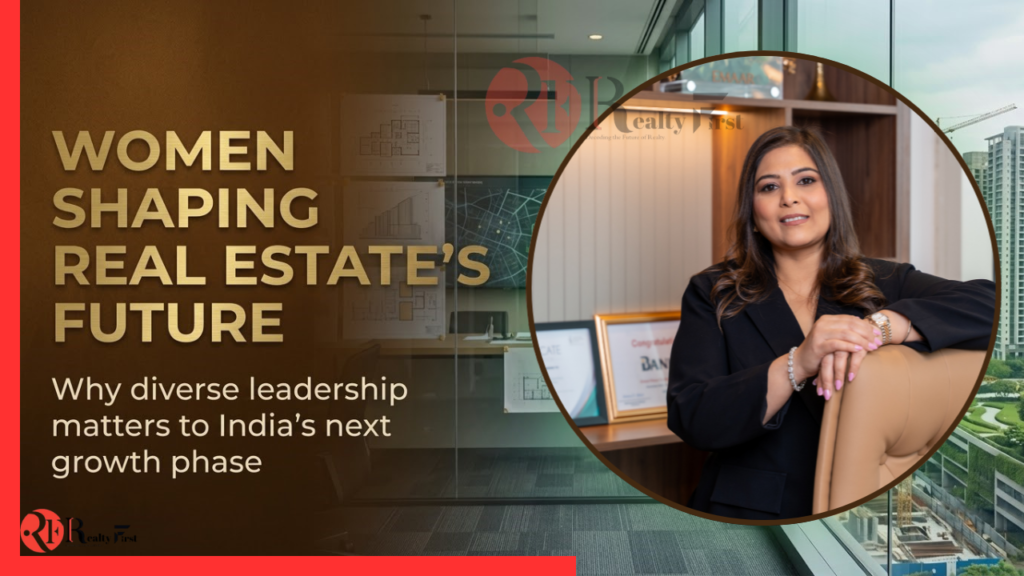
By Ms. Aditi Jhunjhunwala, Head of Operations, Banke International Properties
India’s real estate sector is undergoing a fundamental shift. As the industry expands in scale, technology adoption and economic importance, the composition of its leadership teams has not changed at the same pace.
Women account for nearly 48.5 per cent of India’s population and around 10 per cent of the construction workforce. Yet, according to the recent JLL–NAREDCO MAHI report, women hold only 1–2 percent of top positions in India’s real estate sector, a gap also highlighted by Deloitte’s research on board diversity.
This disparity is no longer only a question of representation. As Indian real estate targets a US$1 trillion market by 2030, building a stronger pipeline of women leaders has become a business imperative. Industry bodies including NAREDCO and CREDAI have increasingly initiated conversations around attracting and retaining more women professionals across the sector.
Over the years, I have often found myself among the few women participating in leadership discussions. What has consistently surprised me is that the challenge has never been a shortage of capable women, but the limited opportunities available for them to progress into decision-making roles. That experience fundamentally changed my perspective on what the real estate industry must do to build stronger leadership.
Also Read: Vasai’s Urban Transformation: Building a Complete City
India’s real estate growth needs broader leadership
The real estate sector currently contributes around 7 per cent to India’s GDP, a figure expected to rise to nearly 13 per cent by 2030. With the market projected to reach US$1 trillion, real estate is positioned to remain among the fastest-growing sectors in the coming years.
Yet the leadership structures within the industry continue to reflect an older business model rather than the increasingly complex market the sector is becoming.
For decades, Indian real estate has been shaped by relationship-driven business models and predominantly male leadership networks. Women today have established significant roles across architecture, engineering, finance, legal advisory, marketing, sustainability and project management. The gap emerges further up the organisational ladder, where comparatively few have progressed into senior decision-making positions.
The contrast becomes more evident when India is compared with global markets. Women occupy double-digit leadership positions across the US, Europe and Asia-Pacific, while India’s real estate sector remains an outlier. Globally, women account for around 14.5 percent of C-suite positions in real estate, highlighting the scale of the leadership gap India still needs to address.
Real estate is becoming a technology and sustainability business
The nature of real estate itself has changed.
The sector is no longer defined only by land acquisition, construction and project delivery. Technology, AI-enabled planning, PropTech, digital transformation, ESG compliance, smart city development, sustainability, customer experience and flexible workplaces are increasingly influencing how long-term value is created.
This complexity makes diversity of thought increasingly important. Real estate now requires collaboration across disciplines, with decisions shaped by technology, consumer behaviour, sustainability, finance and urban planning.
Research by McKinsey has consistently shown that organisations with more diverse leadership teams outperform their peers, reinforcing the argument that inclusion can be a business advantage.
For real estate, women leaders can bring perspectives that are particularly relevant as the sector navigates AI, digital innovation and ESG-led development. A broader leadership base can contribute to smarter, more sustainable and customer-focused urban environments while supporting more balanced business decisions.
Women are already influencing the built environment
Across the broader built-environment ecosystem—including construction, infrastructure and PropTech—women are increasingly taking leadership roles in innovation, customer engagement and digital transformation.
Sanya Runwal at Runwal Realty, Shraddha Goradia at Dosti Realty, Anushka Singh at DLF, and Pavitra and Nirupa Shankar at Brigade Group are examples of leaders driving strategy, marketing, business development and organisational transformation.
At an institutional level, Godrej Properties, Embassy Group and Lodha Group have also initiated visible steps aimed at strengthening the pipeline of women professionals and leaders.
These developments demonstrate that meaningful change is possible when organisations make sustained efforts to create opportunities for women to progress.
The changing homebuyer makes the case stronger
The case for greater representation becomes even more relevant when viewed through the changing profile of India’s real estate customer.
Women are no longer only influencing household property decisions. They are increasingly first-time, independent and single homebuyers, entrepreneurs, investors and NRI buyers.
Their expectations can extend well beyond the size of a home. Safety, accessibility, community infrastructure, sustainability, digital convenience and quality of life are increasingly important considerations.
Leadership teams that better reflect this evolving customer base can be better positioned to understand changing preferences and develop products and experiences that respond to them.
A more diverse leadership structure, therefore, is not simply about who occupies a boardroom seat. It can also influence how businesses understand their customers and anticipate shifts in market demand.
Retaining women requires more than hiring
Increasing women’s representation at entry and mid-career levels alone will not close the leadership gap. The more difficult challenge is maintaining career continuity.
Many talented women leave the profession during critical career stages as workplaces continue to adapt to maternity, childcare and caregiving responsibilities. Statutory maternity benefits are important, but long-term career progression requires a broader support structure.
Where feasible, companies need to consider flexible work arrangements, structured return-to-work pathways, childcare support, mentoring, leadership sponsorship programmes and equitable performance evaluations.
Shared parental responsibilities also have a role to play. Progressive paternity policies can help reduce the disproportionate career impact of caregiving on women, while career breaks should not automatically become permanent barriers to leadership progression.
Pay equity remains part of the leadership challenge
Compensation disparities further complicate the issue.
Studies by Primus Partners and the WTC India Services Council indicate that women in technical roles within real estate often earn 30–40 per cent less than their male counterparts. Women in leadership positions earn approximately 15 percent less.
Closing the leadership gap therefore requires more than creating opportunities for advancement. Compensation equity must form part of the conversation around women’s participation and progression in the sector.
Transparent evaluation frameworks, clear career pathways and measurable accountability can help organisations address both representation and pay disparities.
The industry needs a stronger leadership pipeline
Building a deeper pipeline of women leaders will require coordinated action across companies, industry bodies, government and educational institutions.
CREDAI and NAREDCO can play a larger role by publishing annual diversity benchmarks, recognising organisations that demonstrate measurable progress and creating leadership sponsorship forums through which senior women executives can mentor emerging professionals.
Government and educational institutions can complement these initiatives through scholarships, structured internships and skill-development programmes. Stronger industry-academia partnerships could also encourage more women to pursue careers in engineering, construction, finance and real estate development.
Greater transparency around diversity metrics would further help establish accountability across the industry.
Also Read: How Mega Infrastructure Has Shaped Navi Mumbai’s Real Estate Story
Diversity is becoming a business metric
The debate around women in real estate leadership ultimately needs to move beyond representation.
Diversity should increasingly be viewed as a business performance metric rather than simply a social obligation. As investors pay greater attention to ESG principles and governance standards, organisations with inclusive leadership structures will be better positioned to attract capital, talent and long-term stakeholder confidence.
The question is no longer whether women deserve a seat at the table. The more important question is whether Indian real estate can afford to shape the cities of tomorrow without the perspectives, innovation and leadership that women bring.
Building more inclusive leadership is ultimately about more than fairness. It is about creating stronger businesses, more resilient organisations and better communities.
If Indian real estate truly aspires to shape the future of urban India, the people leading that transformation must reflect the diversity of the society they are building for.