
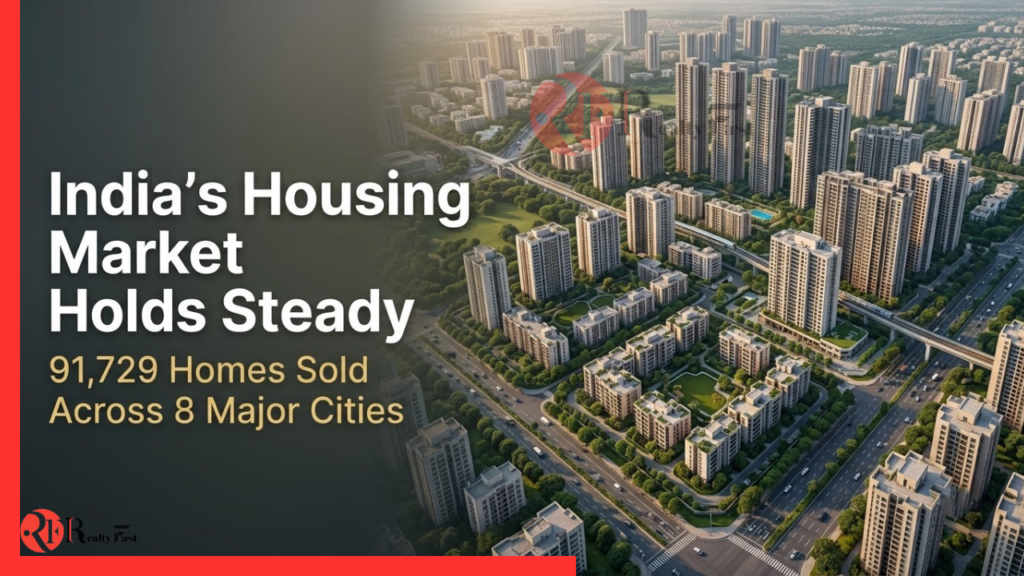
Mumbai: India’s residential real estate market remained relatively stable in the April-June quarter, with home sales continuing to exceed new supply despite a sequential moderation in both metrics. According to PropTiger.com’s latest Real Insight Residential report, 91,729 housing units were sold across the top eight cities in Q2 2026, compared with 89,161 new homes launched during the quarter.
New launches declined 4.2% quarter-on-quarter (QoQ), while sales fell 4.4% QoQ. However, sales remained ahead of fresh supply, limiting the risk of a significant accumulation of unsold inventory. The sales-weighted average residential price increased 1.0% QoQ to ₹10,153 per sq ft, marking the second consecutive quarter in which the figure remained above the ₹10,000 per sq ft level.
On a year-on-year (YoY) basis, new launches increased 6.0% from 84,138 units in Q2 2025. Sales, meanwhile, declined 6.1% from 97,674 units recorded in the year-ago quarter, which was a relatively elevated base.
The report attributes the sequential slowdown partly to pre-monsoon seasonality and buyer caution amid the US–Iran conflict. Technology-driven markets such as Bengaluru, Pune and Hyderabad saw a more pronounced impact, particularly in the sub-₹1 crore housing segment, where sentiment was affected by AI-led workforce restructuring and layoffs across the technology sector.
MMR Remains Largest Market as Prices Continue to Rise
MMR retained its position as the largest market among the eight cities in terms of both sales volume and value. The region recorded sales of 24,112 units at ₹15,422 per sq ft, with prices rising 20.4% YoY.
Bengaluru recorded the strongest annual price appreciation among the eight markets, with prices increasing 26.0% to ₹9,931 per sq ft, even as housing sales declined 9.2% YoY.
Pune crossed the ₹8,000 per sq ft mark for the first time, reaching ₹8,084 per sq ft after a 13.7% YoY increase. Ahmedabad remained the most affordable market among the top eight cities at ₹5,295 per sq ft and recorded the strongest sequential price growth, rising 7.0% QoQ.
The sales performance varied considerably across markets. Kolkata posted the highest sequential growth, with sales rising 22.0% QoQ, supported by a post-election recovery. Chennai recorded a 36.0% YoY increase in sales, even as new supply remained 43.3% below its year-ago level.
Delhi-NCR and Hyderabad remained comparatively stable. Hyderabad’s new launches increased 21.6% YoY, supported by the city’s IT, pharmaceutical and data-centre ecosystem.
Sales Continue to Outpace New Supply
The Q2 data shows a continued balance between housing demand and supply across the major urban markets. While overall sales declined from the previous quarter, the fact that 91,729 units were sold against 89,161 new launches suggests that developers continued to maintain supply discipline.
Among individual markets, Bengaluru recorded 14,186 sales in Q2 2026, down 9.2% YoY, while new launches rose 36.7% to 16,827 units. Pune reported 12,642 sales, a 20.8% YoY decline, alongside 12,622 new launches, down 7.1% YoY.
Hyderabad recorded 13,196 sales, up 14.6% YoY, while new launches rose 21.6% to 13,074 units. MMR reported 24,112 sales, down 7.0% YoY, against 24,882 new launches, which increased 7.9% YoY.
Delhi-NCR recorded 9,352 housing sales, down 7.0% YoY, while launches declined 2.8% to 10,127 units. Kolkata saw sales fall 8.6% YoY to 3,517 units, even as new launches rose 37.1% to 3,020 units.
Ahmedabad recorded 7,541 sales, down 20.2% YoY, against 4,295 new launches, up 2.0%. Chennai reported 7,183 sales, representing a 36.0% YoY increase, while launches fell 43.3% to 4,314 units.
Policy and Cost Environment Remains Supportive
The broader economic environment remained relatively predictable during the quarter, with the RBI repo rate at 5.25%, moderating inflation and continued government capital expenditure providing stability.
Changes in GST rates on construction-related materials have also been absorbed into project economics. The reduction in GST on cement from 28% to 18%, along with the reduction on marble and granite from 12% to 5%, is estimated to provide a 2–3% buffer against construction costs.
However, the report does not view these reductions as a direct catalyst for lower residential prices. Instead, they represent a partial offset to project costs, while housing prices continued to record YoY growth across all eight cities.
“Q2 2026 confirms India’s residential market is maturing, not weakening,” said Prakash Tejwani, CEO, PropTiger “Prices have held above ₹10,000 per square foot for two straight quarters even as buyers turn more selective. Kolkata and Chennai are showing genuine demand-led recovery, while Bengaluru and Pune continue to command pricing power despite tech-sector caution. Disciplined supply positions developers well for the festive quarter, though affordability remains the key variable to watch.”
Festive Quarter to Test Demand Strength
The housing market is expected to enter Q3 2026 with support from the festive season, which could provide an important test of underlying buyer demand.
The report expects continued recovery in Kolkata, normalisation of supply in Chennai and sustained momentum in Bengaluru and Delhi-NCR. Infrastructure completions, including Bengaluru Metro Phase 3, the Pune Line 3 extension and Chennai Phase 2, are also expected to support market activity.
Affordability, however, remains a key concern. Annual residential price appreciation ranges from 4.4% in Chennai to 26.0% in Bengaluru, potentially placing greater pressure on mid-income buyers.
Also Read: From City Apartments to Farm Plots: The Lifestyle Shift Reshaping Indian Real Estate
With sales moderating but continuing to exceed new supply, the report characterises the market as one moving towards greater maturity rather than broad-based weakness. The festive quarter is expected to provide a clearer indication of whether demand can absorb continued price growth and sustain the current balance between housing sales and new launches.