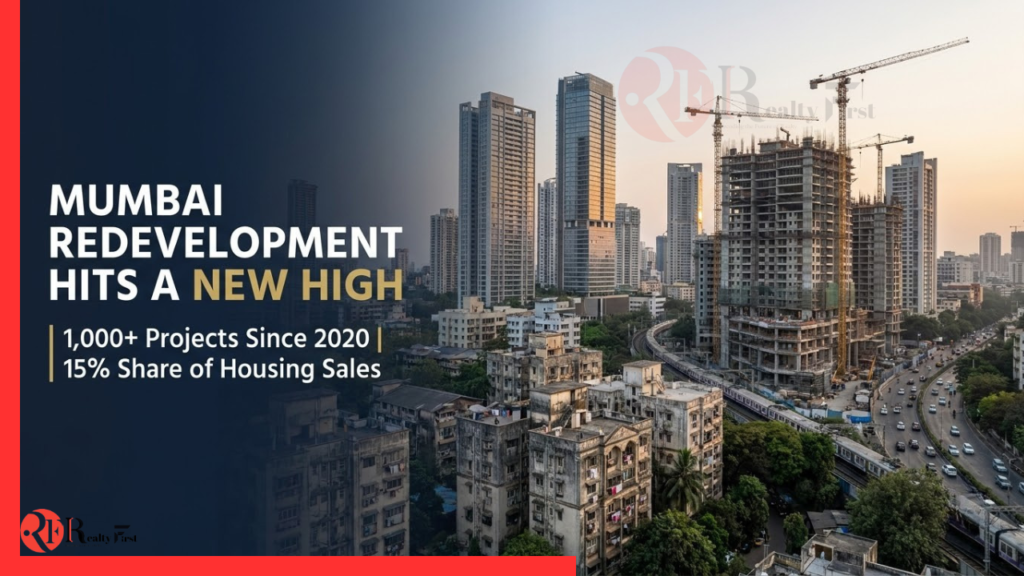
Mumbai’s redevelopment market is undergoing a structural shift, with more than 1,000 projects launched since 2020 and the segment’s share of residential sales rising to 15% in 2025-H1 2026, compared with approximately 6% during 2016-2021, according to a report by JLL and NAREDCO Maharashtra.
Titled “Redevelopment in Mumbai: The Inflection Point, from Land Scarcity to Systematic Urban Renewal,” the report was released on September 03, 2026, at NAREDCO Maharashtra’s Real Estate & Infrastructure Investors’ Summit 2026 (REIIS 2026) in Mumbai. It identifies the growing need to replace ageing buildings and the scarcity of developable land as key factors reshaping the city’s residential property market.
The report estimates that approximately 1,000 redevelopment projects launched since 2020 account for 13% of Mumbai’s overall residential supply. It also highlights a significant change in market activity, with redevelopment sales now outpacing new project launches.
The scale of slum rehabilitation has expanded substantially. Mumbai currently has 1,202 active projects covering 321,858 hutments across 2,156 acres. This represents nearly four times the total acreage completed during the 30 years since the formation of the Slum Rehabilitation Authority (SRA) in 1995.
“Mumbai faces a fundamental constraint that no regulatory framework can resolve: an absolute scarcity of developable land. Redevelopment has transitioned from a commercial opportunity into an urban survival imperative. The market has graduated from fragmented, single-plot reconstructions to a systemic transformation, with 850 projects launched since 2020 comprising 15% of market share, 2,156 acres in the slum pipeline representing four times all activity over the previous 30 years, and sales now outpacing launches for the first time. This is not a real estate cycle; it is the operationalization of urban survival strategy. With virtually no vacant land left and 13,500 cessed buildings requiring urgent replacement, the question is not whether redevelopment will dominate Mumbai’s supply, but how quickly we can safely execute this essential transformation,” said Karan Singh Sodi, Senior Managing Director – Mumbai MMR & Gujarat and Alternatives, India, JLL.
Kamlesh Thakur, President, NAREDCO Maharashtra, said the report’s findings reflected a significant change in Mumbai’s real estate landscape, with redevelopment emerging as a primary source of housing supply. He attributed the shift to measures such as DCPR 2034, lower consent thresholds and cluster-focused reforms, which he said were helping streamline project execution and restore market momentum.
He added that NAREDCO Maharashtra would continue working with government bodies, institutional partners and resident societies to advance transparent and sustainable urban renewal. He also highlighted the role of new metro lines and connectivity tunnels in supporting the redevelopment process and modernising Mumbai’s infrastructure.
Also Read: Why Andheri West Is Emerging as Mumbai’s Most Complete Western Suburb Growth Story
Ageing Buildings and Rising Property Values Shape Redevelopment Demand
Mumbai has approximately 13,500 cessed buildings requiring urgent replacement, creating a substantial pipeline for redevelopment across established residential neighbourhoods. According to the report, the Western Suburbs account for 22.4% of the city’s ageing stock, while South Mumbai represents 14.2%.
Property values in several locations have risen alongside redevelopment activity. Worli commands prices of INR 1,00,000–INR 1,15,000 per sq. ft., reflecting appreciation of 25-28% over three years. In Bandra-Khar, capital values range from INR 90,000–INR 95,000 per sq. ft., with growth of 25-30% over the same period.
Mid-market locations have also recorded substantial gains. Kandivali-Borivali has seen appreciation of 20-25%, with capital values ranging from INR 32,000–INR 37,000 per sq. ft.
Redevelopment activity is concentrated in a handful of suburban locations. Borivali, Malad, Andheri, Vikhroli and Goregaon together account for around 36% of projects launched since 2020. The Western Suburbs contribute 35-45% of both redevelopment launches and sales during 2025-H1 2026.
Slum Rehabilitation Expands Across 2,156 Acres
Slum rehabilitation has emerged as a major component of Mumbai’s redevelopment pipeline. The 1,202 active projects currently cover 321,858 hutments across 2,156 acres, an area nearly four times the total acreage completed during the three decades following the SRA’s establishment in 1995.
Large-scale developments illustrate the growing role of cluster-based redevelopment. These include the 101-acre Juhu Lane-Gilbert Hill cluster, the Dharavi redevelopment project and the 420-acre Goregaon scheme at Motilal Nagar.
A policy reform introduced in November 2025 removed individual consent requirements for large slum clusters, prioritising execution over unanimity. The report identifies this change as part of a broader regulatory shift intended to facilitate the implementation of large redevelopment schemes.
The expansion of the slum rehabilitation pipeline also reflects the scale of the challenge facing Mumbai as it seeks to replace existing housing stock while accommodating demand within a city with limited vacant land.
Infrastructure Projects Reshape Mumbai’s Property Markets
Transport infrastructure is emerging as a key factor influencing redevelopment prospects and property values across Mumbai and its surrounding regions. Metro Lines 4, 6 and 11, the Coastal Road and the proposed Borivali-Thane Twin Tunnel are among the projects identified in the report as potential catalysts for improved connectivity and changing land values.
The Coastal Road’s Phase 2 is expected to be completed by 2027, while the Borivali-Thane Twin Tunnel is scheduled for 2028. The tunnel is expected to reduce travel time between Borivali and Thane to 15 minutes.
The Goregaon-Mulund Link Road is expected to improve east-west connectivity, while the Airoli-Katai Naka Freeway and Metro Line 8 are supporting the development of the Navi Mumbai-Airport corridor.
The report identifies five infrastructure-led locations and corridors that could benefit from these investments.
The East-West Belt along the Jogeshwari-Vikhroli Link Road (JVLR) and Mulund stands to benefit from Metro Line 6, which is expected to improve connectivity between eastern and western neighbourhoods.
The Wadala-Chembur Hub is positioned to gain from the intersection of Metro Lines 4 and 11, alongside the Worli-Sewri Connector.
Greater Thane-Kalyan could see improved accessibility through the Borivali-Thane Twin Tunnel, which is expected to bring the journey time down to 15 minutes.
The Navi Mumbai-Airport Corridor is seeing accelerated industrial conversion in anticipation of Metro Line 8, while South Mumbai’s core areas could benefit from Metro Line 11 and the Coastal Road, which are expected to improve access to ageing cessed properties and support their redevelopment.
According to the report, these infrastructure investments are influencing property markets even before all the projects become operational, as improved connectivity is expected to reshape the relative attractiveness of locations across the metropolitan region.
Regulatory Changes Expand Options for Residents
Regulatory changes have altered the way redevelopment projects are planned and approved. Under DCPR 2034, the consent threshold has fallen to 51%, while eight distinct regulatory pathways are now available for redevelopment.
The framework also provides for floor space index (FSI) of up to 4.0 for cluster and slum redevelopment projects.
Self-redevelopment has gained traction as another route for housing societies. Under this model, residents’ societies undertake redevelopment without relying on a third-party developer. The report identifies more than 1,600 active proposals in this category, indicating a growing role for residents in decisions concerning their properties.
For large slum clusters exceeding 50 acres, the November 2025 reforms removed individual consent requirements, with the stated objective of prioritising project execution.
Together, these measures are changing the regulatory environment for redevelopment, although the scale of the pipeline means that execution remains central to the pace at which projects can be completed.
What the Shift Means for Developers, Buyers and Mumbai
The report presents the increase in redevelopment sales relative to launches as evidence that the segment is developing into a more established source of residential supply, rather than remaining dependent solely on policy-led activity.
For developers, the growing pipeline offers opportunities to deploy capital in established neighbourhoods where vacant land is scarce. However, the scale of the proposed transformation also makes timely and safe project execution an important consideration.
For homebuyers, redevelopment can provide access to newly constructed homes in existing residential locations, without the 5–7-year infrastructure lag associated with developments in peripheral areas, as described in the report.
For Mumbai, redevelopment offers a means of replacing ageing buildings and improving the use of existing urban land. Cluster-based schemes can also create opportunities to provide public amenities as part of the renewal process.
With approximately 13,500 cessed buildings requiring replacement and 1,202 active slum rehabilitation projects spanning 2,156 acres, the figures underline the scale of the city’s renewal requirements. The report’s findings point to redevelopment becoming an increasingly important component of Mumbai’s housing supply, with the pace of implementation likely to remain central to the market’s next phase.