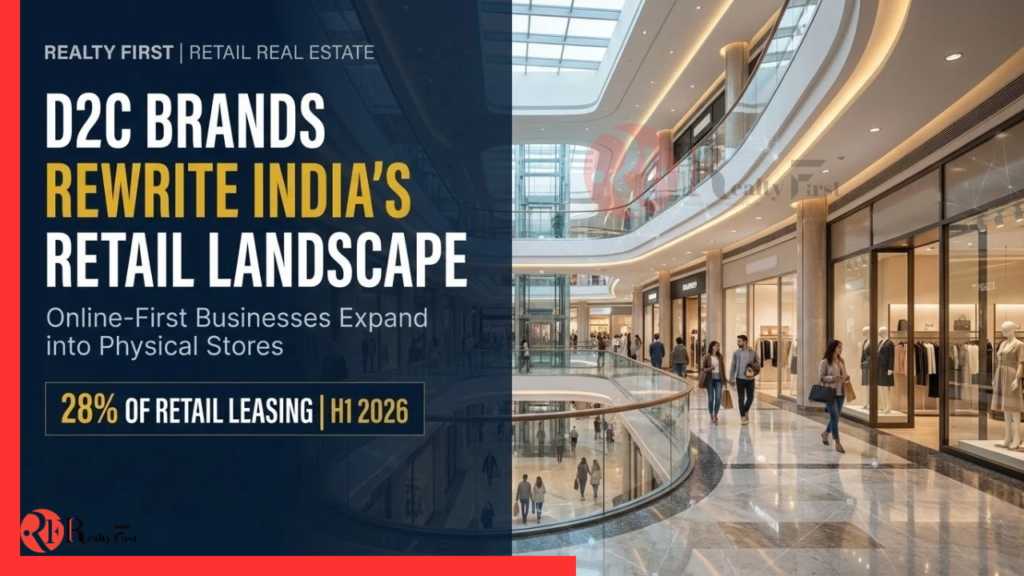
India’s retail property market is seeing a growing contribution from direct-to-consumer (D2C) brands, as online-first businesses expand into physical stores to build brand recognition, improve customer engagement and strengthen consumer trust.
According to CBRE, D2C brands accounted for around 28% of India’s overall retail leasing activity in January-June 2026, up from approximately 23% in H1 2025. Total retail leasing rose 20% year-on-year to around 3.9 million sq. ft. during H1 2026, reflecting continued demand from retail occupiers.
Delhi-NCR led retail space take-up, accounting for 35% of the total, followed by Chennai at 17% and Mumbai at 15%. The figures point to a changing relationship between digital commerce and physical retail, with stores increasingly serving purposes beyond completing transactions.
For D2C businesses, physical outlets are becoming part of a broader brand strategy. They offer customers an opportunity to experience products first-hand, interact with staff and assess quality before making a purchase. This can be particularly relevant for brands seeking to establish credibility as they move beyond online channels.
“D2C brands are bringing a different approach to physical retail. The store is increasingly being viewed as an extension of the brand rather than just a sales outlet. This is creating strong demand for well-located spaces within quality malls and retail destinations, where footfalls, ambience and the overall customer experience can strengthen brand recall. For malls, this also creates an opportunity to curate a more dynamic and experience-led tenant mix,” said Nandini Taneja, CEO, Bhumika Enterprises.
The expansion is also influencing the formats brands choose. Rather than depending solely on conventional large-format outlets, D2C companies are exploring experience centres, smaller stores, pop-ups, shop-in-shop concepts and flagship locations. These options allow businesses to establish an offline presence while managing capital expenditure and the risks associated with expansion.
CBRE has also identified micro-stores and curated multi-brand platforms as alternative models for D2C companies entering physical retail. Such formats can give brands greater flexibility as they assess markets and build their store networks.
For developers and landlords, the growing offline footprint of digital-first businesses creates potential demand across multiple retail formats, including established shopping malls, high streets, mixed-use developments and emerging retail destinations. However, location decisions increasingly involve more than rental costs. Catchment characteristics, consumer demographics, visibility, accessibility and the ability to connect online and offline sales channels are also becoming important considerations.
“India’s retail market is moving towards a more nuanced expansion cycle. D2C brands are no longer looking at physical stores simply for reach; they are using them to test markets, understand consumer behaviour and create stronger offline-online integration. This is likely to support demand for strategically located retail assets across established as well as emerging consumption corridors,” said Azad Ahmad Lone, President, Biigtech.
Fashion and apparel accounted for around 69% of D2C retail leasing activity in H1 2026, making it the largest contributing category. Homeware and furnishings followed at 12%, while jewellery accounted for 7%. The category mix underscores the relevance of physical stores for products where customers may want to examine materials, try items, assess design or receive personalised assistance before buying.
Physical retail can also help brands address some of the limitations of online-only shopping. Direct interaction with products and staff may help consumers evaluate their options and develop confidence in a brand, particularly in categories where touch, trial and visual presentation influence purchase decisions.
The move into physical stores does not signal a retreat from digital commerce. Instead, it reflects how D2C businesses are incorporating offline channels into their wider omnichannel strategies as they mature. Retail outlets can complement digital platforms by supporting product discovery, customer interaction and brand visibility.
Also Read: How Infrastructure Development Is Transforming Panipat’s Housing Market
For India’s retail real estate sector, the trend presents an opportunity to adapt leasing strategies and store formats to the requirements of digitally native occupiers. With overall retail leasing growing and D2C brands accounting for a larger share of activity, demand is increasingly being shaped by businesses that began online but are turning to physical locations to build longer-term consumer relationships.