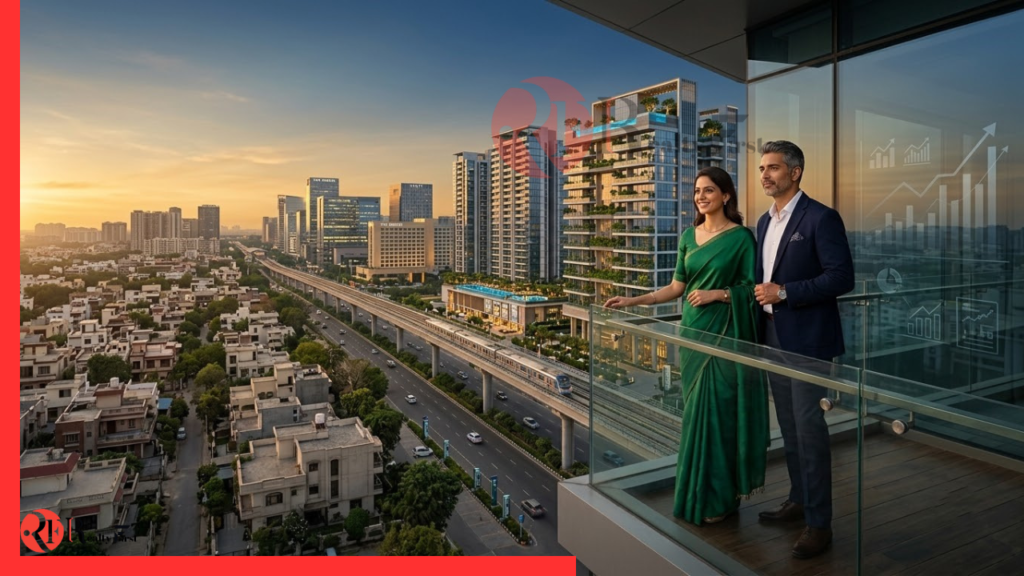
India’s luxury housing market is undergoing a structural transformation, with premium residences increasingly being viewed as long-term wealth assets rather than lifestyle purchases alone. Affluent buyers are no longer restricting their search to established addresses. Instead, they are actively evaluating emerging growth corridors that offer superior infrastructure, stronger connectivity and the potential for sustained capital appreciation. This shift reflects a broader change in investment behaviour, where residential real estate is becoming an integral part of wealth preservation and portfolio diversification.
The trend is supported by broader market indicators. Knight Frank’s Wealth Report projects India to remain among the world’s fastest-growing wealth markets over the coming years, while ANAROCK has consistently reported that luxury housing now accounts for an expanding share of residential sales across major cities. Although these reports highlight the scale of growth, they also point to a deeper behavioural shift among high-value homebuyers.
Also Read: Flight to Quality: Why Premium Housing Is Reshaping India’s Residential Real Estate Market
Priyamvada Navet, Dy CEO, Experion, said, “India’s luxury housing segment is undergoing a profound shift – from being viewed purely as a lifestyle purchase to a core component of long-term wealth strategy. Today’s discerning buyers, especially HNIs and global Indians, see premium homes not just as spaces of refined living but as high-conviction assets that deliver strong capital appreciation, rental yields, and portfolio diversification. Factors like limited supply of quality developments, rising aspiration levels, and robust economic fundamentals are accelerating this transition.”
Infrastructure has emerged as one of the most influential drivers of this evolving investment approach. Increasingly, buyers are making decisions based on how cities are expected to expand over the next decade rather than on present-day market conditions. While Golf Course Road continues to remain a preferred destination because of its established ecosystem, corridors such as Dwarka Expressway, Southern Peripheral Road and Noida Expressway are steadily attracting attention as future centres of urban growth.
Dr. Gautam Kanodia, Founder, KREEVA and Kanodia Group, said, “While affluent buyers today are driven by the prestige associated with a particular address, at the same time, they are also concerned by the quality of life that a location can sustain over time. Well-managed projects, wellness-focused design, environmental considerations and seamless connectivity have become central to purchasing decisions. The home is expected to perform multiple roles: as a residence, a long-term asset and a legacy investment for the next generation. That is a noticeable evolution from what we were seeing even five years ago.”
The concentration of multinational companies, global capability centres and high-value service industries within select business districts is also influencing residential demand. Premium housing demand is increasingly following clusters of higher-income employment rather than broader employment growth, helping explain why specific micro-markets continue to outperform despite fluctuations across the wider real estate market.
Prateek Tiwari, Managing Director, Prateek Group, says, “Noida Expressway reflects this shift particularly well. Improved regional connectivity, institutional development and expanding commercial activity have steadily strengthened buyer confidence. Many purchasers are entering these emerging locations not because they are looking for immediate gains but because they recognise that integrated infrastructure and planned development tend to support long-term value creation. The investment horizon has become considerably longer than it once was.”
Developers are also witnessing buyers entering emerging locations much earlier in the development cycle. Rather than waiting for infrastructure projects to be completed, many affluent investors are positioning themselves in anticipation of future value creation as civic infrastructure and social ecosystems mature.
Ashwani Kumar, Pyramid Infratech, said, “We see buyers entering growth corridors much earlier than before. They understand that once physical infrastructure is complete and social ecosystems mature, pricing usually adjusts accordingly. Rather than waiting for a location to become fully established, many affluent investors are comfortable identifying future potential at an earlier stage. That reflects greater confidence in infrastructure-led urban development as well as a more disciplined approach to long-term wealth creation through residential real estate.”
Also Read: India’s Infrastructure Boom Needs a Capital Strategy, Not Just Execution
The changing dynamics suggest that NCR’s premium residential market is no longer shaped solely by where wealth currently resides. Instead, investment decisions are increasingly being guided by expectations of where future urban expansion, infrastructure development and economic activity will converge. While the shift may appear gradual today, it has the potential to redefine the region’s luxury housing landscape over the coming years.