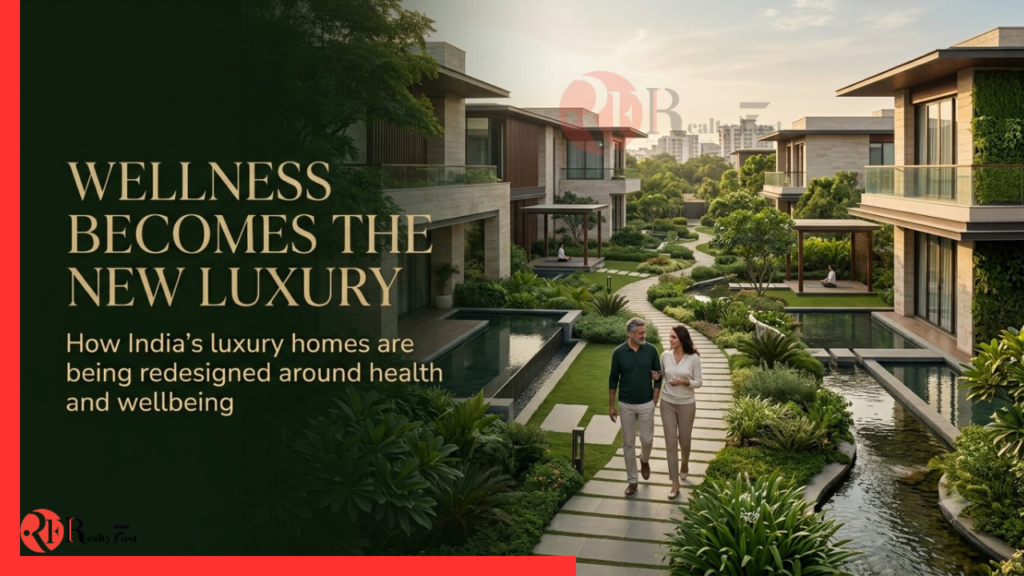
India’s luxury housing market is seeing a shift in what affluent buyers expect from premium residences, with developers increasingly placing wellness, preventive healthcare and long-term wellbeing at the centre of project design.
The change is moving the definition of luxury beyond large homes, imported finishes and expansive clubhouses. Developers are now exploring low-density masterplans, biophilic architecture, clean-air systems and integrated health infrastructure, as wealthy homebuyers increasingly regard their residences as long-term lifestyle assets rather than simply financial investments.
The shift comes as luxury housing continues to outperform the broader residential market, even as affordability pressures affect mass-market housing demand.
The trend also mirrors a wider transformation in global real estate. According to the Global Wellness Institute, wellness real estate is the fastest-growing segment of the global wellness economy. The segment stood at $584 billion in 2024 and is projected to nearly double to $1.1 trillion by 2029. Developers are increasingly incorporating wellness into neighbourhood planning and residential design instead of limiting it to premium amenities.
Also Read: Mumbai Records 1,499 Luxury Home Transactions Worth ₹14,903 Crore in Q1 FY27
Wellness Becomes Part of Luxury Housing Design
Indian developers say the post-pandemic homebuyer has become more selective about the quality of the living environment. Factors such as privacy, environmental quality and everyday liveability are increasingly being considered alongside location and brand when affluent consumers assess residential purchases.
Recent market data from JLL showed a sharp rise in premium housing launches during the first quarter of 2026, pointing to continued demand in the upper end of India’s residential market.
Some developers say the emphasis on wellness predates its emergence as a prominent industry theme.
Yukti Nagpal, Director, Gulshan Group, said, “Luxury today is moving beyond premium specifications to encompass healthier, more meaningful ways of living. Buyers increasingly value open spaces, greenery, privacy and a stronger connection with nature. At Gulshan Group, this thinking has been integral to all our projects, including our recently handed over Gulshan Dynasty, where low density planning and expansive green landscapes were designed to enhance everyday well-being. We believe wellness is fast becoming a defining dimension of luxury housing.”
The approach is now extending beyond individual design features towards entire residential ecosystems.
Developers Build Around Preventive Health and Longevity
Trehan IRIS is positioning wellness as the foundation of its residential offering rather than as an additional amenity. Its recently launched Omara in Gurugram is positioned as “India’s First Luxury Well-being Residences”, combining preventive health, a dedicated longevity clinic, recovery, movement, nutrition and environmental design within a single residential ecosystem.
The project also includes wellness experiences curated in association with partners such as L’Occitane & Knox.
The strategy reflects a broader evolution in global wellness real estate. Developers are increasingly moving beyond conventional gyms, spas and fitness facilities towards residential environments designed to support long-term wellbeing and healthier lifestyles.
The Global Wellness Institute identifies longevity, healthy buildings and community-scale wellbeing among the key themes influencing the next generation of residential development.
Aman Trehan, Executive Director, Trehan IRIS, said, “The future of luxury living is not simply about creating more refined spaces, but about creating environments that meaningfully enhance the way we live. Omara has been conceived as a residential ecosystem where preventive health, architecture and everyday experiences come together to foster a more holistic approach to wellbeing. At Omara, wellness is not an amenity within the project. It is the organising principle behind it.”
Wellness-Led Housing Moves Beyond Metros
Developers also expect wellness-focused residential demand to extend beyond India’s largest metropolitan markets.
Nimbus Group is preparing wellness-led residential developments across Tier I and Tier II cities, pointing to rising health awareness and improving infrastructure as factors that could expand demand beyond established luxury destinations.
Yamini Agarwal, Director, Nimbus Group, said, “Health-conscious homebuying is no longer confined to metropolitan India. Buyers across Tier I and Tier II cities increasingly associate quality housing with cleaner environments, better planning and long-term wellbeing. We see wellness becoming a mainstream design philosophy rather than a niche luxury offering.”
Whether wellness will translate into a sustained pricing advantage for developers remains uncertain. But the direction of the luxury housing market suggests that competition is increasingly moving beyond taller towers, larger homes and bigger clubhouses.
Also Read: Real Estate Sector Welcomes MahaRERA’s Automatic Four-Month Project Timeline Extension
For India’s affluent homebuyers, the next measure of luxury could increasingly be whether the built environment can deliver a healthier and more liveable everyday experience.