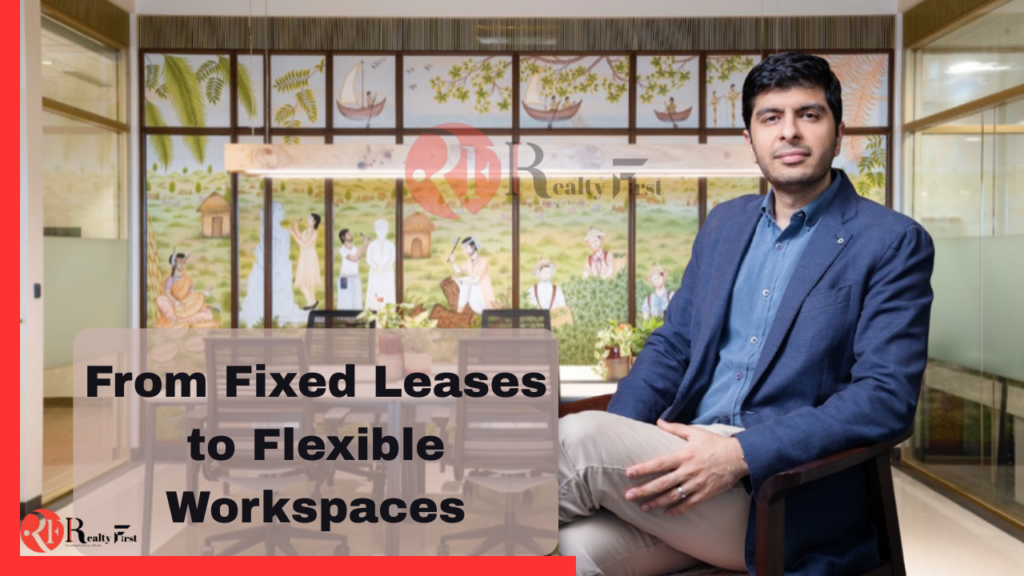
By- Robin Chhabra, CEO & Founder of Dextrus.
As companies rethink cost, culture, and agility, managed workspaces are emerging as the new default for India’s evolving business landscape.
The Indian workplace has undergone more transformation in the last five years than in the preceding two decades. What began as a pandemic-led disruption has now matured into a structural shift: companies are moving away from long-term traditional leases and increasingly adopting managed office solutions. This shift is not merely a reaction to uncertainty—it signals a deeper behavioural and operational recalibration in how organisations use, value, and invest in workspace.
As someone who has spent years designing and building work environments, I see this change as part of a larger narrative: workspaces are no longer static real-estate decisions but dynamic, strategic tools. And managed offices offer exactly that—strategic flexibility.
Everything is going from Fixed to Fluid
For decades, Indian commercial leasing revolved around one model: long-term commitments, large deposits, capital expenditure, and zero flexibility. Companies planned for 10–15 years ahead, calculating headcount growth and designing offices with permanence in mind. Today, that mindset no longer aligns with business realities.
Three major shifts have accelerated the decline of traditional leasing:
1. The volatility of headcount planning
Hiring cycles, hybrid roles, and distributed teams have made it nearly impossible for companies to forecast long-term space requirements. Locking into large square-footage commitments is now seen as a financial risk rather than stability.
2. The rise of OPEX over CAPEX
Enterprises prefer operational expenditure—predictable, scalable, and free from upfront investments—over massive capital deployments for interiors, technology, compliance, and maintenance. Managed offices convert what was once a capital-heavy project into a service-led model.
3. The need for speed
Traditional leases require months of planning, approvals, and build-outs. Managed office providers deliver fully functional, compliant spaces in a fraction of the time, allowing businesses to move with market velocity.
The Managed Office Value Proposition is More Than Just Flexibility
At the surface, managed offices offer scalability and plug-and-play environments. But the reason they are winning is deeper—they optimize the entire lifecycle of workspace management.
1. A triple-layered efficiency model
Managed offices operate at the intersection of real estate, hospitality, and technology. This blended model delivers:
- Operational efficiency: Centralised housekeeping, security, utilities, and compliances.
- Experience efficiency: Focus spaces, collaborative zones, ergonomic design, greenery, and natural light.
- Financial efficiency: Transparent, predictable cost structures without the burden of long-term liabilities.
This integrated ecosystem is something traditional leases cannot match without significant internal investment.
2. A design lens built for human performance
Most legacy offices were constructed from the landlord’s perspective—maximising rentable area. Managed office operators today design from the occupant’s perspective—maximising usability, comfort, and performance.
Spaces are created to support:
- Deep-focus work
- Movement and well-being
- Collaboration and serendipity
- Brand expression
- Employee belonging
In an era where retention and productivity matter more than ever, the workspace has become an asset, not just an address.
3. Technology as the invisible backbone
From access control and visitor management to room booking systems, IoT-led energy optimisation, and security protocols—managed offices bring sophisticated infrastructure that enterprises benefit from immediately. Traditional leases typically require organisations to deploy this themselves. In a managed setup, it is fully integrated, future-ready and can be a shared resource which often can be prohibitive when adopted singularly.
Large Enterprises Are Leading the Shift
While coworking initially served freelancers and startups, the narrative has decisively shifted. Today, the strongest demand for managed offices comes from large enterprises and multinationals.
Their motivations include:
1. Multi-city footprints without operational overload
Expanding into new markets is easier when workspace setup is no longer a logistical project but a service request.
2. Consistent brand experience across locations
Managed offices allow organisations to create and maintain their brand ethos in interiors, layouts, and experience—without building everything from scratch.
3. Hybrid and distributed teams
Many companies now maintain multiple smaller offices closer to talent pools rather than one large headquarters. Managed spaces enable this spoke-and-hub model efficiently.
4. Risk mitigation
Traditional leases involve long lock-ins and unpredictable maintenance costs. A managed model offers contractual agility and removes operational risk.
Enterprises today are not merely renting space—they are outsourcing workspace management as a specialised service.
The Economics: Cost Reductions Without Compromising Quality
One of the most compelling reasons behind this shift is economic optimisation. A typical traditionally leased office requires Security deposits, Fit-out CAPEX, Long lock-in periods, Furniture, equipment, technology, Compliance and licensing, Amc’s, Repairs and renewals, Recurring operational overheads. Most of these are variable and unpredictable.
Managed offices convert this entire setup into one consistent monthly cost with zero surprises. When organisations evaluate total cost of ownership (TCO), managed spaces often lead to savings of 20–35% over a 3–5 year period.
This clarity and control are especially crucial in today’s dynamic business environment.
Managed Spaces Expand Market Access
Premium commercial real estate in Tier-1 cities is becoming increasingly competitive and expensive. Managed office providers help companies secure spaces in grade-A developments that might otherwise be inaccessible.
Moreover, as Tier-2 cities mature—Indore, Kochi, Jaipur, Coimbatore, Lucknow—the demand for managed offices is increasing exponentially. These markets benefit from:
- A rising corporate presence
- Growing skilled talent pools
- Lower real-estate costs
- Demand for premium, ready-made infrastructure
The ability to activate high-quality workspace quickly is accelerating economic participation in these regions.
The Future: A Hybrid Ecosystem of Workspaces
The debate between traditional leases and managed offices is not a binary one. Both models will continue to coexist. But the proportion is shifting—and significantly in favour of managed solutions. The next decade of workplace evolution will be shaped by:
1. Demand for experience-centred design
Offices will increasingly focus on emotional comfort, belonging, and wellness—not just desks and cubicles.
2. Flexible commitments and portfolio fluidity
Companies will maintain a mix of long-term anchors and short-term managed hubs.
3. Technology-enabled operations
AI-led facility management, smart energy systems, and data-driven layout optimisation will become standard.
4. Sustainability as a workspace mandate
Green buildings, energy-efficient materials, and conscious design will drive site selection and build-outs.
Managed offices are already aligned with these shifts—and will continue to lead innovation in these areas.
The rise of managed workspaces is not a temporary trend—it reflects a deeper ideological shift toward agility, cost efficiency, human-centric design, and operational excellence. Traditional leases served a world where stability mattered more than speed. Today, businesses prioritise responsiveness, optimisation, and culture. Managed offices help them achieve all three. As India’s work landscape evolves, the organisations that will thrive are those that view workspace not as a fixed asset, but as a living, adaptive ecosystem. And managed offices are the most future-ready expression of that philosophy.