Bengaluru’s real estate market has long been shaped by the city’s technology-driven economy, the rise of global capability centres, and a steady influx of skilled professionals. Over the past three decades, Fortune Primero has quietly built a strong presence within this ecosystem, focusing largely on premium commercial and industrial developments through a build–own–lease–manage model.
Today, under the leadership of Raahil Reddy, Director at Fortune Primero, the company is entering a new phase of growth. The firm is expanding into residential development while bringing with it the same long-term ownership philosophy and operational discipline that defined its commercial portfolio.
A Legacy Built on Long-Term Ownership
For over three decades, Fortune Primero focused primarily on commercial and industrial real estate. Unlike many developers who build and exit projects, the company adopted a model centered on ownership and long-term asset management.
The firm has accumulated over one million square feet of commercial and industrial space leased to a diverse tenant base that includes companies such as Tata Motors, Toshiba, US-based multinational firms, and several European industrial companies.
“We followed a very standard build–own–lease–manage model for all our commercial properties,” Reddy explains. “We maintained ownership of the assets rather than exiting them. That allowed us to build long-term relationships with tenants while continuously improving the properties.”
This approach not only ensured consistent asset appreciation but also helped the company build strong tenant relationships across sectors.
Why the Shift Towards Residential Development
While Fortune Primero had undertaken smaller residential projects in the past, the decision to enter large-scale residential development was driven by both market shifts and evolving buyer expectations.
One of the factors influencing this move was the changing landscape of the commercial real estate sector following the pandemic.
“Commercial real estate, particularly office space, has been evolving over the last few years,” Reddy notes. “Hybrid work models and shifting workplace preferences have slowed certain segments of office demand.”
However, the company’s entry into residential development is not merely a response to market conditions. It is also driven by an opportunity to rethink how developers engage with homebuyers.
Despite strong developers delivering quality homes, Reddy believes there remains significant room for improvement in customer communication and transparency.
Replacing Opacity with Technology
According to Reddy, one recurring challenge across the industry is the lack of transparency that buyers experience after the purchase agreement is signed.
“When we analysed customer feedback across the industry, we noticed a consistent pain point, transparency,” he says.
Often, buyers feel disconnected from the project’s progress once the transaction is completed, uncertain about construction timelines, approvals, or how funds are being utilized.
“The industry has historically been perceived as opaque. Our goal is to replace that opacity with transparency through technology.”
To address this, Fortune Primero is investing heavily in digital platforms that allow homeowners to track construction progress in real time.
Through a dedicated resident portal, buyers will be able to access construction milestones, documentation, approvals, and project updates. The platform will also include live camera feeds from construction sites, offering customers a direct view of the progress.
The company is also exploring artificial intelligence-driven systems that allow buyers to interact with project information, ask questions, and navigate developments through digital walkthroughs.
For Reddy, transparency is not simply a feature but a fundamental shift in how developers build trust with customers.
“When someone buys a home, it is often the largest investment of their life. They deserve clarity about what is happening with the project they have invested in.”
Designing Homes for a Post-Pandemic Lifestyle
Beyond transparency, Fortune Primero’s residential projects will reflect a design philosophy inspired by global developments while remaining grounded in Bengaluru’s local context.
The company’s upcoming flagship residential development in Sarjapur, on land it has held for nearly two decades, represents the first step in this new direction.
Reddy notes that the pandemic significantly reshaped housing preferences across Bengaluru.
“Before COVID, demand for premium housing in Bengaluru was relatively slower compared to smaller apartments,” he explains. “But after people spent more time living and working at home, priorities changed.”
Homebuyers today are seeking larger living spaces, improved layouts, and communities that offer a better lifestyle environment.
“The demand for bigger homes and better living environments has grown. People are willing to invest more in the experience of living.”
However, Reddy emphasises that residential demand continues to vary across different micro-markets.
When planning the Sarjapur project, the company carefully studied income levels, affordability ranges, and demographic trends before determining the project configuration.
“Understanding the customer is critical. The project design has to match the economic realities and lifestyle expectations of that specific micro-market.”
The Future of Bengaluru’s Skyline
Bengaluru has historically maintained a relatively low-density skyline compared to cities like Mumbai. However, Reddy believes vertical development will inevitably increase in the coming years.
Government policies that allow higher floor area ratios and transferable development rights are already encouraging taller developments across the city.
Yet he stresses that vertical growth must be balanced with thoughtful planning.
“The ideal scenario is to build taller structures on larger land parcels,” he says. “If a tower rises forty floors within a ten to fifteen acre development, you can still preserve significant green spaces while offering the advantages of high-rise living.”
Such planning ensures that density does not compromise environmental comfort — a quality that remains central to Bengaluru’s identity as a green city.
The Rise of Integrated Urban Communities
Reddy also believes that integrated townships and mixed-use developments will become increasingly important in Bengaluru’s urban future.
With traffic congestion emerging as one of the city’s biggest challenges, self-contained communities that combine housing, retail, office spaces, and recreational amenities are gaining popularity.
“These developments allow people to live closer to where they work and access essential services within walking distance,” he explains.
Over time, he expects Bengaluru to evolve into a network of interconnected urban clusters — a central business core supported by multiple integrated township ecosystems.
Such development patterns could significantly improve quality of life by reducing commute times and creating more balanced urban environments.
A Philosophy Built Around Trust
For Fortune Primero, the long-term vision extends beyond individual projects.
Reddy believes the company’s legacy will ultimately be defined by the trust it builds with customers.
“If I had to prioritise one value for our brand, it would be trust,” he says.
Innovation and sustainability are important pillars of the company’s strategy, but trust, he argues, is what ultimately defines a developer’s reputation.
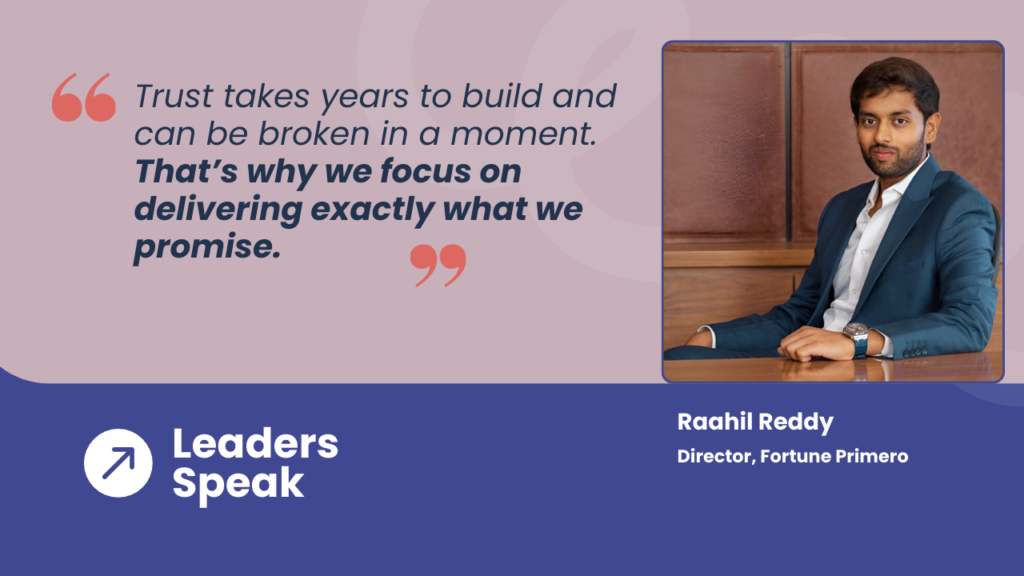
“Trust takes years to build and can be broken in a moment. That’s why we focus on delivering exactly what we promise.”
This philosophy is reflected in what he describes as the company’s guiding principle — building to last.
Building Cities as a Creative Responsibility
For Reddy, real estate development is not just a commercial activity but also a creative and civic responsibility.
“I like to think of what we do as a form of art,” he reflects. “An artist has a canvas and paints something meaningful. In our case, the world becomes our canvas.”
Every project, he believes, should contribute positively to the city and the communities that inhabit it.
“If we can make the world slightly better with every project we build, then we know we are moving in the right direction.”