By Jash Panchamia, Promoter, Suraksha Smart City
The boundaries of Mumbai have expanded to house the bourgeoning financial and industrial expansion. The expansion has gone beyond Borivali, once the last frontier of Mumbai. Presently, the townships beyond Borivali are fast emerging as Mumbai’s next superfast growth corridor.
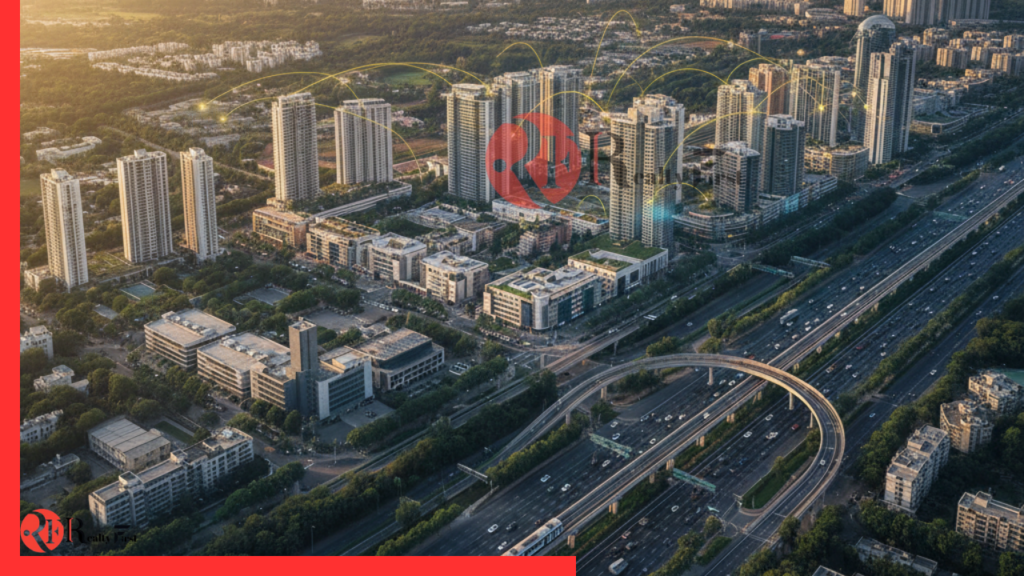
Suburbs such as Mira-Bhayandar and Vasai have become the keystone of Mumbai’s plan to decongest the core city in terms of population, economic pressures, and infrastructural bottleneck. Lack of space to expand the city’s socio-economic growth, and rising costs of the limited available space has pushed the city planners for the infrastructural, commercial, industrial, trade, and residential projects beyond Borivali on the western line of Mumbai along with NH48 to boost the city’s growth and this region is now an integral part of Mumbai 4.0
The major infrastructural developments pushing this growth include metros, rail corridors, port developments, and highways. The recent metro connectivity and developments will ease travel time, thereby improving work-life productivity. Metro Line 9 of the Red Line will connect Dahisar East with Mira-Bhayandar and is expected to ease congestion along the Western Railway Corridor once it opens. Meanwhile, the proposed Gold Line 8 will link Mumbai’s current airport with the upcoming Navi Mumbai airport, reducing travel time between the two and giving areas like Mira-Bhayandar and Vasai easier airport access through interchanges with Lines 7 and 9.
Continuing with the infrastructural growth, the ongoing Thane-Borivali Twin Tunnel will be India’s widest and longest urban road tunnel. It will transform the travel experience with lowered travel time and pollution, and minimal congestion. The way Mumbai travels in the future will change with this tunnel. Additionally, rail link corridors like the Panvel-Borivali-Vasai, coastal roads connecting Versova and Bhayandar and Anand Nagar in Thane with the Eastern Freeway, and logistic corridors like Samruddhi Mahamarg, will contribute to ease in travel time, and lower overall costs spent on travel or goods transport over land.
Infrastructural developments in suburbs like Vasai and Mira-Bhayandar equals to rapid and well-thought-out industrial and commercial growth. Government agencies and private players in industrial and commercial sectors can benefit from the connectivity in areas like supply chain efficiency, and reduced logistics costs. Rising real estate costs due to space constraints in Mumbai have been an issue. The new hubs in places like Vasai and Mira-Bhayandar boosted by the infrastructural growth, will reduce the pressure on Mumbai and provide economic and job opportunities to these areas. The growing businesses in these areas mean better productivity and communication, along with energy.
Along with connectivity ease and support for economic boost, the employment and business opportunities will be on a rise. At a time when the country’s economic growth is dependent on ease in transportation and well-planned industrial hubs, the ease in travel and transport of goods with more planned and expansive business establishments will allow Mumbai to grow its share in India’s economic boom. There are already plans in place to develop newer business and logistics zones in these suburbs. The Vadhvan and Dighi ports are in the running to play a key role in easing transport costs and assistance and lower pressure on Mumbai.
There will be a noticeable rise in sectors in these suburbs with high levels of productivity ranging from financial sector, biotechnology, and healthcare to logistics and warehousing, and chip manufacturing. It means an increase in direct and indirect employment prospects.
These overall developments will act as the precursor for growth in residential areas. It is heightened by lack of the necessary available space in Mumbai to offer homes for the growing population. Also, high rates in main suburbs of Mumbai means areas like Vasai and Mira-Bhayandar offer space for affordable and spacious residential development. The infrastructural, industrial, and commercial advances have pushed the popularity of these locations for complete residential offerings.
The boost in residential development has also come from the affordable rates. The target buyers are the young crowd looking for spaces at these areas within their budget. Real estate giants are converting this demand into launching and building gated townships for such clientele. Buyers are now looking at options of high-end to mid-budget homes complete with facilities suitable for all their needs. Furthermore, many areas have developed or have planned suitable supportive facilities like schools, malls, shopping centres, hospitals, and recreational zones. These areas will be a self-sufficient bubble for the residents.
Townships beyond Borivali in are fast becoming Mumbai’s new growth corridor with its development to offer a high-quality work-life balance. The future will see a noticeable rise in affordable modern living backed by state-of-the-art infrastructure, and booming economic growth.