
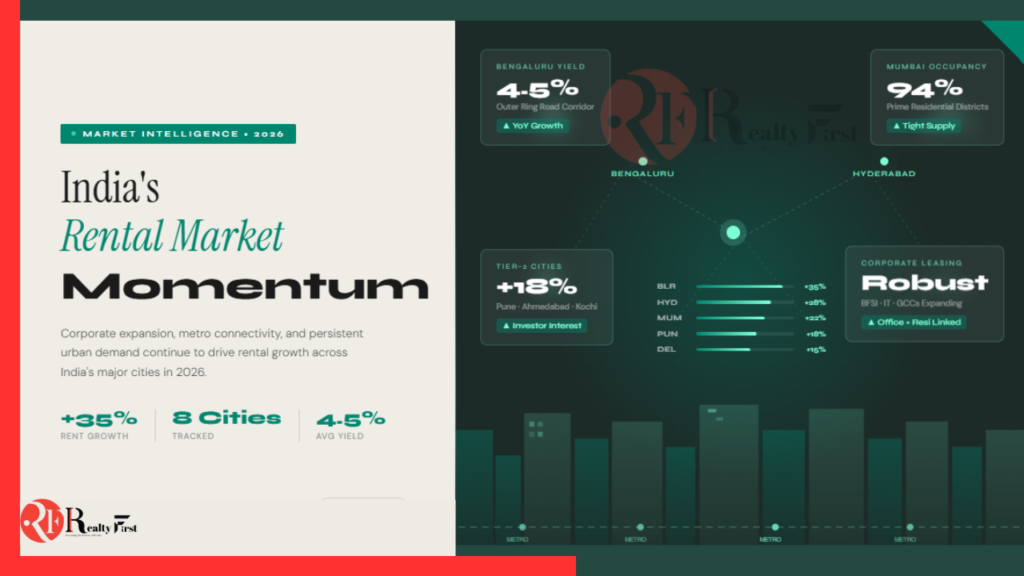
New Delhi: India’s residential rental markets across major metropolitan cities are continuing their upward trajectory in 2026, supported by sustained corporate expansion, infrastructure upgrades, and persistent housing demand. According to the latest 2026 market assessments released by leading real estate consultancies, including JLL, Knight Frank, and CBRE, rental values in key Tier 1 cities have remained firm, with several micro-markets recording year-on-year growth amid tight supply conditions.
Major cities such as Mumbai, Bengaluru, Delhi, and Hyderabad continue to lead rental growth in 2026. Industry data indicates that employment-driven housing demand, particularly in technology, financial services, consulting, and global capability centers, has kept occupancy levels high in core business districts and well-connected suburban corridors.
“Leasing momentum observed in 2025 has carried into 2026, particularly in employment-centric micro-markets,” a senior residential analyst at JLL said in its latest quarterly commentary. “Return-to-office mandates, combined with workforce expansion in technology and BFSI sectors, are supporting steady rental absorption across metropolitan India.”
Also Read: Home Loan Interest Rate Outlook 2026: What Borrowers Should Expect Next
Mumbai’s prime residential districts have maintained strong rental levels due to constrained inventory and high tenant demand near commercial hubs. In Bengaluru, continued expansion of IT parks and global capability centers has reinforced rental growth in areas adjacent to Outer Ring Road and Whitefield corridors. Hyderabad’s financial district and western micro-markets remain among the most active leasing clusters, supported by steady corporate hiring.
Office market performance has further reinforced residential rental demand. According to CBRE’s 2026 India Office Outlook, gross leasing volumes across major cities remain robust, reflecting corporate confidence and expansion plans. Sustained office absorption in Bengaluru, Hyderabad, Mumbai, and Pune has translated into stable housing demand within commuting distance of commercial zones.
Meanwhile, rental growth is not limited to Tier 1 cities. Emerging urban centers such as Pune, Ahmedabad, and Chennai are witnessing consistent rental activity. Analysts note that comparatively lower capital values in these cities are delivering stronger rental yields relative to premium metro markets. This has prompted increased investor interest in diversified residential portfolios.
Knight Frank’s 2026 residential update highlights that infrastructure development continues to influence rental patterns. Metro rail expansions, new expressways, and airport upgrades have improved connectivity in peripheral neighborhoods, contributing to rental appreciation in newly accessible zones. Areas located near operational metro corridors are reporting higher occupancy and tenant preference.
However, affordability remains a key concern. While rental demand remains healthy, industry reports indicate that tenants in select micro-markets are allocating a larger share of household income toward housing costs. Real estate advisors observe that this dynamic is prompting gradual migration toward suburban nodes offering relatively moderate rent levels without sacrificing connectivity.
Also Read: Best Localities for First-Time Buyers: Your Complete Guide to Finding the Right Home in 2026
Interest rate conditions in early 2026 have also played a role in sustaining rental demand. With home loan rates stabilizing but remaining above pandemic-era lows, some prospective buyers continue to delay purchases, thereby supporting rental occupancy levels in urban centers.
Looking ahead, property consultants project moderate but stable rental growth through the remainder of 2026. While sharp spikes may normalize as new residential supply enters the market, demand linked to employment clusters and infrastructure-led expansion is expected to sustain rental resilience in major cities.