Think back to the last time you bought something significant without seeing it in person first. For most of us, that idea still feels uncomfortable. And yet, in the world of real estate, virtual site visits are quietly but powerfully rewriting the rules of property discovery, shortlisting, and even purchase. Imagine being able to walk through a two-bedroom apartment in Bengaluru while sitting in your office in Mumbai, or touring a beachside villa in Goa before you have even booked your flight. That is not a distant, futuristic scenario. It is happening right now, in 2026, and it is changing the way buyers, developers, and brokers think about property buying in ways that would have seemed extraordinary just a few years ago.
The shift toward virtual site visits is not simply a matter of convenience, though convenience is certainly a big part of the appeal. It represents a deeper transformation in how information is consumed, how trust is built between buyers and sellers, and how geographic barriers that once limited a buyer’s options have begun to dissolve. For first-time home buyers, the ability to explore dozens of properties digitally before narrowing down to two or three physical visits is a game-changer in terms of time, cost, and decision-making quality. For developers, offering high-quality virtual tours has become a competitive necessity rather than an optional feature. And for the real estate sector as a whole, the rise of virtual site visits is accelerating proptech adoption at a pace that is reshaping the entire industry. In this article, we will explore what virtual site visits really involve, why they are gaining momentum, and what buyers, investors, and developers need to know to stay ahead of this curve.
What Are Virtual Site Visits and How Do They Work?
Virtual site visits are digital experiences that allow a prospective buyer or investor to explore a property remotely, as if they were physically present on-site. The technology powering these experiences ranges from simple 360-degree photo tours stitched together from a smartphone to highly immersive, headset-based virtual reality walkthroughs that let you move through every room, step out onto the balcony, and even look up at the ceiling to assess the quality of the fittings. The sophistication of the experience varies considerably depending on the technology the developer or broker has invested in, but even at its most basic level, a good virtual tour provides far more information and emotional resonance than a set of static photographs ever could.
At the higher end of the spectrum, modern virtual site visits in 2026 incorporate spatial audio, allowing you to hear the ambient sounds of the surrounding neighbourhood from within the tour. They include interactive elements that let you change wall colours, switch between furnished and unfurnished views, and even swap out flooring materials or kitchen countertop finishes to see how different design choices would look in the actual space. Some platforms now use artificial intelligence to generate photorealistic renders of under-construction properties based on architectural plans, giving buyers a remarkably accurate preview of what a project will look like on completion. The technology is not perfect, and experienced buyers know to visit in person before signing any agreement. But as a research and shortlisting tool, virtual site visits have become extraordinarily powerful.
The Technology Stack Behind Virtual Property Tours
The technology enabling virtual site visits today is a combination of several converging innovations. At the base level, high-resolution 360-degree cameras are used to capture photographic or video representations of completed properties. These are then stitched together using software platforms to create navigable tours that a buyer can access through a web browser on their phone or laptop, with no special equipment required. This form of virtual tour is the most widely available today and is increasingly standard practice among developers of mid-range and premium residential projects in major Indian cities. The quality of the experience depends heavily on the lighting conditions during the shoot, the resolution of the camera, and the care taken in constructing the digital journey through the property.
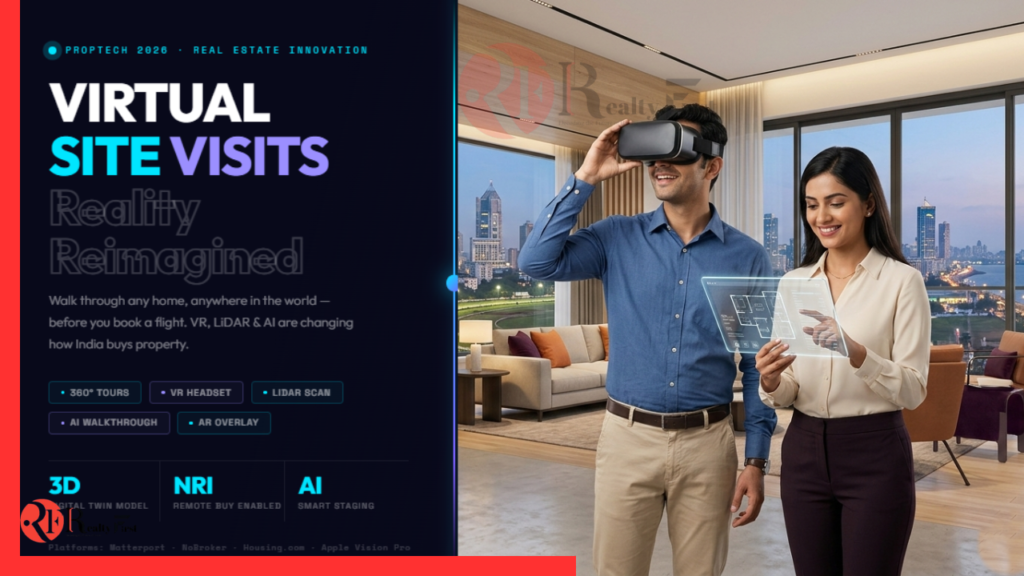
Beyond photo-based tours, the more sophisticated end of the virtual site visit spectrum uses LiDAR scanning technology to create precise three-dimensional models of spaces. LiDAR, which stands for Light Detection and Ranging, uses laser pulses to measure exact distances and construct centimetre-accurate digital replicas of physical spaces. These scan-based models can be explored in a Matterport-style interface where you can move from room to room, pull up floor plan views, and even measure the exact width of a window or the height of a doorway from within the digital environment. For buyers who are considering custom furniture purchases or renovation work, this level of detail is genuinely transformative. It removes the guesswork from a decision that is, for most families, the largest financial commitment of their lives.
VR Headsets, Augmented Reality, and the Next Frontier
While browser-based virtual tours are the most accessible form of virtual site visits today, the technology is moving rapidly toward fully immersive experiences powered by virtual and augmented reality. In 2026, VR headsets like the Apple Vision Pro, Meta Quest 3, and their successors have made high-quality immersive experiences available at a price point that is within reach of premium showrooms and real estate sales offices. Several leading developers in India and globally are now offering dedicated VR experience zones at their sales offices, where prospective buyers can don a headset and walk through a life-size digital replica of a property that may still be years from completion. The impact on buyer confidence is significant. Being able to stand inside a virtual living room and feel the proportions of the space, understand the flow between rooms, and experience the view from the master bedroom window creates a level of emotional connection with a property that no brochure or flat render can match.
Augmented reality is bringing a slightly different but equally exciting dimension to virtual site visits. With AR applications running on a smartphone or tablet, buyers visiting an empty shell of an under-construction flat can point their device at a bare concrete wall and see it transformed instantly into a furnished, decorated room with their chosen design palette. Developers are using this technology to allow buyers to experiment with multiple interior fit-out options in real time, during the physical site visit itself. This combination of physical presence and digital enhancement is creating a new category of hybrid site visit that blends the irreplaceable authenticity of being on-site with the flexibility and richness of digital property exploration.
Why Virtual Site Visits Are Becoming Essential for Home Buyers in 2026
There are several compelling reasons why virtual site visits have moved from a pandemic-era novelty to a mainstream expectation in the property market of 2026. The most fundamental driver is the sheer scale of today’s property market. A family in Hyderabad looking to buy a flat has access to listings in dozens of projects spread across multiple sub-localities, each with multiple configurations, floors, and facing options. Physically visiting even a fraction of these properties within a realistic time frame is simply not possible, particularly for dual-income households where weekends are precious. Virtual site visits allow buyers to do the essential work of narrowing down their shortlist from twenty projects to three or four targeted visits, saving weeks of travel time and enormous amounts of mental energy.
The second driver is the growing prevalence of out-of-city and Non-Resident Indian buyers who are purchasing property in cities other than where they currently live or work. NRI buyers from the Gulf, the United States, the United Kingdom, and Southeast Asia have historically been disadvantaged in the Indian property market because of their inability to physically inspect properties they are considering. Virtual site visits have partially addressed this disadvantage by giving remote buyers access to a level of visual and spatial detail that makes informed decision-making possible from thousands of kilometres away. Several developers now offer live, guided virtual tours where a sales agent accompanies the buyer through the property in real time via video call while the buyer asks questions and directs the camera to areas they want to examine more closely. This live format is proving particularly popular with NRI buyers who want the human element of a personal guided tour without the need to be physically present.
Time Savings and Decision Quality: The Buyer’s Perspective
From a pure buyer experience standpoint, the benefits of virtual site visits extend well beyond simple convenience. Research consistently shows that buyers who have done thorough virtual research before visiting a property in person arrive at the physical visit with much sharper, more specific questions, a clearer sense of what they are looking for, and a higher level of engagement with the developer’s sales team. This translates into better quality conversations, more confident decision-making, and a reduced likelihood of post-purchase regret. Developers who offer comprehensive virtual site visits report that buyers who engage with their virtual content before visiting in person have a significantly higher conversion rate than those who visit cold, which reflects the role of the virtual experience in pre-qualifying and emotionally engaging the buyer before the physical encounter.
For buyers who are comparing multiple projects simultaneously, virtual site visits also provide a consistent and comparable frame of reference. When you visit properties in person on different days, your memory of the first property has already begun to fade by the time you are standing in the third one. Virtual tours, which you can revisit as many times as you like, allow you to compare two properties side by side in a way that is simply not possible with physical visits alone. You can pull up the virtual tour of Project A and Project B on your laptop and systematically compare the kitchen layout, the bedroom proportions, the balcony views, and the finish quality, bringing a rigour to your shortlisting process that physical visits alone rarely achieve.
How Developers Are Using Virtual Tours to Boost Sales Velocity
From the developer’s perspective, virtual site visits have become one of the most effective tools in their pre-sales and marketing arsenal. The ability to offer immersive digital access to a project well before construction is complete allows developers to launch sales campaigns earlier, reach a geographically broader audience, and reduce the substantial costs associated with building and maintaining physical sample flats. A high-quality virtual tour, once created, can be used across a developer’s website, embedded in social media campaigns, shared via WhatsApp with prospective buyers, and accessed by channel partners and brokers across the country without any additional cost per exposure. The return on investment from a well-produced virtual tour is compelling, and forward-thinking developers in 2026 view it as a foundational marketing asset rather than a supplementary one.
Beyond the sales funnel, some developers are now using virtual site visit data to understand buyer behaviour and preferences in ways that were previously impossible. Analytics built into virtual tour platforms can tell a developer exactly which rooms buyers spend the most time in, where they pause and look around most carefully, which areas they skip through quickly, and what interactive features they engage with most frequently. This data is being used to refine product design, improve showroom layouts, and personalise follow-up conversations with individual buyers based on what their virtual tour behaviour reveals about their preferences. It is a level of buyer insight that no physical visit has ever been able to provide.
The Role of AI and Proptech in Enhancing Virtual Site Visit Experiences
Artificial intelligence is playing an increasingly important role in making virtual site visits more intelligent, personalised, and predictive. AI-powered recommendation engines are now capable of analysing a buyer’s stated preferences, browsing history, and virtual tour engagement patterns to suggest properties they are likely to find appealing, even before the buyer themselves has fully articulated what they are looking for. Platforms like NoBroker, Housing.com, and several newer proptech startups are using machine learning algorithms to create personalised property discovery journeys that feel almost curated by a knowledgeable friend rather than generated by an anonymous algorithm. This personalisation makes the virtual site visit experience far more efficient for buyers and far more targeted for developers and brokers.
AI is also transforming the quality and accessibility of virtual tours themselves. Automated virtual staging, where AI tools generate photorealistic furnished versions of an empty property from a set of photographs or architectural plans, has made it possible for even smaller developers and individual sellers to offer high-quality visual content without the expense of hiring photographers, staging companies, and 3D visualisation studios. Natural language AI assistants embedded within virtual tour platforms can answer buyer questions in real time as they explore a property digitally, providing information on carpet area, floor loading capacity, RERA registration details, nearby schools and hospitals, and EMI calculations based on current home loan interest rates. This convergence of virtual property exploration and intelligent information delivery is creating a buying experience that is genuinely more informative than most physical sales office visits.
Challenges and Limitations That Still Need to Be Addressed
Despite the enormous progress that has been made, virtual site visits are not without their limitations, and responsible commentary on the future of home buying requires an honest assessment of where the technology falls short. The most significant limitation remains the inability of any digital experience to fully replicate the sensory reality of a physical site visit. No virtual tour can tell you how noisy the neighbourhood is on a weekday morning, whether the lift lobby smells of damp concrete, how strong the mobile network signal is inside the flat, or whether the view from the master bedroom window is partially obstructed by a tree that was not visible in the tour photographs. These sensory and contextual details matter enormously to buyers, and they are the reason that experienced property advisors consistently recommend virtual tours as a powerful first step but caution against making a final purchase decision without at least one thorough physical visit.
Internet connectivity and device access remain barriers for a meaningful segment of the Indian buying population, particularly in smaller cities and rural areas where property transactions are also growing. While smartphone penetration in India is high, the quality of internet connectivity required for a smooth, high-definition virtual tour experience is not universally available. This means that developers who invest heavily in virtual tour technology may inadvertently be optimising their reach for an urban, digitally connected buyer demographic while remaining less accessible to buyers in emerging markets where their products may also be targeted. Bridging this digital divide is a challenge that both the technology sector and the real estate industry will need to address collaboratively as virtual site visits become a more central part of the property buying journey.
Trust and verification also remain open questions in the virtual site visit ecosystem. Buyers who have been exposed to digitally enhanced or selectively presented virtual tours that made a property appear more spacious, better lit, or better finished than it actually is have understandably developed a degree of scepticism about the authenticity of virtual content. The industry needs clearer standards around what constitutes an accurate versus an aspirational virtual representation of a property, and developers who consistently deliver what their virtual tours promise will build a significant trust advantage in a market where buyer confidence is hard-won and easily lost.
What the Future of Virtual Site Visits Looks Like Beyond 2026
The trajectory of virtual site visit technology points toward experiences that are increasingly indistinguishable from physical site visits in terms of sensory richness and informational completeness. Within the next few years, advances in haptic feedback technology will allow buyers wearing compatible devices to feel the texture of surfaces they are touching in the virtual environment. Spatial computing platforms will make it possible to have a full-scale virtual property experience in any physical space, without the need for a dedicated showroom or specialised equipment. AI-generated photorealistic renders of under-construction properties will become so accurate that buyers will be able to make informed purchase decisions based on virtual content alone for a wider range of property types.
The integration of virtual site visits with the broader legal and financial property transaction process is another major development on the horizon. Blockchain-enabled title verification, digital stamp duty payment, e-registration of sale agreements, and AI-assisted mortgage processing are all technologies that are already being piloted or deployed in various parts of the world and in select Indian states. As these digital transaction tools mature and integrate with virtual property exploration platforms, the theoretical prospect of completing an entire property purchase journey, from first virtual tour to final registered ownership, without a single physical visit to an office or a property, will move from a speculative idea to a practical reality for a growing number of buyers.
Also Read: Managed Offices Over Traditional Leases: Why India Is Moving Toward a New Workspace Future
Conclusion: Virtual Site Visits Are Not the Future. They Are the Present.
The conversation about virtual site visits being the future of home buying misses an important truth. For a rapidly growing number of buyers, developers, and real estate platforms in India and globally, virtual site visits are already the present. They are the way buyers first encounter properties, the way developers pre-sell projects before construction completes, and the way NRI and out-of-city buyers participate in markets that their physical presence would otherwise exclude them from. The technology is imperfect, and the physical site visit is not going away. But the role of the physical visit is shifting, from a first point of contact with a property to a confirmation and final validation of a decision that has already been substantially formed through digital exploration.
For buyers, the message is clear. Embrace virtual site visits as a superpower in your property search. Use them to explore widely, compare systematically, and arrive at physical visits informed, prepared, and with a clear sense of what you are looking for. For developers, the message is equally urgent. Buyers in 2026 expect virtual tour access as a baseline. Those who invest in high-quality, accurate, and feature-rich virtual experiences will build stronger buyer relationships, shorten their sales cycles, and command a meaningful competitive advantage in a crowded market. The future of home buying is digital-first and human-verified, and the businesses that understand this will lead the next decade of India’s real estate story.
Ready to explore your next home virtually? Start by searching RERA-registered projects in your target city, look for developers offering 3D walkthroughs or live virtual tour options, and make your shortlist from the comfort of wherever you are right now. Your dream home might be just a click away.