The National Capital Region’s next phase of urban expansion may not be defined by the outward spread of its existing cities. Instead, it could be shaped by high-speed regional transit.
As the NCR prepares for a significant population surge—from 7.86 crore today to 14.73 crore by 2041—urban planners face a fundamental challenge: where will nearly seven crore additional residents live over the next 15 years? According to the author, the answer increasingly lies in creating new transit-oriented urban centres rather than continuing to stretch the boundaries of Delhi, Gurugram or Noida.
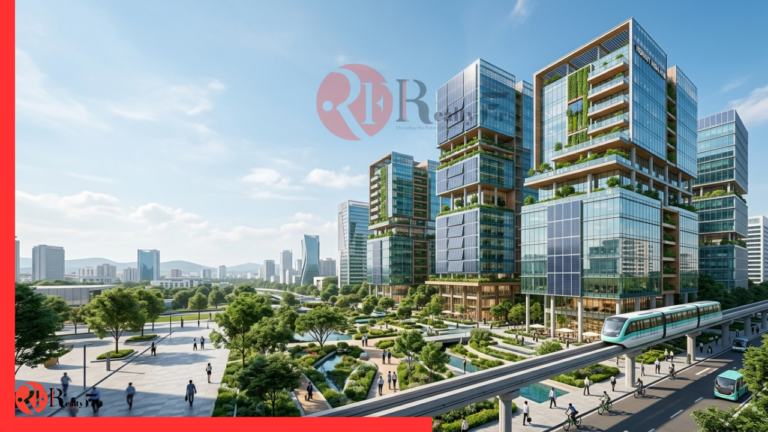
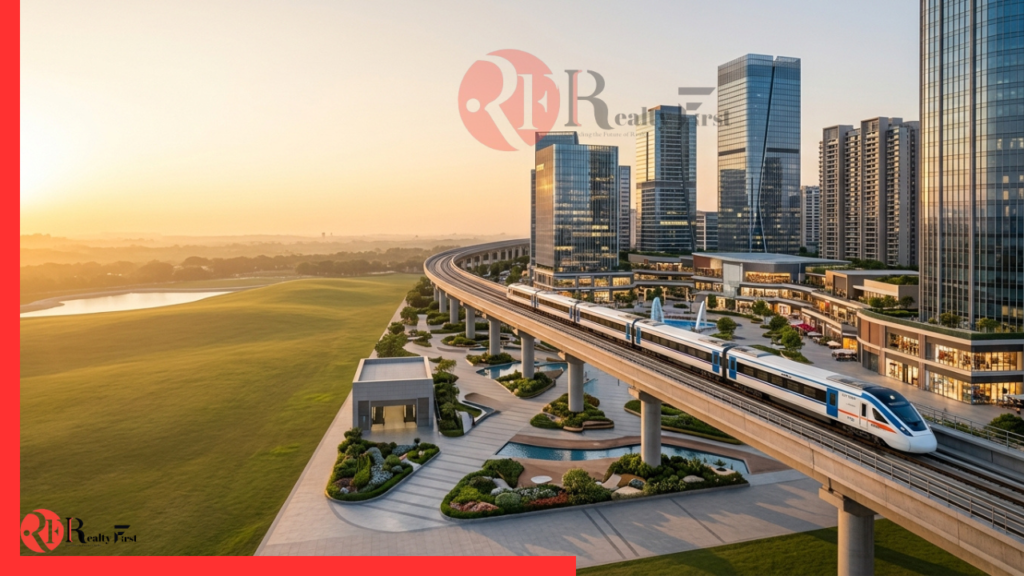
That strategy took a decisive step forward last week when the National Capital Region Planning Board approved the development of four new urban centres, popularly referred to as “Namo Cities,” under Regional Plan 2041. Conceived as semi-greenfield, mixed-use, transit-oriented developments (TOD) around existing and upcoming Namo Bharat stations, the proposed cities will be selected through a competitive process in which participating states submit proposals. The Centre has committed ₹5,000 crore over five years to support the initiative.
According to the author, the announcement represents far more than another housing initiative. It reflects a broader shift in how NCR’s future urban growth is expected to be planned.
Also Read: When Servers Replace Skylines: How Data Centres Are Reshaping India’s Real Estate
Infrastructure Has Always Shaped Real Estate Demand
The impact of transport infrastructure on property markets is already evident across the NCR.
India’s first Regional Rapid Transit System (RRTS) corridor—the Delhi–Ghaziabad–Meerut Namo Bharat corridor—has demonstrated how high-speed regional connectivity can influence real estate activity. By significantly reducing travel time while offering a faster, more comfortable and sustainable mode of transport, the corridor has emerged as a key catalyst for development along its route.
Property markets in Meerut, Ghaziabad, Muradnagar and Modinagar have responded strongly. Residential and commercial properties located within a two-kilometre radius of Namo Bharat stations have appreciated between 30 per cent and 67 per cent during the past two years. In Meerut, land prices have risen from ₹8,000–12,000 per sq. yard to ₹12,000–20,000 per sq. yard, illustrating the multiplier effect that improved regional connectivity can generate.
Commenting on the broader vision behind the project, Shalabh Goel, Managing Director, NCRTC, said:
“Namo Bharat was envisioned as a catalyst for sustainable and balanced regional development. Through enhanced accessibility, it will unlock new growth corridors, encourage development beyond traditional urban centres and foster vibrant transit-oriented communities that support long-term economic and social progress. By transforming regional connectivity and bringing people closer to opportunities, it is laying the foundation for a more integrated and polycentric NCR.”
The Next Wave of Growth Is Likely to Follow Transit Corridors
The relationship between infrastructure and property appreciation is not new.
Earlier regional plans, including Regional Plan 2021, promoted balanced development through counter-magnet cities. Yet, in practice, growth consistently followed major infrastructure investments rather than planning documents alone.
The Dwarka Expressway offers one of the clearest examples. According to a PropEquity study, residential launch prices along the corridor nearly doubled from ₹9,434 per sq. ft. in 2020 to ₹18,668 per sq. ft. in 2024, largely driven by improved connectivity and supporting infrastructure.
The author argues that the same principle now underpins the Namo Cities initiative. Under Regional Plan 2041, future urban expansion across the NCR is expected to revolve around high-speed regional mobility, creating a network of interconnected urban centres while substantially reducing travel times between key destinations.
Connectivity Is Changing the Geography of Real Estate
According to Vijay Ram Rattan, Chairman of Ram Rattan Group, the transformation represents a structural shift rather than a temporary market cycle.
“Every major value unlock in NCR has traced back to a connectivity inflection point. The RRTS changes the radius of viable real estate significantly. Locations that felt peripheral two years ago are now within commuting range of central employment nodes, and that repricing is only beginning. Classic case in point is Naugaon in Alwar District where my Group operates. Namo Bharat (RRTS) stations are coming up in Rajasthan as part of the 196 km Delhi-Gurugram-SNB (Shahjahanpur, Neemrana, Behror–Alwar) corridor.”
Attention is now increasingly focused on the proposed Delhi-Gurugram-SNB (Shahjahanpur-Neemrana-Behror) corridor, which is expected to connect emerging growth centres across Haryana and Rajasthan.
Market observers believe the corridor could replicate the success of the Delhi-Meerut route by opening up new investment destinations and accelerating urbanisation in locations that have so far remained underdeveloped.
The Next Gurugram May Not Be Another Gurugram
For nearly two decades, the NCR’s growth has largely centred around a limited number of dominant urban hubs. Delhi remained the administrative nucleus, Gurugram developed into the corporate powerhouse, while Noida evolved into a major residential and commercial destination.
Regional Plan 2041 reflects a different planning philosophy.
Rather than allowing existing cities to continue expanding indefinitely, policymakers are seeking to distribute future population and economic activity across multiple interconnected urban nodes linked by high-capacity transit infrastructure. According to the author, the objective extends beyond delivering additional housing. It is about creating entirely new economic centres capable of supporting the NCR’s next phase of growth.
Transit Alone Cannot Build a City
India has experimented with planned urban centres before, with varying degrees of success.
According to the author, what differentiates the Namo Cities initiative is that the transport backbone is being established first, with urban development planned around an operational mobility network instead of relying on infrastructure to arrive later.
However, rail connectivity by itself cannot guarantee successful urbanisation.
The author notes that Meerut has long enjoyed road and rail links with Delhi, yet the sharp increase in property values materialised only after the Namo Bharat project was announced.
Ultimately, employment opportunities, educational institutions, healthcare infrastructure, governance capacity and sustained private investment will determine whether these locations mature into self-sustaining cities or remain well-connected residential clusters.
Supporting this view, Vikram Singh, President – Project at Central Park, said:
“Homebuyers in NCR have matured considerably. They no longer make location decisions based on distance from Delhi alone. Infrastructure certainty, specifically knowing a corridor is funded and on schedule, is now a primary purchase trigger. The RRTS gives buyers that certainty across new corridors.”
Also Read: Why Andheri West Is Emerging as Mumbai’s Most Complete Western Suburb Growth Story
Execution Will Decide the Success of Namo Cities
The final locations of the four proposed Namo Cities are yet to be identified. Participating states will submit proposals before the sites are selected through a competitive evaluation process.
Even so, the broader direction is becoming increasingly clear.
As the NCR prepares to accommodate nearly seven crore additional residents by 2041, future urban expansion is expected to become increasingly aligned with regional mobility infrastructure. The underlying logic remains straightforward: people follow employment opportunities, businesses gravitate towards connectivity, and cities evolve where both converge.
According to the author, the Namo Cities initiative offers a significant opportunity to reshape NCR’s development pattern. Whether it becomes the region’s next urban success story, however, will ultimately depend on timely infrastructure delivery, efficient approvals and sustained economic activity.