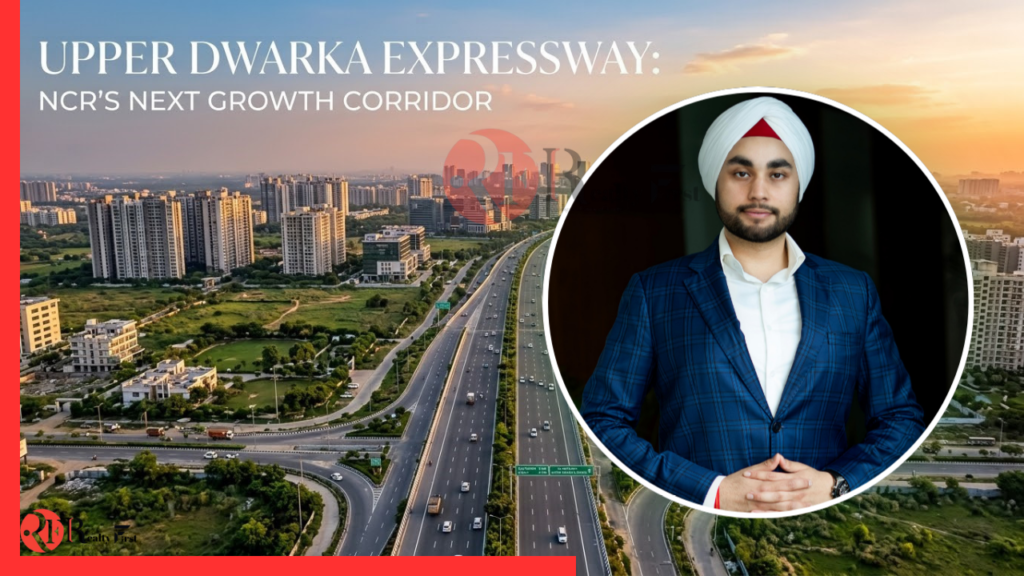
By Ishwin Singh Hora, Director, Reach Group
In real estate, infrastructure has often been the catalyst that transforms overlooked locations into high-growth investment destinations. Across the National Capital Region (NCR), several corridors that once remained on the periphery have evolved into thriving residential and commercial hubs after major connectivity projects became operational. According to Ishwin Singh Hora, Director, Reach Group, the proposed Upper Dwarka Expressway could represent the next phase of this infrastructure-led transformation.
Also Read: Greenply Introduces TermiVax Anti-Termite Plywood with Nanotechnology-Based Protection
Infrastructure Has Historically Driven Value Creation
NCR’s real estate evolution has repeatedly demonstrated the relationship between connectivity and capital appreciation. Corridors including NH48, Noida Expressway, NH248A, Dwarka Flyover, and more recently the Dwarka Expressway, were once considered peripheral markets with comparatively lower valuations. As transport infrastructure improved and projects reached completion, these locations witnessed substantial appreciation while attracting large-scale residential and commercial development.
The proposed Upper Dwarka Expressway appears to be following a similar trajectory.
As NCR continues to expand beyond its traditional urban centres, infrastructure is emerging as one of the primary drivers of real estate value. In this context, the corridor has the potential to develop into a significant growth axis connecting Delhi, Gurugram, Dwarka, and the wider NCR region.
Understanding the Infrastructure Premium
One of the most enduring trends in real estate is what can be described as the “infrastructure premium cycle.”
Before major projects become operational, valuations are largely driven by future expectations. Once connectivity improves and infrastructure is completed, uncertainty declines, accessibility strengthens and buyer confidence typically increases. This transition often narrows the valuation gap between emerging corridors and established locations.
The Dwarka Expressway offers one of the most recent examples. For several years, the corridor was viewed primarily through its future connectivity potential. As key sections became operational, residential and commercial activity accelerated alongside improved market sentiment. Early investors who entered before completion benefited from the corridor’s subsequent appreciation.
A similar pattern has been observed across several growth corridors in NCR, where proposed infrastructure initially generates interest and, once delivered, supports faster development and stronger capital appreciation.
Why the Upper Dwarka Expressway Is Gaining Attention
The Upper Dwarka Expressway runs parallel to the Dwarka Expressway and is projected to become an important transport corridor for commuters travelling between Delhi and Gurugram. The route passes through Sectors 99, 102, 103, 106, 107 and 108, extends across the commercial sectors 114 and 115, and ultimately connects with Najafgarh Road.
According to the author, the project’s significance extends beyond the construction of another roadway. It forms part of a broader effort to strengthen regional mobility and improve connectivity between Delhi and Gurugram.
This assumes greater importance as Gurugram’s population is projected to double by 2041. Continued population growth is expected to sustain demand for residential development over the next 15-16 years, increasing the need for additional transport infrastructure.
As urban density and traffic volumes continue to rise, NCR requires new corridors capable of supporting future residential and commercial expansion. The author notes that, according to news reports published in leading dailies, both the NCRPB and GMDA are working on proposals to improve the 75-metre Upper Dwarka Expressway road.
The corridor is expected to play an important role in easing congestion, distributing traffic more efficiently and improving access to emerging development zones as well as the Dwarka Expressway micro-market.
Commercial Real Estate May Benefit Significantly
For commercial real estate, accessibility remains one of the strongest determinants of long-term demand.
According to the author, Sector 114, located at the intersection of Delhi and Gurugram, is well positioned to benefit from enhanced road infrastructure. Its strategic location enables it to draw demand from both cities while serving the surrounding residential catchments.
Improved connectivity has historically strengthened the performance of retail developments, office projects, hospitality assets and mixed-use destinations. Businesses increasingly favour locations that offer efficient access to consumers, employees and transportation networks.
As mobility improves, commercial districts generally benefit from larger catchment areas and greater customer accessibility, both of which contribute to stronger long-term asset performance.
From an investment perspective, infrastructure-led expansion has often translated into higher occupier demand and sustained value creation over time.
Residential Markets Could Also See Stronger Demand
The author believes the residential impact could be equally significant.
Enhanced connectivity through the Upper Dwarka Expressway could improve the appeal of nearby residential micro-markets, particularly among homebuyers seeking convenient access to both Delhi and Gurugram.
Modern homebuyers increasingly prioritise connectivity when evaluating residential projects. Daily commuting time, proximity to employment hubs, airport accessibility and overall ease of travel have become central considerations in purchase decisions.
As transport networks become more integrated, residential locations with superior connectivity have generally demonstrated stronger long-term performance than the broader market.
The Next Chapter in NCR’s Real Estate Growth
According to Ishwin Singh Hora, NCR’s real estate market is entering a phase where infrastructure integration, rather than standalone developments, is likely to become the primary driver of long-term value creation.
The transformation witnessed along the Dwarka Expressway illustrates how strategic connectivity can reshape an entire micro-market. The author believes the Upper Dwarka Expressway has the potential to generate a comparable impact by strengthening regional mobility and supporting commercial growth, particularly in Sector 114.
While infrastructure projects typically require time to mature, the author concludes that history has often rewarded investors who identify emerging growth corridors before they become mainstream. As NCR continues to expand, the Upper Dwarka Expressway could become the next significant chapter in the region’s infrastructure-led real estate story.