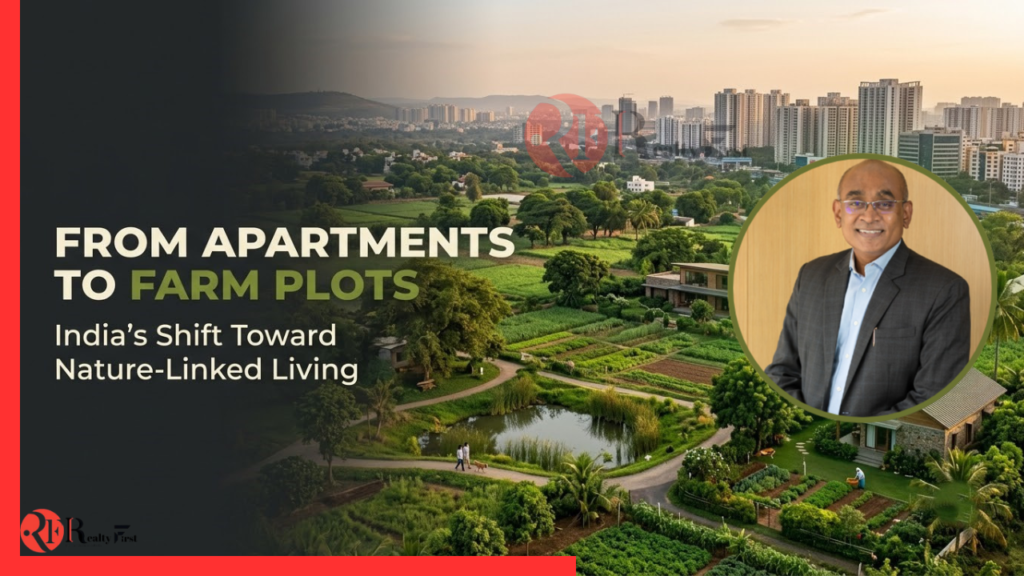
By Raghunath Bhattagiri, Managing Director, Triguna Country Homes
For almost two decades, the aspiration for India’s urban middle class was relatively straightforward: pursue a good education, build a career and eventually own an apartment in a growing city. A home represented both security and social progress. That aspiration has not disappeared, but the definition of what people want from their living environment is beginning to change.
Across Bengaluru, Hyderabad, Pune, Chennai and the outskirts of NCR, a different pattern is becoming visible. Young professionals, startup founders, NRIs, doctors and senior executives are increasingly looking beyond conventional city apartments towards farm plots and agricultural community models located close enough to urban centres for convenience, but sufficiently removed from the intensity of city life.
India’s urbanisation is continuing at pace. The urban population increased from 31% in 2011 to a projected 40% by 2036, according to World Bank estimates, translating into about 600 million people living in towns and cities within a decade. Yet the same cities drawing people towards them are also creating a desire for occasional escape. For many, that escape is increasingly taking the form of a weekend destination closer to nature.
The pandemic accelerated this movement, but it did not create it. The underlying drivers are more fundamental: limited space, rising stress and changing economics. A well-located apartment in a city can cost several times what a comparable plot on its outskirts cost a decade ago. Rising maintenance expenses, longer commutes and declining personal space have further altered the economics of urban homeownership.
Also Read: Shremoha launches premium senior living platform with partnerships in Pune and Gurugram
As a result, the question buyers ask is gradually changing. Instead of focusing only on how close a home is to the workplace, more people are beginning to consider how much personal time their choice of location gives back.
This is where farm plots have entered the broader real estate conversation. They are increasingly being viewed not merely as agricultural assets, but as lifestyle-oriented spaces that can combine trees, water bodies, walking trails, cleaner surroundings, community areas and weekend recreation with the possibility of long-term capital appreciation.
The trend reflects a wider global movement towards lower-density, nature-linked living. Importantly, it is no longer limited to ultra-high-net-worth buyers. Upper-middle-class consumers are also considering such properties as a combination of investment and personal lifestyle asset. Managed farmland models have made the proposition more accessible because buyers can own land without necessarily taking on the responsibilities associated with running a farm themselves.
There is also an economic argument behind the interest. Residential rental yields in most Indian cities remain at 3–5%, among the lowest in the world. Land, meanwhile, can appreciate as infrastructure and connectivity improve. But farmland should not be treated as an assured-return asset. Like any other investment, it requires careful evaluation of the underlying asset and the risks involved.
The shift also has a climate dimension. More than half of the urban infrastructure India will need by 2050 is yet to be built, while green cover in rapidly expanding cities is not keeping pace with urban growth. For some buyers, choosing a farm plot instead of another concrete high-rise is therefore becoming as much about seeking relief from heat and congestion as it is about lifestyle or investment.
There has also been a generational change in how land is perceived. Older buyers often viewed land as comparatively risky and apartments as the safer choice. Younger buyers are increasingly looking at apartments as standardised products and land as a scarce resource. Residential buildings can continue to rise vertically, but new land around expanding cities cannot be created.
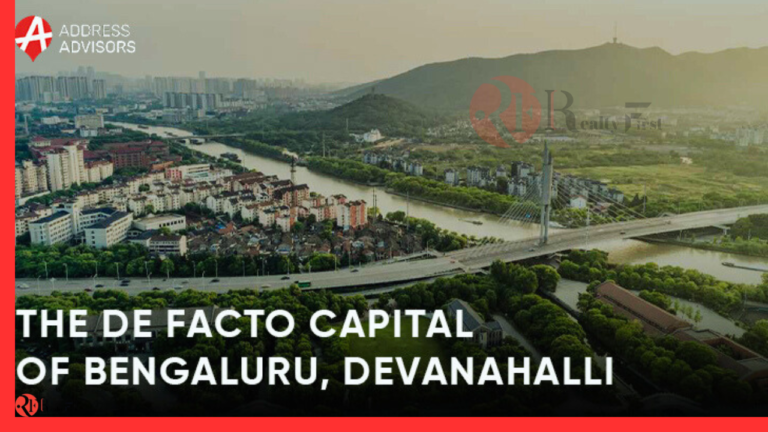
That scarcity is already visible in peripheral growth corridors. Areas such as Devanahalli and Kanakapura near Bengaluru are seeing steady demand as buyers move further from the urban core and developers respond with plotted and farmland-led projects.
However, the trend should not be romanticised. Farmland requires the same level of due diligence as any other real estate investment. Not every plot represents a sound purchase, and not every managed farmland project is credible. Clear title, zoning compliance, water availability, road access, governance and long-term maintenance arrangements are considerably more important than the imagery used in a project brochure.
For buyers, one of the biggest risks is treating farmland as an impulse purchase driven by the appeal of a weekend lifestyle. For developers, the corresponding risk is viewing the category simply as a quick-sale opportunity. The segment can mature sustainably only if transparency, credible development practices and professional on-ground management become central to the model.
From Housing Economy to Habitat Economy
What does this mean for the future of Indian real estate?
In my view, India is gradually moving from a housing economy towards a habitat economy. In a housing economy, the fundamental product is a residential unit. In a habitat economy, the proposition extends to the way people want to live.
That means buyers are evaluating more than square footage. They are also considering time, health, privacy and the ability to exercise greater control over how they spend their weekends.
India will continue to require housing at scale, and its cities will remain critical engines of economic growth. But within urban India, the definition of a successful lifestyle is quietly evolving. Developers and buyers who understand the duality of modern life—working in the city while recovering in nature—could influence how the next phase of real estate demand develops.
A generation ago, owning an apartment was widely regarded as evidence that one had made it. For a growing section of Indians today, owning a piece of green land represents something different: the ability to remain connected to nature while participating in the economic opportunities of the city.
Also Read: Why India Needs More Women Leaders to Shape the Future of Real Estate
That could prove to be one of the more consequential lifestyle shifts to emerge in Indian real estate.