By Mr. Parthh K. Mehta, CMD, Paradigm Realty
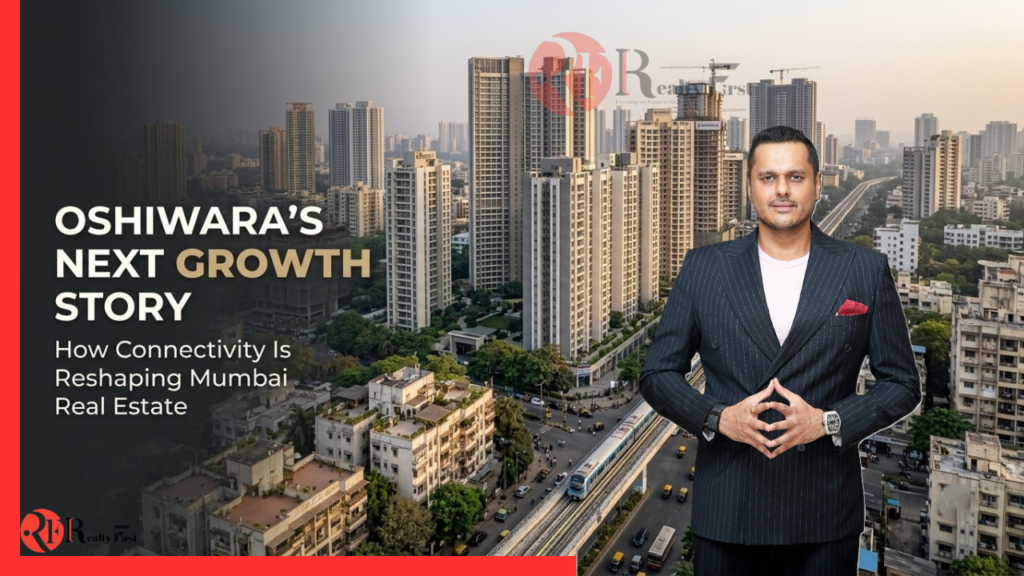
Mumbai’s real estate expansion has repeatedly demonstrated the role infrastructure plays in creating and unlocking value. Across successive growth corridors, from the western suburbs to the Bandra-Kurla Complex (BKC), improved connectivity has often been followed by residential and commercial development. As Mumbai enters another phase of large-scale infrastructure expansion, Oshiwara is emerging as a micro-market where several of these forces are converging.
Positioned between Andheri, Goregaon, Lokhandwala and Versova, Oshiwara has historically benefited from its location within Mumbai’s western suburbs, although it remained less prominent than several of its established neighbours. That is changing as infrastructure investment, redevelopment, road connectivity and commercial development reshape the district. Metro access and the gradual emergence of new commercial activity are strengthening Oshiwara’s position as a residential locality within a high-potential urban zone.
The change also points to a wider shift in homebuyer priorities. Location decisions are increasingly being influenced by commuting efficiency, neighbourhood infrastructure and long-term liveability rather than established pin codes alone. In a city where travel time can have a direct bearing on quality of life, locations that offer easier access to employment and social infrastructure are gaining relevance. For Oshiwara, infrastructure is therefore becoming a central component of its evolution into a more complete urban ecosystem.
Also Read: From City Apartments to Farm Plots: The Lifestyle Shift Reshaping Indian Real Estate
Metro connectivity strengthens Oshiwara’s accessibility
The operational Metro Line 2A has strengthened connectivity across Mumbai’s western corridor, linking Oshiwara with Andheri, DN Nagar, Goregaon, Malad, Kandivali and Dahisar. The improved network has reduced travel times and made movement across the western suburbs more convenient. For professionals working across different commercial hubs, the expanded connectivity also broadens employment catchments and adds to Oshiwara’s residential appeal.
Road infrastructure provides another layer of accessibility. The locality has direct connections to the Western Express Highway, Link Road and S.V. Road, giving residents access to Mumbai’s airports, business districts and key social infrastructure. As transport networks improve, the effective distance between residential areas and employment centres becomes shorter, strengthening the appeal of strategically positioned micro-markets.
The potential impact of future infrastructure could further influence property values in the area. One of the key projects is the Versova-Bandra Sea Link, which has the potential to alter commuting patterns along Mumbai’s western coastline by reducing travel time to Bandra and eventually improving connectivity to BKC, one of the country’s important commercial districts.
Historically, major transport infrastructure has had a multiplier effect on surrounding real estate by improving accessibility, widening buyer catchments and attracting fresh investment. Oshiwara’s position within this evolving network gives the locality an opportunity to benefit from the longer-term effects of these connectivity improvements.
Commercial development adds another growth driver
The development of the Oshiwara District Centre (ODC) is another significant element in the locality’s evolution. Envisioned by the Mumbai Metropolitan Region Development Authority (MMRDA) as a mixed-use urban precinct, ODC brings together commercial offices, retail, public infrastructure and civic amenities.
The importance of a planned business district extends beyond the creation of office space. Such developments can help establish a more integrated urban ecosystem in which commercial activity, residential communities and supporting infrastructure develop alongside one another.
Oshiwara’s expanding commercial activity has already contributed to a more balanced mix of workplaces, homes and lifestyle infrastructure. At the same time, redevelopment is changing the physical character of the neighbourhood. Ageing buildings are being replaced by modern residential communities, while civic infrastructure and public spaces are being upgraded.
For a land-constrained city such as Mumbai, redevelopment serves two purposes: it creates additional housing supply while also providing an opportunity to improve the wider neighbourhood. In Oshiwara, this transformation has included wider internal roads, better-designed residential complexes, improved utilities and upgraded public spaces, strengthening the foundation for longer-term urban value creation.
Social infrastructure supports liveability
Connectivity alone does not determine the attractiveness of a residential micro-market. Oshiwara also benefits from established social infrastructure, including schools, healthcare facilities, shopping destinations, entertainment hubs and hospitality offerings.
The availability of these facilities has helped the locality evolve into a more self-sustained urban neighbourhood. For residents, proximity to everyday amenities can reduce dependence on longer journeys while contributing to convenience and overall quality of life.
This broader assessment of neighbourhoods is increasingly relevant to the modern homebuyer. Project-level specifications remain important, but purchasing decisions are also being shaped by factors such as commuting efficiency, surrounding infrastructure, liveability and the potential for long-term growth.
Why infrastructure-led appreciation matters
Micro-markets that can offer a combination of housing, connectivity, social infrastructure and economic activity are increasingly positioned to compete with more established locations. Legacy value can provide a location with an initial advantage, but limited scope for future transformation may constrain its longer-term appeal.
From an investment perspective, infrastructure-led value creation can provide a more durable foundation than speculative growth. Connectivity projects contribute to economic value by improving productivity, reducing travel time and expanding access to employment opportunities. When these improvements coincide with commercial development and redevelopment-led urban renewal, they can support sustained demand rather than relying solely on short-term market cycles.
Oshiwara represents this convergence of multiple structural drivers. Operational metro connectivity, future transport infrastructure, commercial expansion and ongoing redevelopment are developing in parallel, collectively influencing the district’s growth trajectory. Its transformation is therefore not dependent on a single infrastructure project but on several factors reinforcing one another across residential and commercial real estate.
Oshiwara and Mumbai’s evolving growth corridors
Mumbai’s next phase of real estate expansion may not necessarily come only from entirely new suburbs. Established urban precincts with strong connectivity and the capacity to unlock previously underutilised potential could also play a significant role.
Oshiwara reflects this changing pattern of urban development. Connectivity, redevelopment and integrated infrastructure are contributing to a neighbourhood where residential activity, commercial opportunities and supporting amenities can coexist. Redevelopment is simultaneously improving the quality of urban living, while integrated planning is helping create neighbourhoods designed to be more liveable and resilient.
As Mumbai continues to expand its urban transport network and invest in infrastructure, the next wave of real estate growth is likely to be shaped by micro-markets capable of translating these improvements into broader urban value.
Also Read: Luxury, Liveability and the New Buyer Checklist for High-Growth Markets
For Oshiwara, the defining opportunity lies not in any individual project, but in the interaction between connectivity, commercial activity, housing and lifestyle infrastructure. Together, these elements are helping shape the locality as an increasingly complete urban ecosystem—and potentially as one of Mumbai’s emerging real estate addresses.