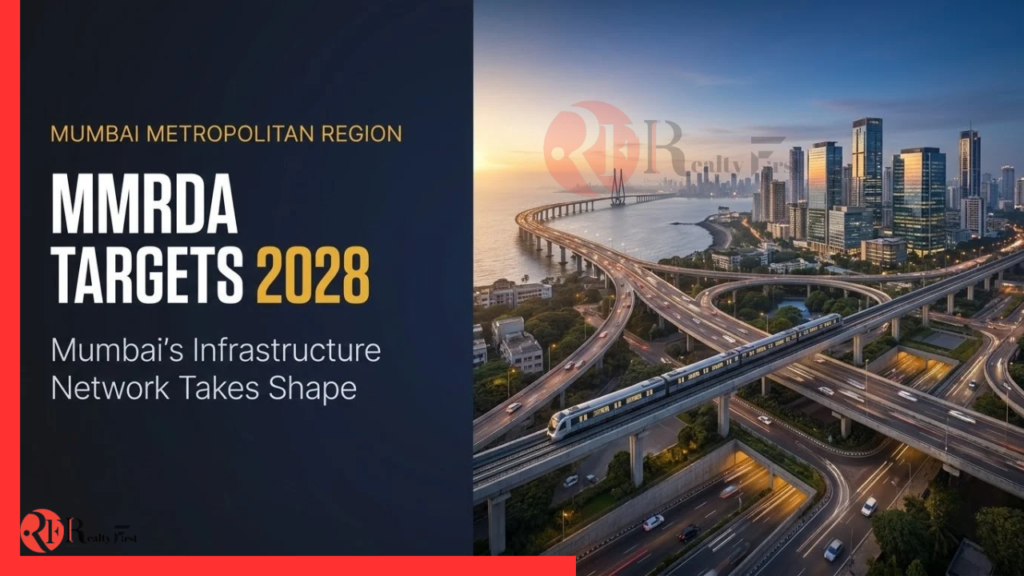
Pune: The Mumbai Metropolitan Region Development Authority (MMRDA) is targeting December 2028 to complete all its ongoing infrastructure projects, a year ahead of the December 2029 deadline, as it advances a network of metro lines, tunnels, sea links and roads intended to improve connectivity across the Mumbai Metropolitan Region (MMR).
The accelerated timeline was announced by Dr Sanjay Mukherjee, Metropolitan Commissioner, MMRDA, at the 6th edition of the Real Estate & Infrastructure Investors’ Summit (REIIS 2026), organised by NAREDCO Maharashtra in Mumbai on September 3, 2026. Speaking during a session on opportunities arising from Mumbai 3.0, he outlined the Authority’s approach to building an integrated transport network around the vision of “Mumbai in 59 Minutes.”
Dr Mukherjee said the objective is to reduce travel time through seamless east-west and north-south connectivity, linking major business districts, residential areas and emerging economic centres across the region.
“Mumbai has finance, it has the best human capital, but what is scarce is time. The concept of ‘Mumbai in 59 Minutes’ is about giving that time back to the Mumbaikar. Our objective is to create seamless east-west and north-south connectivity so that people can travel across the region faster, more efficiently and with greater predictability. The change in connectivity will be visible very soon, and Mumbai in 59 Minutes will soon become a reality.”
MMRDA’s Integrated Road Network to Link Key Business and Residential Hubs
MMRDA is developing approximately 10 major link-road and connectivity interventions to establish a more integrated road network across Mumbai and the wider metropolitan region. The plan is intended to improve movement in both east-west and north-south directions while connecting established business districts with residential clusters, airports, ports and emerging growth centres.
The proposed network will strengthen connectivity from Nariman Point and Cuffe Parade through the Eastern Freeway and the Mumbai Trans Harbour Link (MTHL). It will also integrate strategic corridors, including the SCLR, Worli connectivity and JVLR.
On the western side, the Bandra–Versova Sea Link, along with subsequent connectivity towards Dahisar, Balkum and the Eastern Freeway, is expected to improve links between different parts of the region. Dr Mukherjee also confirmed that work on the SCLR has commenced, adding another component to the expanding road network.
The broader objective is to create a connected mobility grid rather than rely on individual road corridors. By distributing traffic across multiple routes, the planned network is intended to reduce travel times and improve movement across the metropolitan region.
Also Read: Ceigall India Gets ₹5,300 Crore LoI for Gujarat Power Transmission Project
Thane–Borivali Twin-Tunnel Project Targets 15-Minute Journey
The Thane–Borivali twin-tunnel project is another major component of MMRDA’s connectivity programme. Construction is progressing following the resolution of key clearance-related issues, with two Tunnel Boring Machines (TBMs) deployed for the underground works.
Once operational, the tunnel is expected to reduce the journey between Thane and Borivali to approximately 15 minutes. The direct underground connection is designed to bypass longer existing road routes between the eastern and western suburbs.
The project is expected to strengthen cross-suburban connectivity, reducing dependence on the existing road network for travel between these two important parts of the Mumbai Metropolitan Region.
Underground Corridor Planned Across Mahim, Dharavi and BKC
MMRDA is also pursuing underground transport infrastructure in some of Mumbai’s most challenging urban areas.
A major corridor linking Mahim–Dharavi with Bandra and the Bandra-Kurla Complex (BKC) is envisaged as part of the wider connectivity network. The proposed system is expected to extend towards the airport, Western Express Highway and JVLR, creating a high-capacity east-west mobility corridor.
The BKC area is also expected to see a significant tunnelling intervention using advanced technology comparable with systems deployed in leading cities globally. These underground projects form part of the Authority’s wider approach to improving connectivity through a combination of surface and subsurface infrastructure.
337 Km Metro Network to Expand Public Transport Options
Alongside road and tunnel infrastructure, MMRDA is developing approximately 337 km of metro network, comprising 14 metro lines, including four metro lines in the CIDCO region.
The expanding metro system is intended to complement road connectivity by providing additional mass-transit options across the metropolitan region. The Authority is also exploring innovative transport solutions, including pod taxis, as a potentially inexpensive and efficient option for selected corridors.
The broader objective is to offer commuters multiple modes of transportation and reduce reliance on any single form of mobility.
Mumbai 3.0 Development Vision Covers 323 Sq Km
MMRDA’s infrastructure plans are linked to its broader Mumbai 3.0 development vision, which encompasses approximately 323 sq km, including around 124 sq km of reserved land.
Dr Mukherjee said the region’s future growth must be supported by planned urbanisation and a focus on liveability. The development approach is intended to accommodate new urban growth alongside substantial green spaces and improved quality of life.
He also emphasised that infrastructure investments alone would not resolve Mumbai’s mobility challenges, highlighting the importance of traffic management and public participation.
“Infrastructure alone cannot solve Mumbai’s mobility challenge. Roads, tunnels, metro and public transportation have to be supported by traffic rules, regulations and discipline. Citizens also have an important role to play in making the city’s transportation system work efficiently.”
Rs 48,000-Crore MMRDA Budget Supports Infrastructure Delivery
MMRDA’s infrastructure programme is backed by a budget of approximately Rs 48,000 crore. Dr Mukherjee highlighted the importance of financial discipline, timely payments and execution within defined schedules in managing large-scale infrastructure development.
He said adherence to project timelines helps contain cost escalation and supports the development of financially viable infrastructure projects. The Authority’s ability to meet its financial commitments, he added, remains important given its highly leveraged structure.
“Budget matters because infrastructure projects have to be bankable. MMRDA is a highly leveraged organisation, and we ensure that our instalments are paid on time. When projects are executed on time, costs are controlled. This discipline is critical for an organisation executing infrastructure of this scale.”
Mumbai Metropolitan Region Emerges as a Focus for Future Growth
The infrastructure programme extends beyond Mumbai city, with the emerging transport network intended to connect Mumbai, Thane, Navi Mumbai, the airport region, the western suburbs and other developing growth centres.
The integration of metro corridors, highways, link roads, tunnels, sea links and potential new transport systems is expected to improve regional accessibility and expand the areas within which residents can live and work while remaining connected to employment and business hubs.
Dr Mukherjee said the Mumbai Metropolitan Region would play an increasingly important role in Maharashtra’s economic development, with infrastructure serving as a key enabler of future growth.
“The future is bright. Within Maharashtra, the future is the MMR. Our focus is to create the infrastructure that will enable this region to grow, connect and prosper. Mumbai in 59 Minutes is not just a slogan; it is the direction in which the entire mobility network is being built,” he added.
Also Read: How Infrastructure Development Is Transforming Panipat’s Housing Market