
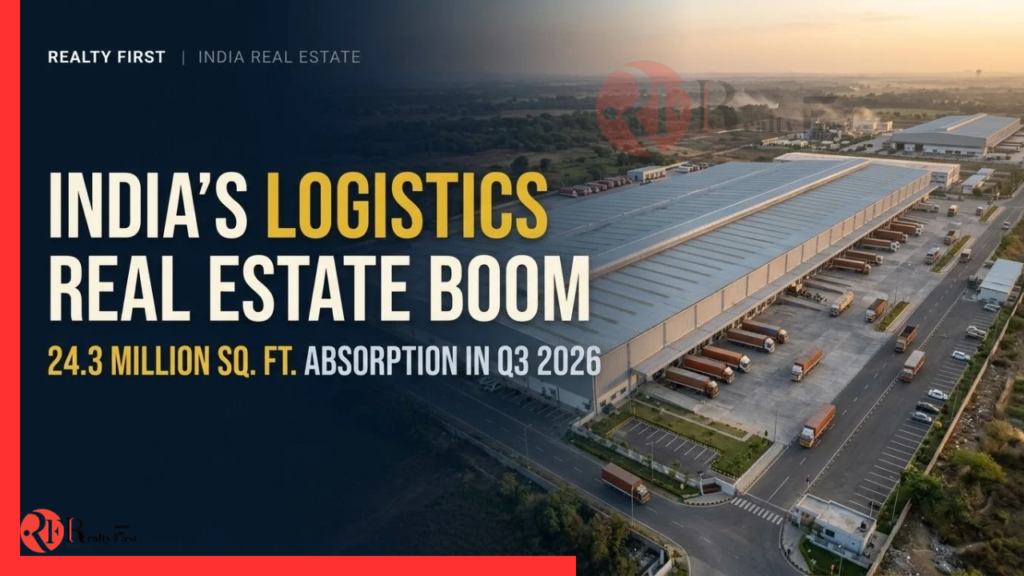
Mumbai: India’s industrial and logistics real estate market recorded 24.3 million sq. ft. of space absorption in Q3 2026, marking a 14.1% year-on-year increase, as manufacturing activity and demand from logistics, retail and other occupiers supported market expansion, according to Savills India.
Cumulative absorption during the first nine months of 2026 reached 59.1 million sq. ft., the highest nine-month total on record and 6.9% higher than the 55.3 million sq. ft. recorded during the corresponding period in 2025.
The market also saw a rise in new supply. Completions reached 26.2 million sq. ft. in Q3 2026, up 21.3% from 21.6 million sq. ft. in Q3 2025, reflecting the continued expansion of industrial and logistics infrastructure across the country.
Also Read: Nehlia Developers Showcases Real Estate Projects at Jaipur Investor Preview
Tier-II and Tier-III Markets Record Faster Quarterly Absorption Growth
Tier-I cities accounted for 19.9 million sq. ft., or 82% of total absorption, during Q3 2026. The remaining 4.4 million sq. ft., representing 18% of demand, came from Tier-II and Tier-III markets.
Although Tier-I cities continued to account for the majority of leasing activity, smaller markets recorded a faster annual growth rate. Absorption in Tier-II and Tier-III cities increased 25.7% year-on-year, compared with 11.8% growth across Tier-I cities.
Over the first nine months of 2026, Tier-I absorption stood at 47.2 million sq. ft., up 7.3% from 44 million sq. ft. in the corresponding period of 2025. Tier-II and Tier-III markets recorded 11.9 million sq. ft., a 5.3% increase from 11.3 million sq. ft.
Industrial and Logistics Supply Expands 21.3% in Q3
New industrial and logistics space additions reached 26.2 million sq. ft. in Q3 2026, compared with 21.6 million sq. ft. a year earlier. Cumulative supply during the first nine months rose to 68.9 million sq. ft., up 25.3% from 55 million sq. ft. in the corresponding period of 2025.
Tier-I markets contributed 19.2 million sq. ft. of quarterly completions, accounting for 73% of the total. This represented a 9.7% increase from 17.5 million sq. ft. in Q3 2025.
Supply growth was more pronounced in Tier-II and Tier-III cities. Completions in these markets increased 72.5% year-on-year to 6.9 million sq. ft., compared with 4 million sq. ft. in the previous year’s third quarter. Their combined supply reached 12.9 million sq. ft. during the first nine months of 2026, up 26.5% from 10.2 million sq. ft. a year earlier.
Grade-A Facilities Gain Share in Absorption
Demand shifted further towards Grade-A industrial and logistics facilities during Q3 2026. These properties accounted for 66% of total absorption, compared with 52% in Q3 2025. Grade-B properties represented the remaining 34%, down from 48% a year earlier.
The supply mix also moved towards Grade-A assets. Their share of new supply increased to 58% in Q3 2026 from 50% in Q3 2025, while Grade-B properties accounted for 42%, compared with 50% in the year-earlier quarter.
The growing preference for Grade-A facilities reflects the increasing importance of infrastructure quality, regulatory compliance and environmental, social and governance (ESG) considerations in industrial and logistics real estate.
Manufacturing Accounts for 31% of Quarterly Absorption
Manufacturing emerged as the largest sectoral contributor to industrial and logistics space absorption in Q3 2026, accounting for 31% of total demand, compared with 27% in Q3 2025.
Third-party logistics (3PL) remained another major source of demand, contributing 26% of absorption. However, its share declined from 34% in the corresponding quarter of the previous year.
Retail recorded a notable increase, with its contribution rising to 12% from 5%. E-commerce maintained a 10% share in both periods, while FMCG/FMCD accounted for 9% in Q3 2026, unchanged from Q3 2025. The share of the other categories declined to 12% from 15%.
The broader category of others includes manufacturing warehousing, cold storage, chemical storage, free trade warehousing zones (FTWZs), inland container depots (ICDs) and urban warehousing.
Delhi-NCR Leads Absorption, While Pune Tops New Supply
Delhi-NCR remained the largest market for industrial and logistics space absorption in Q3 2026, accounting for 20% of the national total. Bengaluru followed with 16%, while Mumbai and Pune contributed 14% and 13%, respectively.
Pune recorded the highest share of new supply among the listed Tier-I markets, accounting for 18% of quarterly completions. Delhi-NCR and Mumbai each contributed 15%, while Tier-II and Tier-III cities collectively represented 27% of the supply added during the quarter.
The city-level distribution of absorption showed varied year-on-year movements. Bengaluru’s share increased to 16% from 11%, while Chennai’s rose to 12% from 5%. Pune’s share stood at 13%, compared with 15% in Q3 2025. Delhi-NCR accounted for 20%, marginally below its 21% share a year earlier.
Mumbai’s share declined to 14% from 15%. Hyderabad accounted for 3%, compared with 6% in Q3 2025, while Kolkata’s share fell to 2% from 7%. Ahmedabad represented 2% of total absorption, down from 4%.
On the supply side, Pune’s share increased to 18% from 15% in Q3 2025. Bengaluru accounted for 11%, compared with 14% a year earlier, while Chennai represented 10%, down from 11%. Mumbai’s share declined to 15% from 18%, and Delhi-NCR remained unchanged at 15%.
Tier-II and Tier-III cities increased their combined share of supply to 27% from 19%, alongside an increase in their share of absorption to 18% from 16%.
Also Read: How Vadhavan Port Could Shape Vasai’s Residential Real Estate Market
Manufacturing and Logistics Demand Expected to Support Growth
India’s industrial and logistics real estate market is expected to maintain steady growth in 2026, supported by manufacturing expansion and demand from 3PL, FMCG/FMCD, retail and e-commerce occupiers.
Rising consumption, supply chain realignment and increasing activity in Tier-II and Tier-III cities are expected to remain important demand drivers. Rental values for Grade-A assets are projected to register a mild increase, while stable yields and continued investor interest are expected to support the sector’s position as a resilient and scalable real estate asset class.