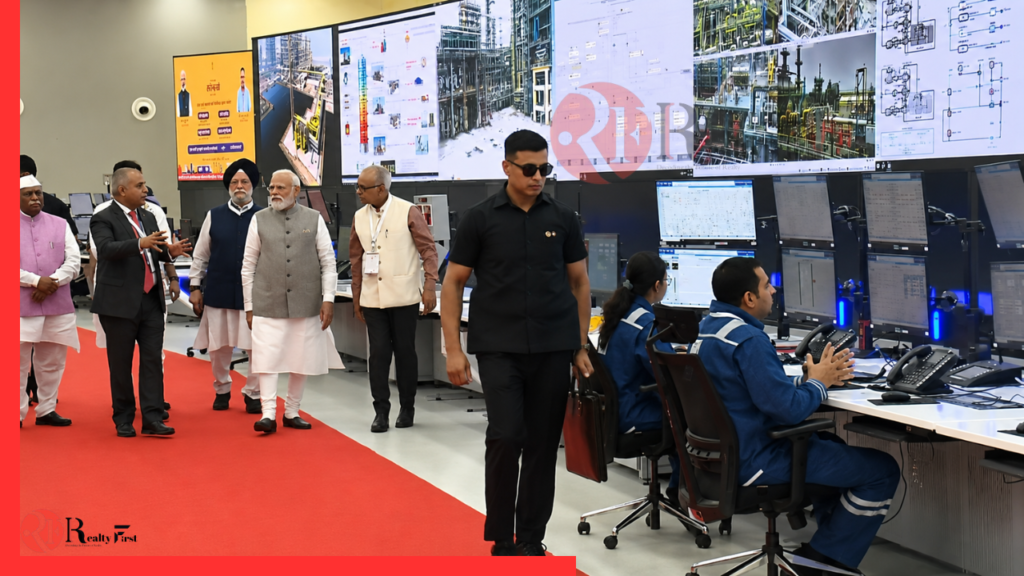
New Delhi: Prime Minister Narendra Modi has dedicated the HPCL Rajasthan Refinery Limited’s Integrated Refinery-cum-Petrochemical Complex at Pachpadra, Balotra, marking a significant milestone in Rajasthan’s industrial development and India’s energy infrastructure. The 9 MMTPA facility, conceived as India’s first greenfield integrated refinery-cum-petrochemical complex, has been developed as a joint venture between Hindustan Petroleum Corporation Limited and the Government of Rajasthan.
The project is also drawing attention to the broader development taking shape around it. The associated HRRL Township in Barmer, designed by CP Kukreja Architects, is planned as a self-sustaining residential and civic community for HRRL, bringing together housing, social infrastructure and climate-responsive urban design in one of India’s most challenging environmental settings.
Also Read: Beyond Housing: Integrated MEP Planning Will Define the Success of Dharavi’s Redevelopment
Speaking at the inauguration, Prime Minister Narendra Modi described the Rajasthan Refinery as a catalyst for regional development and said, “this massive refinery will serve as a permanent medium of employment for thousands of people,” while congratulating the youth of Rajasthan on the achievement.
The refinery is positioned to contribute to India’s energy security and petrochemical self-sufficiency. At the same time, the township seeks to translate the scale of this industrial infrastructure into a more sustainable and liveable environment, with its planning shaped by the climate, ecology and social needs of the region.
Located across 248 acres in the Thar Desert, the HRRL Township incorporates residential, institutional, civic and security infrastructure. The design responds to a landscape marked by saline soils, limited groundwater availability and summer temperatures exceeding 50°C. Rather than following a conventional industrial housing model, the project adopts a climate-responsive approach to urban planning and desert habitation.
One of the central ideas informing the master plan is the traditional Rajasthani “johad”, a water-retention system designed to channel, slow, filter and recharge monsoon runoff into the ground. At the township, housing clusters, recreational areas, social amenities and public facilities are organised around this hydrological framework, placing water management and landscape at the centre of the settlement’s urban form.
The township has received the national HUDCO Design Award and a 4-Star Rating under the GRIHA Large Developments category. These recognitions acknowledge its approach to contextual architecture, sustainable planning, climate-responsive design and socially conscious industrial housing.
Its environmental measures include 100 percent rooftop rainwater harvesting, a 2 MLD sewage treatment plant supported by dual plumbing for water reuse, 12 recharge pits, solar-powered street lighting, native xeriscape planting and more than 5,000 indigenous trees. According to the project details, these interventions reduce potable water demand by 45 percent, while passive cooling strategies lower energy demand by 38 percent.
The architectural response is closely tied to Barmer’s extreme climatic conditions. The township incorporates thermal mass, shaded fenestration, recessed openings, high-SRI roof coatings and cross-ventilation, alongside traditional architectural elements such as jaalis and jharokhas where they contribute to environmental performance.
More than 30 percent of the site has been retained as functional open space, with over 75 acres allocated to landscape, shaded streets, pedestrian movement and community use. The planning approach seeks to make open spaces an active part of everyday life rather than treating them simply as residual areas between buildings.
The township’s design also extends beyond environmental performance to create a broader civic ecosystem. Schools, anganwadis, retail areas, a guest house, club, auditorium, township offices and security infrastructure are connected through a pedestrian-oriented network.
Shaded edges, internal courts, walkways and key intersections are intended to distribute public activity throughout the development. This approach positions the township as more than a residential settlement, integrating social infrastructure and community spaces into the larger industrial development.
Dikshu C. Kukreja, Managing Principal, CP Kukreja Architects, said, “Large infrastructure is often measured by capacity, output and investment. But its deeper legacy lies in the lives it sustains around it. At Barmer, our endeavour was to design not just a township, but a resilient civic system that listens to the desert. The HRRL Township draws from indigenous water wisdom, passive design and community-centred planning to create a model of habitation that conserves, adapts and endures. It demonstrates that even in one of India’s most demanding climates, architecture can become an instrument of ecological balance and social continuity.”
Also Read: The Rise of Goregaon East: Mumbai’s Next High-Growth Business District for New-Age Companies
The HRRL Refinery and Township together place Barmer at the centre of a new phase of industrial and urban development in Rajasthan. While the refinery represents a major addition to India’s energy infrastructure, the township demonstrates how large industrial projects can be accompanied by climate-sensitive planning, sustainable resource management and community-focused urban design.
For the region, the combined development reflects a broader approach to industrial growth—one in which energy infrastructure and the urban ecosystems supporting it are planned as interconnected components of long-term development in arid India.