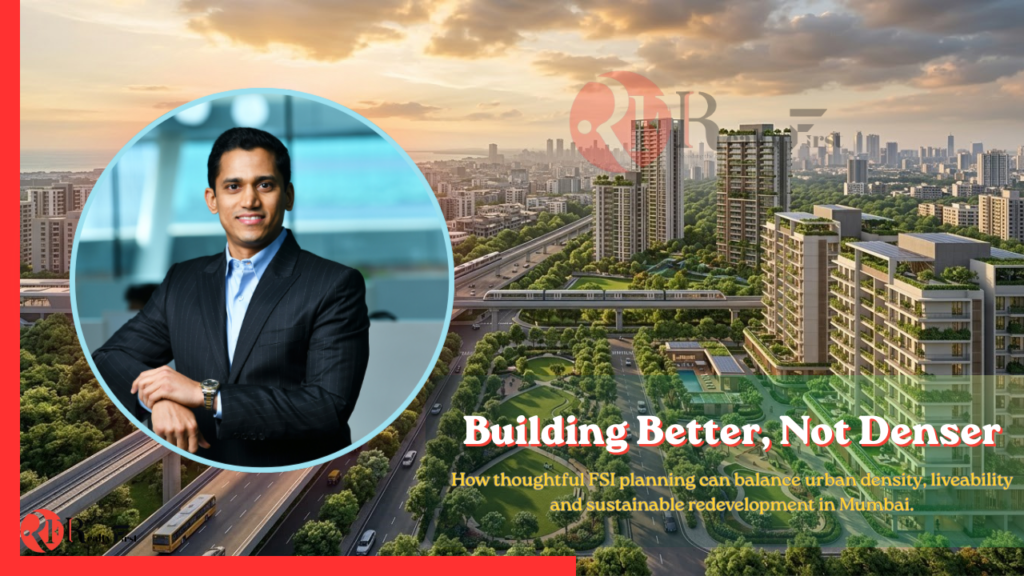
By Chintan Sheth, Chairman and Managing Director of Sheth Realty
As Mumbai continues to grapple with limited land availability, accommodating future population growth has become one of the city’s most pressing urban challenges. Industry reports estimate that the population of the Mumbai Metropolitan Region (MMR) will reach around 2.9 crore by 2030, making efficient land utilisation increasingly critical. Against this backdrop, Floor Space Index (FSI) has emerged as one of the key planning tools shaping the city’s next phase of development.
FSI determines the amount of built-up area that can be constructed on a land parcel. While often viewed as a technical planning concept, its effective implementation has a direct influence on housing quality, urban density and the overall liveability of a neighbourhood. When applied thoughtfully, FSI-led development has the potential to improve residential experiences while supporting the city’s long-term growth.
Its importance becomes even more pronounced in Mumbai’s redevelopment landscape. Under conventional development norms, permissible FSI is largely linked to the width of the adjoining road and is generally capped between 2.5 and 3.24. However, redevelopment models such as Slum Rehabilitation Authority (SRA) schemes and specific planning frameworks under MCGM can allow the effective FSI to increase to 8 to 10. While this significantly expands the amount of built-up area that can be developed on the same land parcel and helps address housing demand, it also places greater emphasis on responsible planning and density management.
Among Mumbai’s suburbs, Mulund stands out as a location with considerable redevelopment potential. Known for its green environment and supported by well-developed infrastructure, the suburb has the opportunity to accommodate FSI-led redevelopment while preserving the qualities that have long defined its residential appeal.
When Higher FSI Comes Without Better Planning
Higher FSI alone does not guarantee better urban development. Redevelopment in areas lacking adequate infrastructure, connectivity or social amenities can adversely affect everyday living. Even in well-connected neighbourhoods, the benefits of redevelopment may diminish if FSI is utilised without adequate planning.
In an effort to maximise land utilisation, developers may significantly increase the number of residential units within a project. While commercially attractive, such an approach can create operational challenges for residents after possession. Long waiting times for elevators, congestion at entry and exit points, traffic bottlenecks within parking areas and delays of 10 to 15 minutes simply to reach one’s home can become part of daily life. These inconveniences can undermine the very advantages that buyers expect from investing in premium locations.
Overcrowding also places pressure on shared infrastructure. Insufficient water storage capacity, heavily utilised clubhouses, overcrowded recreational facilities and limited open spaces can diminish the overall residential experience. Since many buyers base their purchase decisions on sample apartments, layouts and views, these operational shortcomings often become evident only after occupation, potentially affecting both homeowner satisfaction and the long-term value of the project.
Mulund’s Approach to Smart FSI Planning
According to Chintan Sheth, the true opportunity lies not merely in securing higher FSI but in using it strategically. In Mulund, balancing built-up development with open spaces, landscaped areas and thoughtfully planned amenities can help retain the suburb’s character while accommodating future growth.
Rather than treating every square foot as saleable inventory, projects can be designed to prioritise lower-density planning and resident comfort. Increasingly, developers are shifting amenities to podium levels instead of occupying the ground floor, creating uncluttered layouts while enabling better tower placement for natural light, cross ventilation and privacy. Such planning, the author argues, reflects the real value of FSI as a tool for improving quality of life rather than simply increasing built-up area.
Encouragingly, some developers participating in Mumbai’s redevelopment cycle have begun recognising the long-term implications of maximising FSI. They are consciously opting for lower-density developments, even if it results in comparatively lower commercial returns, with the understanding that better planning, reduced congestion and an improved resident experience create stronger and more sustainable value over time.
Open Spaces Matter as Much as Built Spaces
Another consequence of excessive density is the reduction of open-to-sky areas within residential communities. Although suburbs such as Mulund continue to benefit from relatively abundant green cover, not every redevelopment project incorporates sufficient landscaped spaces internally.
With seasonal fluctuations in air quality becoming increasingly common, green spaces both within and beyond residential communities are gaining greater importance. Mulund’s existing environmental advantages position it well to support redevelopment that integrates landscaped open areas alongside higher-density development.
At the same time, FSI-led redevelopment is enabling ageing buildings and underutilised land parcels to be transformed into modern, low-density gated communities that better meet contemporary lifestyle expectations.
Infrastructure Supports Sustainable Growth
Mulund’s redevelopment potential is further strengthened by its established urban ecosystem. The suburb already benefits from multimodal connectivity, with a combination of existing and upcoming infrastructure projects reducing the need for entirely new urban networks. This places Mulund in a stronger position than several emerging micro-markets that continue to build foundational infrastructure.
One of the key advantages of carefully planned FSI utilisation is its ability to optimise land use without compromising the residential environment. Modern master planning allows ground-level spaces to be dedicated to landscaped gardens, recreational zones and open areas, creating communities that remain functional, breathable and less congested.
According to Chintan Sheth, strategic use of FSI can help create integrated communities that offer residents access to lifestyle amenities, generous open spaces and supporting infrastructure that smaller, fragmented developments often struggle to provide.
As Mumbai accelerates its redevelopment journey, Mulund, in the author’s view, demonstrates how rising population pressures can be addressed through thoughtful planning without compromising long-term liveability.