
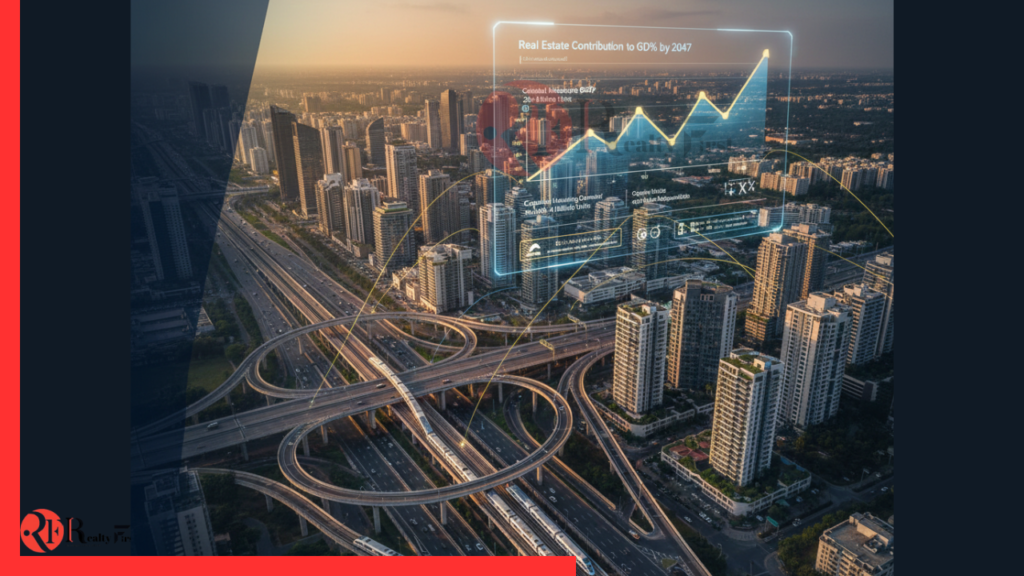
Infrastructure has moved decisively from being a supporting enabler to the central force shaping India’s next real estate cycle. From expressways and rapid rail to airports, logistics corridors and urban transit systems, large-scale public investment is now determining where cities expand, where jobs cluster and where capital flows.
According to Colliers, India’s real estate sector could scale into a USD 5–10 trillion market by 2047, contributing nearly 14–20% to the country’s GDP, underscoring the sector’s growing economic relevance. This transformation is being driven less by organic city sprawl and more by planned connectivity. In effect, infrastructure is no longer following real estate demand; it is actively scripting the geography of India’s future growth corridors.
Travel time, once a limiting factor in urban expansion, is rapidly losing its significance as India’s transport infrastructure expands. New expressways, expanding metro networks, RRTS, and airport-led corridors are compressing commute durations and effectively stretching city boundaries outward. This has given rise to the concept of “60-minute urban regions”, where locations once considered peripheral are now viable for both living and working without compromising access. Colliers notes that such connectivity-led planning is unlocking fresh growth corridors beyond saturated city cores, enabling a more decentralised and balanced pattern of development. As mobility improves, real estate demand is increasingly gravitating towards these well-connected edges, reshaping urban geography across key markets.
Moreover, India’s urban expansion is steadily moving away from traditional, radial city growth towards linear, corridor-led development aligned with major infrastructure investments. Instead of cities spreading outward in all directions, growth is now following expressways, transit lines, and logistics spines that offer speed, scale, and planning visibility. NCR exemplifies this shift, with corridors such as Dwarka Expressway, Southern Peripheral Road, New Gurgaon, the Noida–Greater Noida Expressway, and emerging airport-led zones evolving into distinct real estate markets in their own right. As connectivity improves and project timelines gain clarity, these emerging corridors often witness capital values appreciating faster than established city averages, particularly as end-user confidence strengthens closer to completion. This early-mover advantage is drawing both developers and long-term investors to infrastructure-aligned locations at a much earlier stage of the growth cycle.
Dr. Gautam Kanodia, Founder, KREEVA and Kanodia Group, says, “In NCR, Gurugram’s real estate evolution today is being driven by micro-markets rather than broad city-wide narratives. Infrastructure upgrades across New Gurgaon, SPR, and Golf Course Road Extension are creating highly differentiated pockets of demand. What’s significant is how improved connectivity is aligning residential aspiration with commercial viability. Buyers are no longer compromising on location or lifestyle—they expect both. These corridors are benefiting from shorter commute times, stronger social infrastructure, and rising brand credibility. For developers, this means moving beyond land aggregation to thoughtful, design-led developments that respond to an informed, globally exposed buyer.”
Salil Kumar, Director- Marketing and Business Management, CRC Group, says, “The Noida–Greater Noida region is at the crossroads, with infrastructure acting as the defining growth lever. The Noida International Airport, coupled with the Noida–Greater Noida Expressway, is transforming the region into a multi-sector economic hub. This is no longer just a residential story; commercial, retail, and logistics demand is rising in tandem. Improved regional connectivity is attracting end-users, corporates, and institutional investors. What stands out is the scale and planning discipline of this growth. Thus, infrastructure here is not reacting to demand; it is proactively creating it, making the corridor structurally strong for the long term.”
Besides, infrastructure-led corridors are reshaping demand across real estate asset classes, with residential, commercial, and retail growth increasingly moving in tandem. Homebuyers are gravitating towards larger homes, integrated townships, and lifestyle-led communities in well-connected outskirts, prioritising space and livability without sacrificing access. The data projects that annual housing demand could double to nearly one million units by 2047, driven by urbanisation and expanding infrastructure, with absorption in these corridors largely end-user-led rather than speculative.
Meanwhile, improved connectivity is decentralising office development, bringing workplaces closer to residential catchments and reducing commute fatigue. Office demand, estimated to stabilise at 70–75 million sq ft annually, is increasingly shifting towards emerging corridors and secondary business districts, often within mixed-use developments near transit nodes. Retail, in turn, is following rooftops, with high-street formats and daily-needs retail gaining prominence along expressways and transit corridors, alongside Colliers’ projection of around 1,500 malls by 2047, many in peripheral and emerging markets.
Karan Malik, Regional Director, Realistic Realtors, said “Infrastructure is increasingly shaping residential demand rather than just influencing price appreciation. In Gurugram, improvements in road capacity, planned transit connectivity and stronger last-mile links are allowing homebuyers to reassess location choices beyond legacy residential hubs. This is translating into demand for newer residential corridors that offer better space efficiency, planned layouts and improved liveability while remaining functionally connected to employment centres. Over the medium to long term, infrastructure-led expansion supports a more balanced residential market by easing congestion in mature micro-markets and enabling supply in planned growth zones. For developers, the opportunity lies not in speculative launches but in aligning product design, delivery timelines and pricing with genuine end-user demand.”
Ashwani Kumar, Pyramid Infratech says, “Gurugram is a textbook example of how infrastructure can reshape the city’s urban cluster. What was once seen as peripheral locations is now firmly integrated into Gurugram’s urban fabric. The expressway has not only improved connectivity to Delhi and IGI Airport but has also catalysed planned development at scale. We are seeing a clear shift in buyer sentiment. Plus, capital values here reflect growing confidence, but absorption is being supported by livability, not hype. Over the long term, corridors like Dwarka Expressway will define Gurugram’s next phase of sustainable urban growth.”
Therefore, infrastructure has moved beyond enabling growth to actively determining which real estate markets will lead the next cycle. Expressways, transit networks, airports, and logistics corridors are effectively choosing future growth corridors by directing capital, employment, and population flows with increasing precision. As the country advances through a multi-decade phase of urban expansion, the coming decade of real estate growth will belong to markets where connectivity, planning, and demand converge.