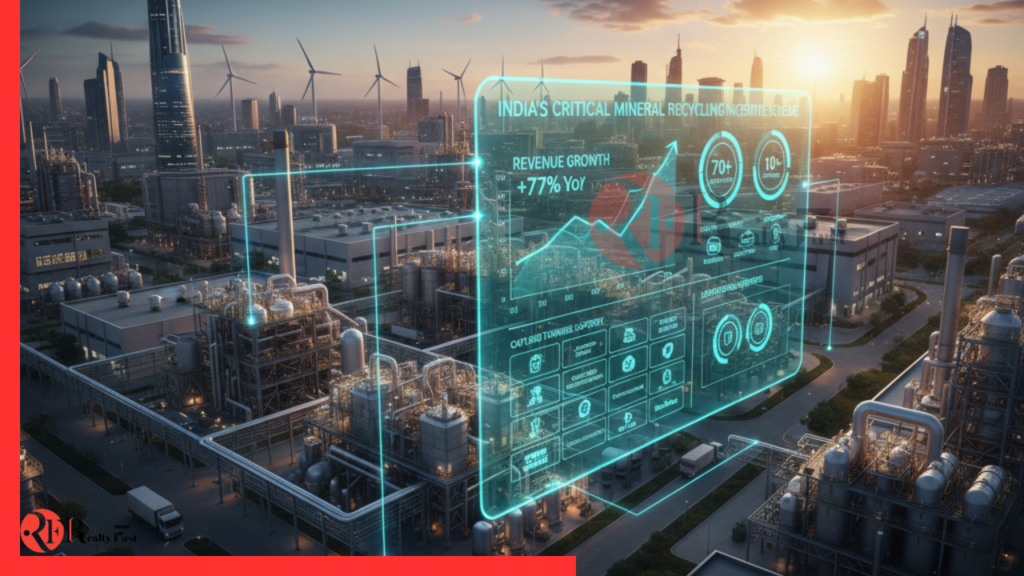
Mumbai: India’s ₹1,500-crore Critical Mineral Recycling Incentive Scheme is gaining rapid momentum, with strong participation from the recycling industry following its full operational rollout, senior officials said at the International Material Recycling Conference (IMRC) 2026, organised by the Material Recycling Association of India (MRAI) in Jaipur.
Addressing the conference, Dr Anupam Agnihotri, Director of the Jawaharlal Nehru Aluminium Research Development and Design Centre (JNARDDC), said over 70 recycling companies have registered under the scheme, while more than 10 recyclers have already received formal eligibility approvals. With clear operational guidelines and investment-linked incentives now in place, the scheme is expected to play a pivotal role in strengthening India’s scrap-based critical mineral supply chains.
The scheme targets the creation of 270,000 metric tonnes of recycling capacity and introduces a differentiated incentive structure. Group A recyclers, with annual turnover exceeding ₹200 crore, are eligible for incentives of up to ₹50 crore or 20% of plant and machinery costs, whichever is lower. Group B recyclers, with turnover below ₹200 crore, can avail incentives of up to ₹25 crore or 20% of capital expenditure.
Dr Agnihotri emphasised that recycling will be central to India’s long-term mineral security under the National Critical Mineral Mission, particularly as global supply chains tighten. “India has identified 24 critical minerals, many of which remain import-dependent. Scrap processing and recovery must now be treated as a strategic priority,” he said.
He warned that rising global resource nationalism could restrict exports of both ores and scrap within the next five to six years, making domestic recycling capacity essential for supply-chain resilience. To ensure quality and seriousness of investment, the scheme limits eligibility to R3 and R4 category recyclers, with minimum processing thresholds and defined purity benchmarks.
The incentive framework combines capital expenditure support with phased operational incentives over a five- to six-year horizon. Incentives are restricted to entities engaged in actual extraction and recovery of critical minerals, excluding black-mass-only operations.
Highlighting the global context, Dr Agnihotri said critical minerals are now central to EV manufacturing, renewable energy, Industry 4.0, and defence technologies, positioning recycling and urban mining as key determinants of national competitiveness.
JNARDDC, an autonomous body under the Ministry of Mines, has been designated as the nodal agency for recycling across aluminium, copper, lead, and zinc, with expanded responsibilities covering critical minerals. The institution is supporting innovation through funding for startups beyond TRL-3, pilot plants, and nine Centres of Excellence, each backed by funding of up to ₹20 crore.
Providing an international perspective, Dr Rachana Arora, Director – Climate Change & Circular Economy at GIZ India, said India’s recycling-led strategy aligns with global trends, citing growing cooperation between India and the European Union across batteries, renewables, electronics, and circular economy initiatives.
On the technology front, Dr Alok Ranjan Paital, Principal Scientist at CSIR-CSMCRI, noted that advanced recycling technologies, including hydrometallurgical and direct cathode-to-cathode regeneration processes, are now ready for scale-up.
From an industry standpoint, Vijay Pareek, Executive Director and SBU Head at Gravita India Ltd., said the scheme brings long-awaited regulatory clarity, accelerating formalisation and investment in scrap-based recovery.
IMRC 2026, being held from January 20–22, 2026, has brought together policymakers, recyclers, manufacturers, and global stakeholders. Industry leaders agreed that recent developments mark a structural shift in India’s mineral strategy, with recycling positioned at the core of critical mineral security.
On the sidelines, the MRAI Battery Recycling Excellence Awards 2026 were announced, with Ardee Industries Limited named Recycler of the Year (MSME Category) and Gravita India Limited winning the Large-Scale Category award.