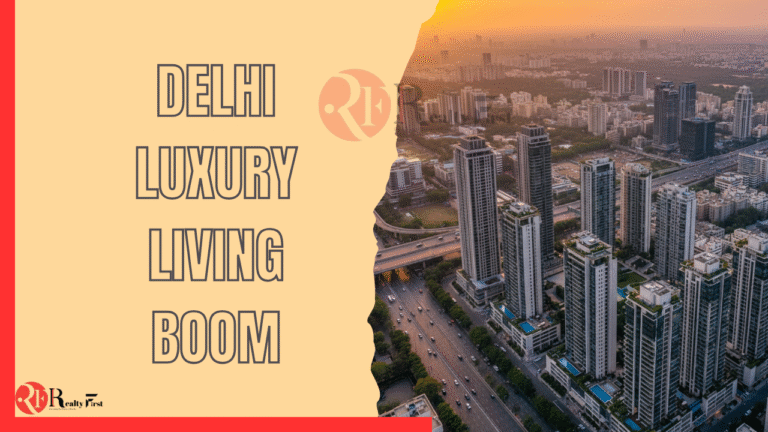
India’s luxury housing market is witnessing a clear shift as high-net-worth buyers increasingly prioritise lifestyle, community, and long-term asset stability over speculative investments. In cities like Gurugram, demand for ultra-luxury residences continues to grow, particularly in prime corridors such as Golf Course Road and Golf Course Extension.
Ralli’s firm recently facilitated high-value residential transactions across a select portfolio of premium developments, reflecting a growing trend where buyers are becoming increasingly selective about the projects they choose.
According to Ralli, the defining factor behind these investments lies in the quality of the development ecosystem.
When clients evaluate properties in the ₹10–₹20 crore bracket, the reputation of the developer plays a crucial role. Buyers strongly prefer established, Grade-A developers such as DLF and other well-known brands with proven delivery records. However, the decision is not driven by brand name alone.
Facilities within the residential community are a major factor. Buyers closely evaluate the quality of the clubhouse, hospitality-style amenities, sports infrastructure, and the overall social environment of the development. Large integrated societies tend to be more attractive compared to standalone towers because they offer stronger community engagement.
“In high-value housing, people want a lifestyle ecosystem,” Ralli explains. “Large residential communities create social spaces where families can interact, children can play, and residents can participate in activities within the society itself.”
Location remains another non-negotiable factor. Buyers carefully assess where the project is situated, connectivity to key business districts, and overall infrastructure development in the surrounding area.
Beyond location and amenities, security and long-term community management are also critical considerations for luxury buyers.
Who Is Buying Ultra-Luxury Homes?
One of the most noticeable changes in Gurugram’s luxury market is the evolving profile of buyers.
Ralli observes that demand is increasingly being driven by “new-wealth” buyers — professionals and entrepreneurs who have benefited from India’s expanding corporate and technology ecosystem.
These include senior executives from Fortune 500 companies, founders of technology firms, and professionals in global corporate leadership roles.
“At the moment, we are seeing a strong presence of new-money buyers,” he says. “Many of them come from the technology and corporate sectors and are comfortable investing large amounts in high-quality developments.”
At the same time, traditional business families and buyers from Delhi and nearby cities continue to remain active participants in the market.
As a result, the Gurugram luxury segment is now supported by a mix of legacy wealth and emerging professional wealth.
The Growing Interest in Holiday Homes
Another trend gaining momentum among high-net-worth buyers is the purchase of second homes.
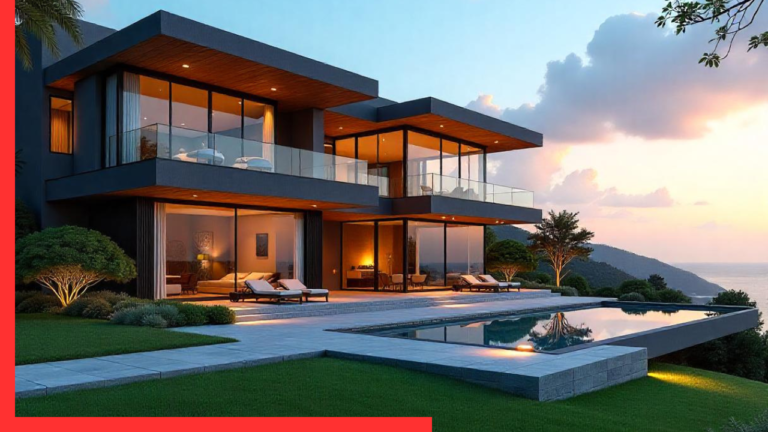
Many buyers who invest in luxury residences in Gurugram are also exploring holiday homes in destinations such as Goa or the hills.
The shift became particularly visible after the pandemic, when flexible work arrangements encouraged people to explore alternate living environments.
“Holiday homes have become a growing segment,” Ralli notes. “Buyers are interested in properties where they can spend time away from the city while still maintaining a base in a major urban center.”
The Role of NRI Investors
Non-resident Indian investors also continue to play a significant role in Gurugram’s high-end real estate market.
According to Ralli, NRI buyers fall broadly into two categories. Some purchase homes with the intention of returning to India in the future, while others treat these properties purely as investment assets.
Many of these investors rent out their properties, taking advantage of Gurugram’s strong leasing market.
While rental yields in cities like Mumbai or Delhi typically remain around two to three percent, Gurugram often offers rental returns of five to six percent in the luxury residential segment.
This higher yield makes the city particularly attractive for investors seeking stable income alongside long-term capital appreciation.
“Leasing in Gurugram is very strong,” Ralli explains. “That’s one reason why investors continue to show interest in the market.”
Why Gurugram’s Prime Corridors Continue to Perform
When discussing micro-market performance, Ralli points to a long-standing investment principle often followed by experienced property investors.
In many cities, the southern part of the urban region, often considered the downtown corridor, tends to deliver stronger long-term returns.
In Gurugram’s case, he believes areas such as Golf Course Extension Road and Sohna Road will continue to outperform other corridors.
These locations benefit from strong infrastructure development, premium residential communities, and access to major business districts.
Connectivity also plays a key role. Infrastructure improvements including rapid metro connectivity, underpasses, and signal-free road networks have significantly enhanced accessibility across the Golf Course Road corridor.
“For example, from Golf Course Road you can reach the airport through a signal-free route,” he notes. “Connectivity like this is extremely important for corporate professionals and global business leaders who travel frequently.”
Why Township Developments Are Gaining Momentum
Ralli also sees a strong future for large township developments that create integrated urban ecosystems rather than isolated residential towers.
Developments that combine housing with retail, parks, healthcare facilities, and social infrastructure tend to perform better over time because they create self-sustained communities.
According to him, these large integrated townships often deliver stronger long-term returns compared to standalone residential towers marketed under luxury or branded labels.
“When a developer builds an entire ecosystem, roads, parks, facilities, and community spaces, that’s what creates long-term value,” he says.
Advice for Real Estate Investors
For investors entering the luxury housing market, Ralli emphasises the importance of long-term thinking.
One of the most common mistakes investors make is chasing unusually high short-term returns offered by lesser-known developers or speculative projects.
Real estate, he argues, should be approached with a long-term perspective and a strong focus on developer credibility.
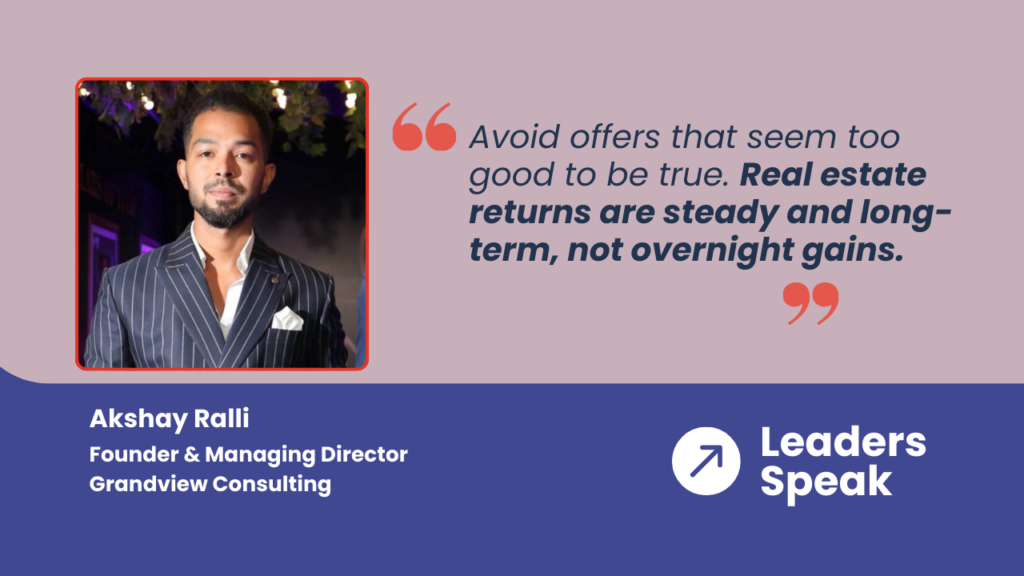
“Always invest with reputed developers who have a proven track record,” he advises. “Avoid offers that seem too good to be true. Real estate returns are steady and long-term, not overnight gains.”
Choosing established developers and holding assets for longer periods typically provides both capital appreciation and rental income stability.
Building a Scalable Advisory Business
For Grandview Consulting itself, the next phase of growth lies in expanding its advisory operations.
The firm currently operates with a team of around 40 professionals and plans to significantly expand its workforce over the next few years as Gurugram’s real estate market continues to evolve.
Ralli believes the city still has considerable growth potential despite rising property values.
“Gurugram is still undervalued in many ways,” he says. “There is a lot of appreciation potential over the next five years.”
With strong infrastructure, corporate expansion, and increasing global capital inflow, the city remains one of India’s most dynamic luxury real estate markets.
And as buyer expectations continue to evolve, advisory firms like Grandview Consulting are playing a key role in guiding investors through the complex world of high-value real estate decisions.