
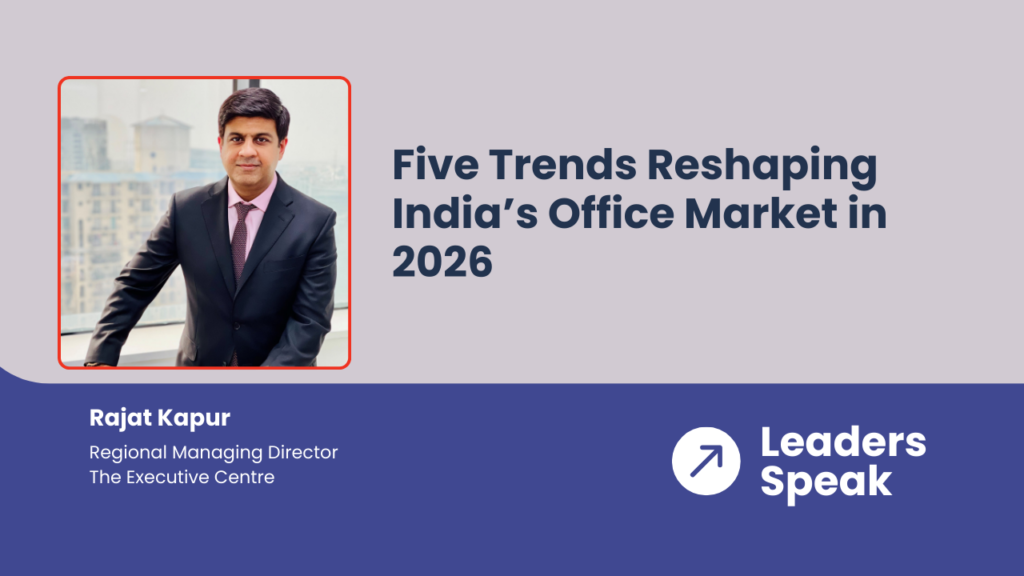
By Rajat Kapur, Regional Managing Director, North India, The Executive Centre
India’s office market has entered 2026 on the back of sustained momentum. After consecutive years of strong absorption across leading metros, the conversation is no longer about recovery; it is about reinvention. Enterprises are reassessing how, where, and why they occupy space. In this transition, flexible workspaces are not a peripheral alternative, they are emerging as a structural driver of the next growth cycle.
GCCs Anchoring The Next Wave of Office Demand
Global Capability Centres (GCCs) are among the most powerful forces reshaping India’s office demand. As per an industry report by Vestian, over the past two years, GCCs have contributed more than 40% of India’s total office leasing, and their share is projected to rise further, potentially surpassing 60% in the coming years. Cities such as Bengaluru, Hyderabad, Pune, and Chennai continue to lead, while Delhi-NCR and Mumbai are seeing an uptick in GCC activity led by BFSI and consulting.
What has changed is the real estate strategy behind this expansion. Unlike earlier waves, where GCCs committed to long-term, large-format campuses from day one, many are now adopting a phased and flexible approach. Flexible workspaces allow them to:
- Enter a new city with speed
- Scale teams without capital-intensive fit-outs
- Pilot new functions before committing to core assets
In 2026, GCC expansion will continue to be the single most influential demand driver across India’s office markets, and flexible workspace operators will be critical enablers of that growth.
Also Read: Budget impact on Indian real estate seen through infrastructure push, housing allocations
The Rise of Premium, Experience-Led Offices
India’s office market is increasingly bifurcated. While overall vacancy remains stable in leading micro-markets, demand is gravitating decisively toward Grade A, well-located, amenity-rich assets.
Across CBDs such as BKC in Mumbai, the Outer Ring Road in Bengaluru, Gachibowli in Hyderabad, and Golf Course Road in Gurugram, occupiers are prioritising:
- Design quality and spatial experience
- Hospitality-inspired common areas
- Integrated F&B and collaboration zones
- Sustainability and wellness credentials
The workplace is now a strategic tool for talent attraction and retention. In an environment where hybrid models remain prevalent, the office must justify the commute. Premium, amenity-rich spaces consistently record higher weekly attendance than commodity alternatives, reflecting a direct link between environment quality and employee willingness to make the trip. Premium, thoughtfully curated spaces that foster community, productivity, and brand identity are outperforming commoditised inventory.
Flexible workspace operators, particularly in the premium segment, are well-positioned here. By delivering fully serviced, design-forward environments in Grade A buildings, they enable enterprises to access best-in-class infrastructure without the long gestation period of traditional leases.
Technology-Driven Space Optimisation
Data is redefining how occupiers think about real estate. The widespread adoption of hybrid work has introduced variability in attendance patterns, making static space allocation inefficient.
The response to this challenge is data. CFO scrutiny on real estate costs, combined with post-pandemic uncertainty about attendance patterns, has accelerated the adoption of real-time occupancy analytics, utilisation dashboards, smart access and booking systems, and AI-enabled demand forecasting. These tools share a common purpose: replacing assumption-based space planning with evidence-based decisions. For occupiers managing large footprints across multiple cities, the ability to act on live utilisation data, rather than waiting for annual lease reviews, has become a meaningful competitive and financial advantage.
This shift is especially relevant in high-cost markets like Mumbai and Bengaluru, where optimising even 10-15% of underutilised space can significantly impact the bottom line.
Flexible workspaces inherently align with this data-led model. Instead of locking into fixed seat counts, enterprises can dynamically adjust space commitments based on headcount trends and project pipelines. The result is a more capital-efficient, asset-light approach to growth, an increasingly important consideration in a macro environment that prioritises prudent cost management.
Flexibility as a Core Component of Occupier Strategy
Flex is no longer a stop-gap solution. Across Tier 1 cities, it is being integrated into long-term portfolio strategies.
Large enterprises are adopting a “core-and-flex” model, maintaining anchor offices under conventional leases while allocating a portion of their footprint to flexible space. This approach offers:
- Agility during expansion or restructuring
- Risk mitigation in uncertain business cycles
- Faster access to new micro-markets
In many cases, flex space becomes the first step in testing a city’s talent ecosystem before deeper investment, a lower-risk way to validate demand before committing to a long-term anchor lease. As companies explore distributed workforce models, flexible workspace platforms offer a low-risk entry point into these markets.
The Expansion of High-Growth Corridors and Financial Districts
India’s next office growth story will be driven by specialised commercial districts and infrastructure-led corridors.
Financial hubs like GIFT City in Gujarat, large-scale developments in Hyderabad’s Financial District, and continued expansion across Bengaluru’s peripheral tech corridors are attracting both domestic enterprises and multinational firms.
These markets are characterised by:
- Institutional-grade developments
- Improved infrastructure connectivity
- Concentration of high-value industries
Also Read: WeWork India Launches Rivet Design and Build Platform; Arnav S Gusain Appointed CEO
Flexible workspace providers are increasingly embedded within such ecosystems, offering occupiers immediate access to institutional-grade space without long lead times. As these corridors mature, flex operators will play a critical role in activating new buildings and accelerating tenant absorption.
India’s office sector in 2026 is defined less by square footage and more by strategy. The emphasis has shifted from expansion for its own sake to calibrated, performance-driven growth.
Flexible workspaces are at the centre of this transformation because they respond to the three imperatives shaping corporate real estate decisions today: agility, experience, and efficiency.
As GCC expansion continues, premiumisation intensifies, and data-led decision-making becomes mainstream, flexibility will not just complement traditional office models; it will help redefine them. What makes 2026 distinct is not that flexible workspace has arrived; it is that it has become the default lens through which enterprises evaluate every real estate decision they make.